
Farewell to Goffredo Fofi, history of a radical rebel
The beloved collaborator, the intellectual, the stickler, the literary and film critic who marked the 20th century has left us

4' min read
Key points
4' min read
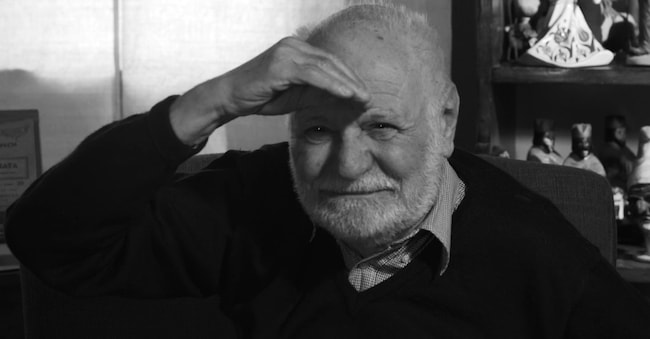
"Io alla lotta di classe ci credo!" (I believe in the class struggle!), Goffredo Fofi exclaimed almost protestingly in Felice Pesoli's fine documentary, Suole di vento, which portrayed the Eugubinian activist and thinker (woe betide the use of the word intellectual!) in all his unlabellable irregularity. The vehemence was due to the knowledge that that phrase was an empty slogan for most today, while for him, a proletarian by birth and secular Franciscan by choice, it was a faith. That is why he was constantly getting on and off trains to take his radical philosophy wherever students, communities, associations of any kind, as long as they were free, invited him. And on one of his perennial journeys between Milan, Rome, Calabria, Salento, Naples and presentations he stumbled and ended a life that we all believed immortal. After all, he had been walking around with a cane for decades while walking faster than a child.
From "Red Notebooks" to "The Donkeys"
.With him goes the 20th century, and that is not a figure of speech. A literary and film critic, feared for his ferocity by Pasolini, Fellini and Antonioni, a supporter of new talents, 'who then impallino al tiro al piattello' he used to mock, he was above all a critic of society. Discoverer of literary talent, agitator of radical ideas, bearer of a thought 'in motion', with which he filled the magazines he contributed to - 'Quaderni rossi', 'Quaderni piacentini', 'Ombre rosse', 'Positif' -, or created - 'Linea d'ombra', "Lo straniero", "Gli asini" - and many pages of this newspaper, he recommended original, marginal, disturbing visions and readings, certainly oppositional to mass narcissism, to the culture of the barons, against which he founded the "university of the donkeys" for unconventional knowledge.
Vagabondo
He was a vagabond and had many homes. He loved, however, his very spartan Roman home, on the first floor, where at lunch and dinner he always hosted young people he engaged in some enterprise to combat cultural sloppiness, to bring forward a new idea of a country, sincere, supportive, for everyone. His birthplace, Gubbio, where the rest of his family of peasant origins still lives, was so poor that his father was forced to emigrate to Germany, from which he fled when he risked being hired by the Nazis. Back in Italy, he took little Goffredo to Rome to visit the Fosse Ardeatine when the massacre was still fresh, planting an anti-fascist seed in his son. The child, gripped by a terrible fear of death, recovered by accompanying the priest back and forth to the cemetery as an altar boy.
Catholicism is a fixed point until adolescence, hence his sympathy for the street priests, the 'last ones' of Father Turoldo and Don Tonino Bello. Gubbio is also the town where he fell in love with entertainment within everyone's reach, the cinema, and especially with Macario, Magnani (then a comedian) and Totò, and thanks to which he laid the foundations to theorise the artistic greatness of Prince de Curtis, on which everyone would later follow him.
The Experience with Danilo Dolci, Rome, Turin, Paris
After graduating as a teacher, he left for Danilo Dolci's Sicily, took care of the children, practised the upside-down strikes, where they built roads, schools, sewers instead of crossing their arms, and learned a model of struggle and organisation different from that of politics. In Rome, he then attended the Olivetti school for social workers and completed the framework of an uncomfortable intellectual (ouch, again!), ready to act in 'hot' places. First in Turin, in front of the gates of Fiat, then in Paris, where he immersed himself in an immoderate consumption of cinema; he then arrived in working-class Milan and in the Naples of oral and theatrical culture, passing through the Bologna of comics between Pazienza and Mattotti. Finally, Rome. Many founding encounters - Ada Gobetti, Elsa Morante, Carmelo Bene, Grazia Chierchi and Piergiorgio Bellocchio; many books written by the man with the soles of wind, a nickname Paul Verlaine used for Arthur Rimbaud.


