
The legacy of Pasquale Pistorio: the man who transformed STMicroelectronics
The 89-year-old engineer was born in Agira in the province of Enna. He was the architect of the merger between Sgs and Thomson in 1987 that gave rise to the semiconductor giant

3' min read
3' min read
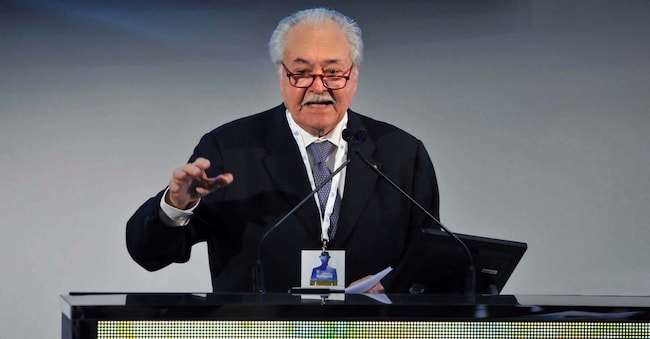
There is a photo that says more than anything about who Pasquale Pistorio was, the engineer Pistorio as everyone liked to call him, who died in Milan at the age of 89. It can be seen on the website of the Pistorio Foundacion, the Vimercate-based foundation he set up in 2005 to 'improve the living conditions of children in developing countries, with a particular focus on education': in that photo is the good-natured, smiling face of a man, a manager, with great intuition and unquestionable skills.
This man, born in Agira in the province of Enna in 1936 (but Catania by adoption), had his sights set on the future and loved his land, Sicily, which he helped transform and improve. A 1963 graduate in Electrical Engineering from Turin Polytechnic, he had begun his professional career as a salesman of Motorola transistors in Piedmont. He then moved to an Italian distributor in Milan as sales manager for Motorola products and in 1967 he was hired by Motorola and became marketing director for Europe in June 1970. From then on, Pasquale Pistorio made a rapidly rising career within the American semiconductor company, arriving in 1978 to be appointed general manager of Motorola's International semiconductor division, responsible for design, production and marketing for all areas outside the USA.
Pistorio has rightly been called the father of Etna Valley, and a book would not be enough to recount what his work has meant for Sicily and for the country system in general. It was he, in 1987, as president and CEO of the Sgs Group, at the time the only Italian microelectronics company, who led the integration with the French Thomson Semiconducteurs that was to become STMicroelectronics. It was he who developed a diversified product portfolio based on fast-growing applications and his worldwide network of strategic alliances, which took it into the top five semiconductor companies by 2001. From a state-owned, almost bankrupt company with a turnover of USD 100 million, Sgs Pasquale Pistorio succeeded in creating a major player in the industry: when Pistorio retired (so to speak) in spring 2005, the company had a turnover of USD 9 billion. And it is thanks to him that the Catania plant, now an advanced centre of semiconductor production in the world, was developed.
Due to the company's brilliant results, the shareholders decided to list its shares on the New York Stock Exchange and the Bourse de Paris (now Euronext Paris) in December 1994. This was followed by a listing on the Italian Stock Exchange in Milan in June 1998.
Pasquale Pistorio has always resolutely defended the centrality of European microelectronics, emphasising its strategic value for every macroeconomic system. His commitment was not limited to theory: it led to concrete results, as he joined the Board of Directors of Medea+, the European advanced technology research programme that is the successor to Medea (Microelectronics for European Applications) and Jessi (Joint European Sub-micron Silicon Initiative), two pioneering projects that he strongly supported from the outset.


