
Google announces Gemini 4 Argon: the challenge to OpenAI and Anthropic remains behind closed doors
The new model focuses on software, finance and cyber security, but access is restricted to selected experts. No date has yet been set for users and businesses: Google wants to strengthen security measures before the public launch.

Google had fallen behind OpenAI and Anthropic in terms of the release schedule for its most powerful models. On 30 September, it responded with Gemini 4 Argon. But this time, the public has been told that the model is being used internally and rolled out to a select group of security experts. We’ll still have to wait to try it out. The announcement comes just one day after the debut of GPT-6.1 Sol. The race continues – indeed, it’s gathering pace – even when the door remains closed.
What is Agon like?
Reading what Google has written, we discover that Argon focuses on long-term projects: software development, financial research, legal work and cyber defence. The technical innovation is the limit of one million output tokens, compared with the previous 64,000. These are the units of text processed by the model: here, the figure refers to how much it can generate during a line of reasoning, not just how much material it can read. The aim is to tackle problems that require many steps.
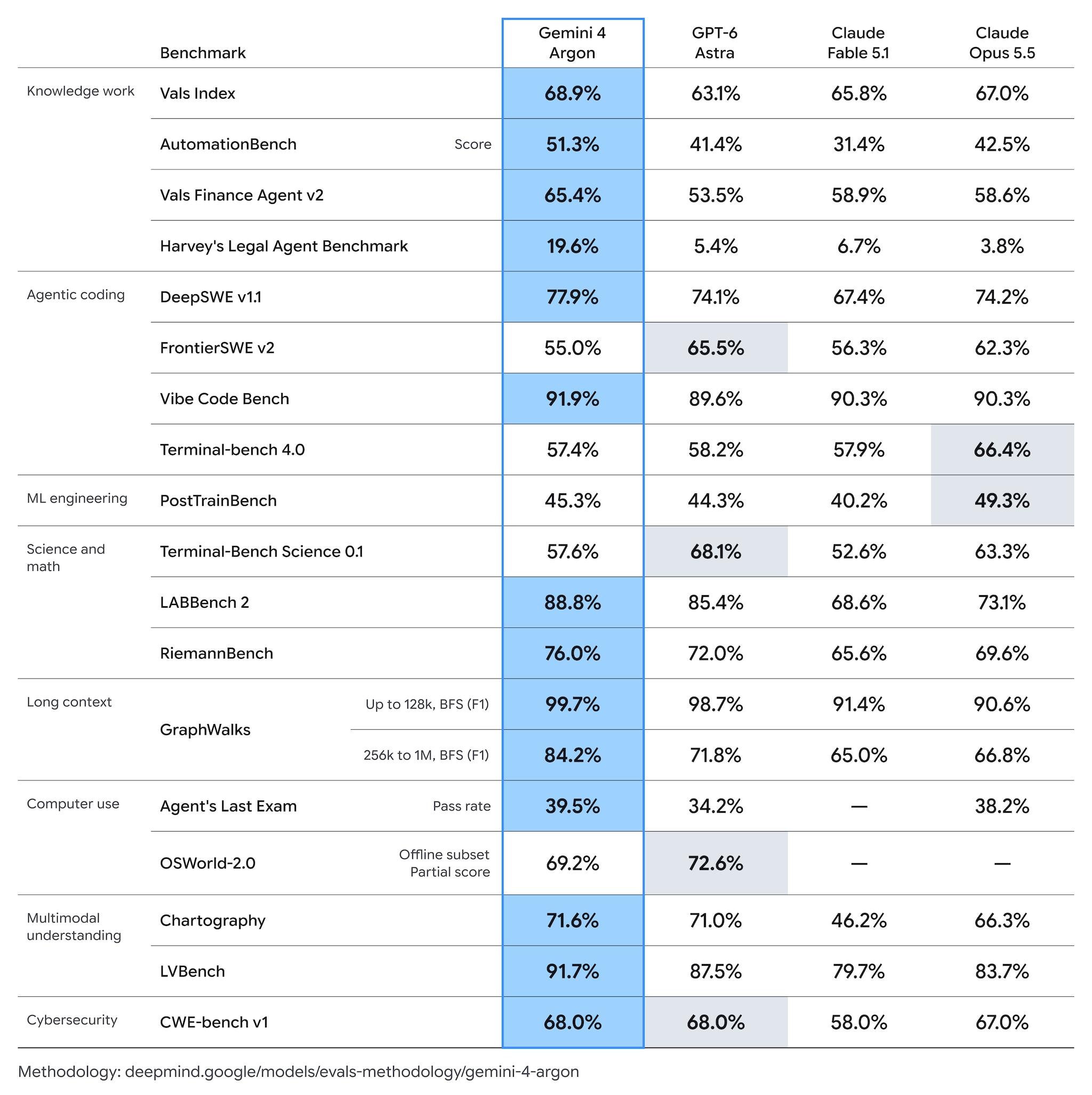
The reported results include 77.9 per cent on DeepSWE, which focuses on software engineering, and 51.3 per cent on AutomationBench, which assesses the execution of business tasks. However, the documentation advises readers to examine the comparisons carefully: it combines tests carried out by Google, external rankings and results reported by competitors. The conditions are not always identical. In video understanding, for example, the number of frames provided to the various models varies. These are indicators of capability, not a universal certification of superiority.
Security explains the restricted access.
Google claims that Argon is capable of identifying, verifying and fixing vulnerabilities; it provides it to selected researchers without any specific restrictions on their IT activities. Before making it generally available, it wishes to strengthen safeguards against abuse, malicious instructions hidden within content, and actions that go beyond the user’s intentions.
There is no specific date. The service will initially be available to paid API customers and Google AI Ultra subscribers. The introductory price announced is $2 per million incoming tokens and $10 per million outgoing tokens, which is set to double. The key question will be how much it will cost to complete a job.


