Products

Google brings Gemini into Workspace: AI becomes the new office colleague

Docs, Sheets, Slides and Drive are transformed into collaborative environments with integrated artificial intelligence. The challenge to Microsoft Copilot comes to a head.

by Luca Tremolada

3' min read

Translated by AI
Versione italiana

3' min read

Translated by AI
Versione italiana

Google tries to rewrite office software. Not with a new application, but with an artificial colleague. Gemini now enters the heart of Docs, Sheets, Slides and Drive. Not as a side assistant. As co-author.

The announcement concerns Google Workspace, the suite with over 3 billion users and more than 11 million corporate customers. Global office operating system numbers. The idea is simple: transform documents, spreadsheets and presentations into environments where AI works together with the user.

Loading...

The stakes are enormous. When Google changes these applications, it practically changes the way a substantial part of the global economy works.

The logic is simple and radical at the same time: transform passive tools into environments where artificial intelligence collaborates with the user throughout the creative process.

The new features of Google Docs.

The first target is the blank page. In Google Docs comes a function called 'Help me create'. All you have to do is describe what you want to achieve and Gemini produces an already structured first draft. It doesn't just write text. It goes looking for material in Gmail, Chat, Drive and also on the web to build the document with the right context.

It is like having a digital researcher who first gathers sources and then puts together the first version of the work. Once the document has been generated, the AI can rewrite individual parts, reinforce a passage, standardise the tone when the file has been written by several people or replicate the structure of an existing business document. The result is a workflow that resembles less and less traditional writing and more and more a dialogue with the software.

How does Google Sheets change?

In spreadsheets, the revolution is even more visible. Sheets have always been a powerful but difficult tool: formulae, functions, logic often reserved for those who chew a little mathematics. Gemini tries to erase this barrier. The user describes the problem in natural language and the system builds the worksheet, retrieves data from documents and generates graphs and tables.

Google also introduces a function called Fill with Gemini that automatically fills cells. According to the company's internal tests, the process can be up to nine times faster than filling in cells manually.

Beneath the surface there is another important innovation. Sheets integrates optimisation tools developed by DeepMind and Google Research. It means that complex problems - such as organising work shifts or distributing resources efficiently - can be solved with a request written in natural language.

Even presentations change their skin.

In Slides Gemini is able to create new slides consistent with the design of the presentation: colours, fonts and visual structure remain aligned to the corporate style. The idea is to free the user from the most mechanical part of the work, that which concerns layout and formatting, to leave room for the construction of the story to be told.

The next step will be even more ambitious: generating entire presentations simply from a description. Document and prompt become the raw material to automatically build a sequence of slides ready to be edited.

Google Drive is the engine

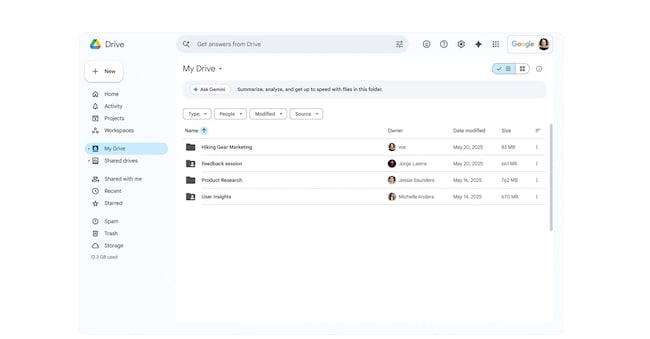
The most strategic transformation, however, concerns Google Drive. For years it was little more than a cloud repository. With Gemini it becomes a knowledge base. Search no longer only returns files, but also intelligent summaries. The new 'AI Overviews', as in NotebookLM, analyse documents and directly display the most relevant information in the results.

In parallel comes 'Ask Gemini', a function that allows you to interrogate the entire company archive as if it were an assistant. One can ask, for example, to find customer feedback on a specific campaign or to summarise information scattered among emails, documents and chats. The AI does not simply return links to files: it produces a structured response.

Google's strategy is clear. It wants to transform Workspace into a system where AI works on real user data: emails, documents, files, calendar. This is an important difference from generic chatbots that mainly fish from the web.

The challenge is inevitably with Microsoft, which is bringing Copilot into Word, Excel and PowerPoint. Both companies are trying to redefine office software. Microsoft is aiming for a universal assistant integrated into the suite. Google, on the other hand, is trying to build a digital colleague who knows the user's work context.

For now, the new functions are available to Gemini Alpha customers and subscribers to the Google AI Pro and Ultra plans, initially only in English.

But the direction is now clear. Office software will no longer be made of menus, icons and commands. It will be made of conversations with a machine that works with us.

Copyright reserved ©
  • Luca Tremolada

    Luca TremoladaGiornalista

    Luogo: Milano via Monte Rosa 91

    Lingue parlate: Inglese, Francese

    Argomenti: Tecnologia, scienza, finanza, startup, dati

    Premi: Premio Gabriele Lanfredini sull’informazione; Premio giornalistico State Street, categoria "Innovation"; DStars 2019, categoria journalism

Loading...

Brand connect

Loading...

Newsletter

Notizie e approfondimenti sugli avvenimenti politici, economici e finanziari.

Iscriviti