Applications

Google I/O 2025: all the videos showing how artificial intelligence will change the future

From repairing a fabric with a photo to virtual dress fittings and 3D video calls

by Chiara Ricciolini

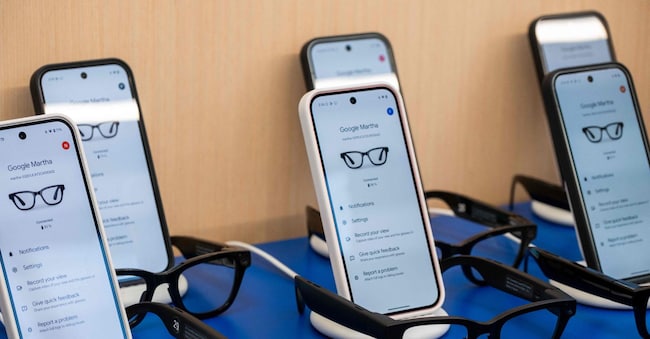
Prototipi degli occhiali Android XR, dotati di Gemini AI, sono raffigurati durante la conferenza annuale degli sviluppatori I/O di Google a Mountain View, California, il 20 maggio 2025. (Foto di Camille Cohen / AFP)

3' min read

3' min read

At the annual Google I/O conference, held in Mountain View, artificial intelligence was at the heart of the news. In a conference with the press, the company outlined the new phase of its strategy: to bring AI into every corner of the digital experience. Let's take a look at the main innovations in a series of videos.

A new way to search for solutions thanks to the 'live' camera

.

Imagine having a virtual assistant to whom you don't have to explain your problems, you just show them to him. This is the new 'Live Mode', a function that allows you to frame an object with the camera and ask direct questions about what you see, in real time. It is the evolution of Google Lens and will be integrated into the search mode and the Gemini app for iOS. This mode will be available in beta by the end of the summer, along with other new features in 'AI Mode': an in-depth search tool based on AI agents that can perform actions for the user. As in this video, in which a hole in a fabric is framed with the camera to ask Google's AI agent for instructions on how to repair it.

Loading...
Un tessuto forato viene riparato grazie alle istruzioni fornite dopo aver inquadrato lo strappo grazie alla modalità live

Astra: the AI that acts alone

.

And again, think of being able to converse with your virtual assistant, who no longer needs step-by-step instructions, but is able on his own to intuit problems and suggest solutions. This is Google's most innovative ambition, called Astra, an experimental project born in 2024 from the idea of a universal assistant. Astra is able not only to observe and respond, but also to act actively: it can remind you where you left your glasses, correct a mistake during homework or complete the pairing of a Bluetooth device for you. Its strength is being able to read the context, without the need for the user to explain it: the AI can decide when to intervene, listen or remain silent. To do so, it accesses information from calendar, email and other Google apps. As in this video, where a boy fixes his bike through guided assistance, a real dialogue, with his smartphone.

Un ragazzo aggiusta la sua bici attraverso un’assistenza guidata grazie ad Astra

Not only that. The project aims to pioneer a new model of learning through AI. "We decided to apply Astra's capabilities to create a conversational AI tutor that could help with learning, in collaboration with LearnLM," the company writes in the launch video.

Con Astra l’AI diventa un vero e proprio tutor per lo studio

The smart glasses that will change our reality

.

These glasses could change the way we are in reality forever. Google has announced new glasses based on the Android XR operating system for mixed reality. These glasses have cameras, microphones and Gemini's artificial intelligence with which you can converse, ask questions about what you see.

A device that will completely change the way humans interact with their environment by altering one of the senses, sight.

Gli occhiali Android XR cambieranno la nostra percezione del mondo

Beam: three-dimensional video conferencing without visors

.

If you live abroad, this function could make you feel less distant from your family. Called Beam, it is a 3D video calling system that uses six cameras and a light-field display to project a realistic, volumetric version of the interlocutor. The system integrates AI models for real-time video and audio processing, paving the way for more 'human-like' virtual meetings. In this video, you can see how this technology renders a three-dimensional, volumetric figure of the person on the video call

Con Beam le videoconferenze diventano tridimensionali

Flow and Veo, words become immersive videos

Now imagine your dream home, with Google's AI you could see it in a video. The company unveiled Flow, an AI-powered video creation application that allows you to generate clips from text or images and join them into coherent sequences. It is designed for filmmakers, creatives and creators, and leverages Veo 3, the new video generation model with built-in audio capabilities and advanced prompt understanding. Veo 2, on the other hand, introduces editing features such as object removal or 'virtual camera' control. As in this video, in which one of the protagonists wonders what it would be like if she could live in her dream world, and through a text description she manages to live an immersive video experience

Flow è l’applicazione che consente con l’AI di generare clip da un testo e unirle in un video

Made-to-measure shopping and virtual try-on

.

Not sure if that pair of jeans you saw on your online shopping app fits you? With Google's AI, you could try them on. In the e-commerce sector, Google is testing a virtual try-on function based on personal images: by uploading a photo of themselves, the user can see how an outfit will look on them. At the same time, the AIshopping agent will be able to monitor prices, select products and complete payments automatically. In this video, one can see how, thanks to this technology, one can 'try on' clothes on ecommerce stores directly on oneself.

l’AI shopping agent consente di provare su se stessi gli abiti che vorremmo comprare
Copyright reserved ©
Loading...

Brand connect

Loading...

Newsletter

Notizie e approfondimenti sugli avvenimenti politici, economici e finanziari.

Iscriviti