
Google is making SynthID Detector available to everyone to identify AI-generated images, videos and audio
Digital watermarks can help identify AI-generated content, but doubts remain about their reliability: false positives, removable marks and differing systems amongst the Big Tech companies. The absence of a watermark does not prove human origin, whilst its presence is not sufficient to prove fraud.

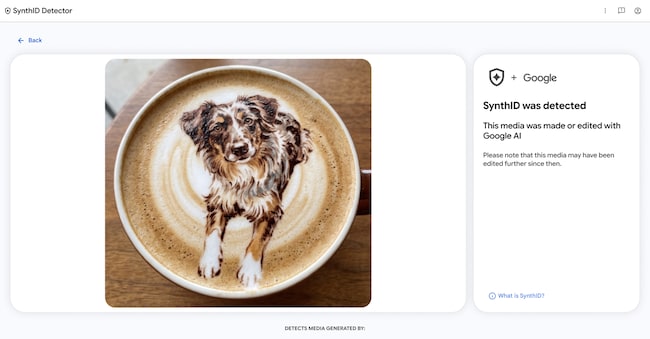
Google is making its AI-generated content verification tool available to everyone. Since yesterday, SynthID Detector has been online and allows users to check images, videos and audio for free – after logging in and, for the time being, in English. Essentially, it identifies watermarks from image, video and audio generators developed by Google and its partners OpenAI, NVIDIA and Kakao. Text content is excluded from the portal, partly because it is a separate issue. In recent days, following in Anthropic’s footsteps, OpenAI announced that in the coming weeks it will introduce a watermark in ChatGPT and Codex responses compatible with the European Union, in response to the AI Act. Its system, textGrain, slightly alters the probabilities of word selection, leaving a statistical footprint. So, things are moving on the Big Tech front when it comes to the transparency and recognisability of AI-generated content. But the question remains the same: will it really be harder to pass off artificial content as human, or will these checks give rise to new misunderstandings? Above all, why isn’t everyone in agreement? Let’s start with SynthID
How it works
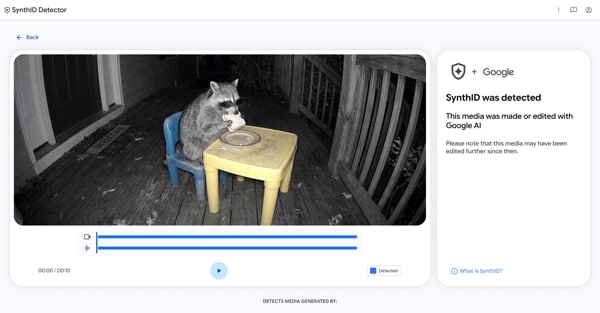
SynthID embeds an invisible signal into the pixels and audio components during generation. The watermark is designed to withstand cropping, filtering and compression. The detector searches for that mark: it does not identify all content produced by AI. If it finds nothing, the file may have been generated by a model that does not use SynthID, or it may have been modified to the extent that the signal has been weakened. The absence of the watermark therefore does not guarantee that the content was created by a human. The risk lies in using that track as evidence of misconduct.
The risk of false positives in AI detectors
Google itself states that its tool is not an AI detector: the result is simply ‘watermark found / not found’. If no watermark is present, this does not mean that the content was created by a human. It may have been generated by a model that does not use SynthID, or the signal may have been corrupted by subsequent edits. Furthermore, the tool cannot distinguish between content created from scratch using AI and content that has merely been retouched using AI. It also holds up well against normal edits (cropping, filters, compression, MP3), but not against those who deliberately seek to remove it. Some preliminary studies suggest that it protects against accidental forgeries, not those created with malicious intent.
As for the text, in OpenAI’s tests, it reports a false positive rate of 1 per cent; detection rates reach around 95 per cent on 400-token passages in fields such as psychology. In another test, replacing a quarter of the words with synonyms causes the accuracy to drop from 92 per cent to 17 per cent. Those wishing to cheat have some leeway; those flagged may have reworked the text. The detector will therefore initially be available only to researchers and specialist organisations.
There is currently no detector suitable for everyone
The other problem is that not everyone is on the same page. Apple has said it will support this later in 2026, so it isn’t available yet. Meta is developing its own open-source tools, Video Seal and AudioSeal. Microsoft 365 combines provenance metadata, visible watermarks and voice alerts. These are complementary systems, each with their own limitations. In short, the risk is that the ‘witch hunt’ against artificial content will prove to be as confusing as it is counterproductive.


