
Google-Luiss, Ai arrives in the classroom. From law to statistics: this is how it will be used
Universities, for Rector Boccardelli, 'must equip young people with the necessary tools to interpret complexity and manage the technological revolution effectively and responsibly'.
by Lorenzo Pace
Key points
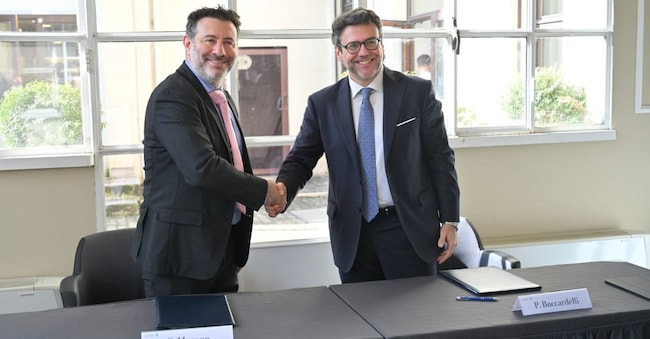
The starting point was made clear early on: almost all students now use artificial intelligence. According to Paolo Boccardelli, rector of the Luiss Guido Carli University, "70% of them do it on a daily basis". This is why the Roman university has entered into an agreement with those who create and manage Ai, namely Google.
Protected environment
Its algorithms will be available to students and teachers, but within a secure environment. The need to protect young people's data was central in reaching the agreement with the American big tech, announced and presented yesterday on the campus in Viale Romania, Rome, during the event "Reimagine the learning experience at Luiss". The internal platform, strengthened by artificial intelligence tools, will guarantee the protection of user data - something that does not happen with chatbots available online, not even Google's - and will make it possible to create a shared space with teachers.
Universities, for Boccardelli, 'must equip young people with the necessary tools to interpret complexity and manage the technological revolution effectively and responsibly'. Not least because Ai is becoming more and more widespread in the world of work: "The central issue is governance and the ability to intercept the risks, making the most of the opportunities. With this new agreement, Luiss strengthens the methodological and scientific direction of its didactic system, identifying in Google's solutions the concrete support for new learning models".
"Customised approach"
The process will be long. And the development, explained the pro-rector for education, Enzo Peruffo, will have to be done vertically. That is, so that the tools can be adapted to each discipline, providing 'a customised approach'. To do this, as was explained during the workshop run by Google in the second part of the event, Gems will be made available, i.e. digital tutors capable of taking on different roles within the curriculum. These will create statistical graphs and strategy matrices, but also flashcards, concept maps and interactive assistants.
Using Law, Political Science and Statistics
In concrete terms, within science degree courses such as Statistics, artificial intelligence will be used for exercises, both to create them and to guide the student in carrying them out. This aspect has been emphasised several times, because the task of the supporting Ai will not be to give the solution (like the other chatbots around), but to offer hints on how to find it. Another intervention, completely different, will be put into practice in faculties such as Law and Political Science, with the creation of virtual characters that can stimulate the student's thinking through discussion.

