
Google NotebookLM, the Gemini Pro-based assistant also arrives in Italy
Named Project Tailwind and later renamed to NotebookLM, it was conceived by a team of experts from Google Labs and based on Gemini Pro 1.5
4' min read
4' min read
Let's start with a certainty: it is a product that is still experimental and therefore in a state of flux, at the time named Project Tailwind and later renamed NotebookLM, conceived by a team of experts at Google Labs and based on Gemini Pro version 1.5, the most powerful large-format model for generative AI developed so far in Mountain View. When it was first presented last July, BigG described it as an attempt to reimagine note-taking software, designing it from scratch and starting from a language model (hence the name LM). In order to test its capabilities and gather feedback to refine its operation, this particular writing assistant has been made available over the last twelve months to a select group of users in the United States. Today, Google is officially announcing its improvements, confirming its availability in 200 countries (including Italy) and continuing in the wake of its initial objective, namely that of helping users make the most of their critical thinking to generate new content, exploiting customised artificial intelligence based on reliable information
News: new sources, online quotations and guides
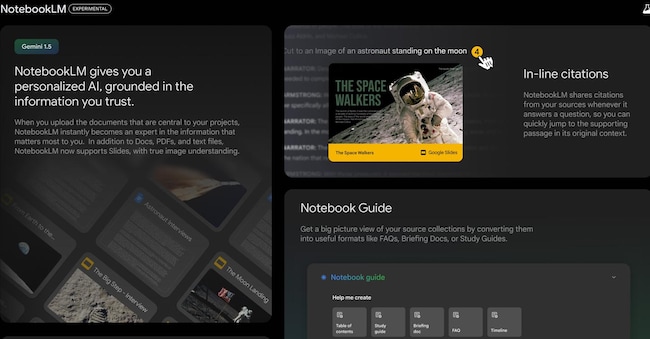
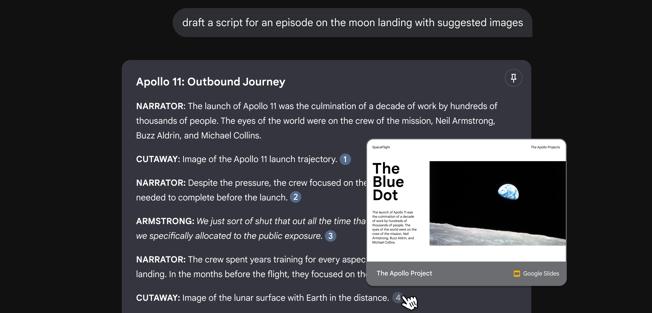
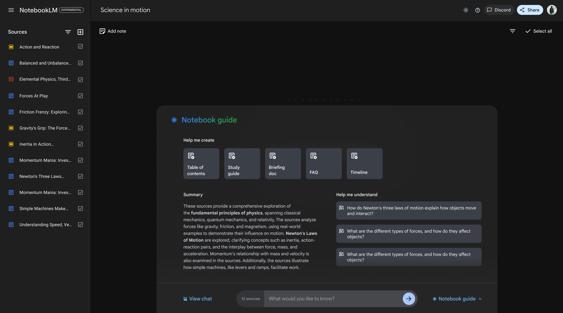
The main prerogative of NotebookLM, in a nutshell, is to train its AI to understand the available material, to create new links between information and to arrive more quickly at the first version of a piece of content, starting from the notes and memos uploaded in the tool and (this is one of the novelties announced) from complementary information sources such as Google Slides, URLs (addresses) of websites, Google Docs, text files and Pdf files (transcripts of interviews and company documents included). In addition, more than 100 languages are supported by the new NotebookLM, whose task will increasingly be to be a trustworthy 'companion' for interpreting and processing the material the user is most interested in. Another new feature of the assistant in fact concerns inline citations: the tool is now able to identify the most relevant content among the selected sources and consequently make it easier to check an answer provided by the AI or to go deeper into the original text. The Guide function, on the other hand, has the task of generating tips and text summaries promising a high-level understanding of sources, converting them into useful formats such as 'FAQs' (questions and answers) or briefing documents. Finally, thanks to Gemini 1.5 Pro's native multimodal functionalities, it will be possible to ask questions about images, graphs and diagrams in presentations and Google Docs; NotebookLM, for its part, will also include quotations for images as supporting elements, if relevant.
The philosophy of NotebookLM
.Steven Johnson, Editorial Director of Google Labs, is one of the souls (and brains) of NotebookLM, and during a videoconference meeting with the international press, he retraced the genesis of the project. "I have written 14 books on the history of science, technology and innovation and have always been fascinated by the possibility of using software tools to aid the research and writing process. I have written extensively on this subject over the years,' Johnson continued, 'and about two years ago, a few people at Google asked me to step forward and become part of the team that would develop a new class of software from next-generation language models. From there, a journey began that led to the construction of tools capable of using the capabilities of large-format models to make connections, understand available information and generate critical insights faster. Compared to traditional artificial intelligence chatbots, the Google Labs creature has in essence the merit of being able to 'root' the processing power of LLMs in the data sources a user deems most important for his or her work. And it is certainly no coincidence, in this sense, that at the basis of NotebookLM there is, as Johnson recalled, a philosophy of co-creation: writers, authors of podcasts and documentaries, musicians, legal experts, but also students and educators have been involved in the development process of these tools from the very beginning and invited to integrate the tool into their workflows. Some examples? Bestselling author Walter Isaacson, who worked with NotebookLM to analyse Marie Curie's diaries for research for his next book.
How it works
.Raiza Martin, Product Manager at Google Labs, instead summarised the functional peculiarities of the software with a definition that is as simple as it is exhaustive: 'it is a source-based artificial intelligence, which means that the AI uses the information uploaded by the user to answer his questions. If, for example, one wants to extract certain concepts from a transcript produced by a phone call or video call, NotebookLM will provide the most reliable answer from the transcript itself, processing content that is not on the Web or generally available. The benefit for the user? A fully customised system, which trains and develops expertise on the most relevant information for the user, and which allows the answer provided by the AI to be linked directly with the source passage used, resulting more easily in context-rich content and reducing the risk of misinterpretation or 'hallucination' by the language model. NotebookLM thus not only assists the user by handling questions and answers, but also allows the user to come up with new creative ideas, interpreting the command given, for instance, to create a script for a short video on a specific topic. Numbers in hand, there are currently 25 million words that can be loaded into one's own 'drawer' (500,000 words per source and up to 50 sources per notebook) and this availability is naturally destined to grow. And as the user adds documents, notes and more, NotebookLM will become more and more expert and precise. Is this a new, substantial step forward for artificial intelligence? Many clues lead one to think so. It is certainly a tool that promises to speed up information processing, a goal for which virtual assistants based on generative AI were and are being born.

