
Google: 1.3 million to train 2,500 professionals in the creative industries in Italia
The company, in partnership with the Digital Republic Fund, is promoting a series of initiatives to revitalise the sector in the face of the challenges posed by AI

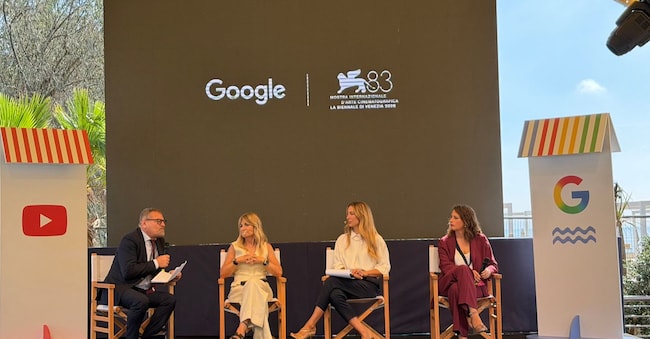
The impact of artificial intelligence on the creative industry is one of the major topics of debate at this year’s Venice Film Festival and Google has chosen this platform to announce a funding initiative focused primarily on training and reskilling in this field.
Through its philanthropic arm, Google.org, the company has announced a grant of one million dollars to the Fondo per la Repubblica Digitale (FRD), supplemented by direct co-funding of up to 500,000 euros from the Fund itself, bringing the total to 1.3 million euros. The aim is to retrain 2,500 professionals at risk of digital exclusion in the film and audiovisual, music and media sectors.
During the presentation, Melissa Ferretti Peretti, Google’s Country Manager for Italy, highlighted the historical link between cinema and innovation: ‘There has always been a relationship between cinema and innovation. Colour, sound, special effects. The role of technology continues to be that of serving human talent and creativity. AI is a set of algorithms, but it has no history, no emotions: those will always be human decisions that cannot be delegated.”
On the relationship with the creative world, Ferretti Peretti added: “Google does not believe in technology imposed from above; in fact, we do not develop tools without the creative community, but rather we develop them with the creative community, as was the case, for example, with Veo in the video sector, which was developed with more than 100 artists. Rather, the question is what skills are needed to capitalise on this change.”
This brings us to the crux of the matter: the impact on work. ‘Around half of today’s jobs did not exist in 1945. In the vast majority of cases, work has been transformed, not lost. It stands to reason, however, that this transformation is taking place at a different pace and with greater intensity than in the past, so we need to focus on skills,’ the manager emphasises.


