
Google now also translates some Italian dialects and 110 new languages
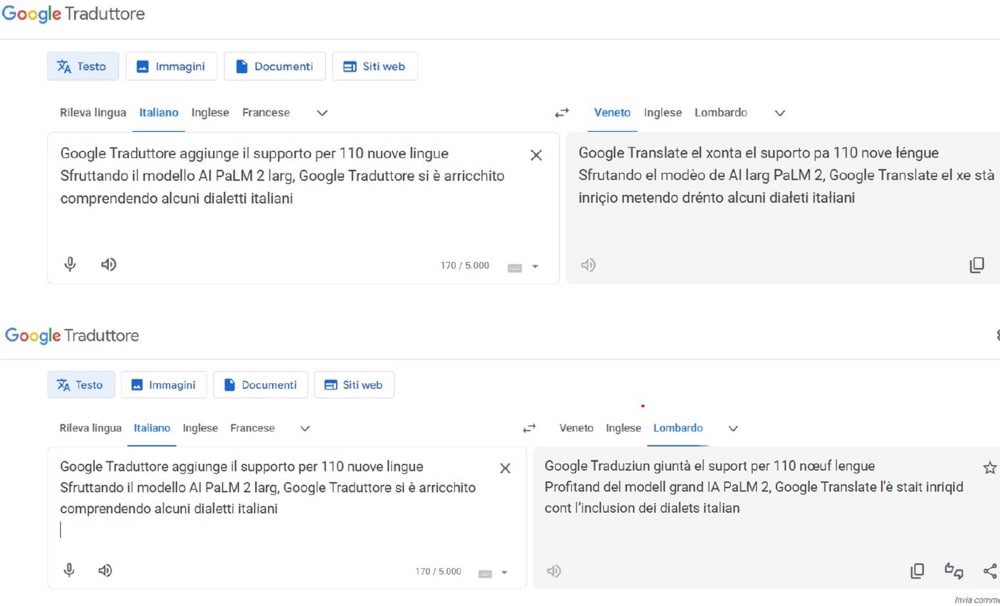
Taking advantage of the AI PaLM 2 larg model, Google Traduttore has been enriched by including some Italian dialects
2' min read
2' min read
What if technology were the viaticum for the salvation of the Milanese or Venetian dialects and local idioms in general that are disappearing? All credit is due to Google Traduttore, the world's most widely used translation system, which has received a major update with the introduction of support for no less than 110 new languages, including the Lombard, Friulian, Sicilian and Ligurian dialects.
"These new languages represent more than 614 million speakers, opening the door to translations for about 8% of the world's population. Some are major world languages with over 100 million speakers. Others are spoken by small indigenous communities and some have almost no native speakers but active revitalisation efforts are underway. About a quarter of the new languages come from Africa, representing our largest expansion of African languages to date, including Fon, Kikongo, Luo, Ga, Swati, Venda and Wolof,' explained Isaac Caswell, senior software engineer at Google Translator. The list of supported languages also includes Cantonese, which has been one of the most requested languages on Google Translator, Punjabi, the most widely spoken language in Pakistan, and other languages considered extinct such as Manx, the Celtic language of the Isle of Man.
The last update in this respect dates back to 2022, when Google added support for 24 languages. The addition of as many as 110 new languages in one fell swoop would not have been possible without the help of artificial intelligence and, in particular, thanks to PaLM 2 larg, which before being supplanted by Gemini powered the Google chatbot Bard. "PaLM 2 has been a key piece of the puzzle, helping Translate more efficiently learn closely related languages, including languages close to Hindi, such as Awadhi and Marwadi, and French Creoles such as Seychellois and Mauritian Creole," Caswell explained.
Setting up one of the new languages and dialects added to Google Translator is child's play, just follow the same steps as when using the translation service: go to the main page of Google Translator (or its app for mobile devices), type the word or phrase to be translated in the box on the left, and use the drop-down menus to choose the source language (e.g. Italian) and the translation language. Unfortunately, the voice function is not available for new languages.
Google has announced that it aims to support at least 1,000 languages, thanks to the use of Ai. The goal is to get to support even more language varieties and spelling conventions, as technology advances and as we continue to collaborate with expert linguists and native speakers.

