
Governor Giani: the 'Florentiner' diamond is ours, we will bring it back to Tuscany
The President of the Region: documents prove that the jewel is among the assets that Anna Maria Luisa de' Medici wanted displayed and maintained in Tuscany

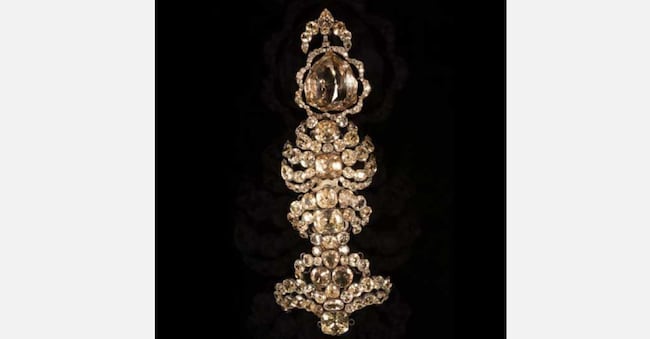
It seemed lost. It was said to have been stolen or sold by the Habsburgs. Or dismembered, according to the memoirs of a Swiss gem dealer published in 1966. In reality it still exists, in all its opulence, with its 137.27 carats and 127 facets. The Region of Tuscany claims it. It is the legendary Florentine yellow diamond, one of the largest in the world. A Hapsburg-Lorraine treasure that, however, documents in hand, is among the assets that Anna Maria Luisa de' Medici, the Electress Palatine, listed among the jewels 'united to the State', and therefore to be kept in Tuscany. This is the thesis of the Region, which has opened a channel of interlocution with Carlo d'Asburgo-Lorena, nephew of the last emperor of Austria among the current owners, who at the beginning of November had revealed to the German weekly Der Speiegl that the precious stone is to be found together with other family jewels in a safe deposit box in Canada.
The Electress Palatine Pact
The so-called "Florentiner" belongs to Tuscany "not morally, but materially", said the governor Eugenio Giani, explaining to the press the documentation according to which the diamond "falls among the goods that the Electress Palatine wishes to be displayed, maintained, in the region of Tuscany for the ornamentation of the State or to encourage the curiosity of foreigners", by virtue of the Family Pact: the stone is mentioned in the annex of 1740 that supplements the will of 1737.
Initial contact with Charles of Habsburg-Lorraine has not yet yielded the hoped-for results, but 'we are confidently waiting,' says culture councillor Cristina Manetti, hoping that the priceless piece 'will at least be put on display again and can be enjoyed in its beauty by the Tuscans. The concession for this exhibition-event, in the Region's intentions, should be transformed into a permanent concession. In support of this operation, Giani, Manetti and the director of the Museo de' Medici, Samuele Lastrucci, presented to the press an unpublished portrait of Maria Magdalena of Austria, an autograph work by Orazio Fidani, which offers a close-up of the Grand Duchess wearing the jewel.
The Reconstruction
The diamond arrived in Florence as a rough stone in the early 17th century: once it had been cut by the Venetian Pompeo Studentoli, it appeared in the portraits of the Grand Duchesses Christine of Lorraine and Maria Magdalena of Austria. On the death of Cosimo III (1723) and then in the inventory commissioned by Anna Maria Luisa de' Medici, the diamond is listed among the jewels 'united to the State'; however, a few years after the death of the Electress (1743), the stone appears outside Tuscany as an element of the imperial diadem of Maria Theresa of Habsburg, and from then on it entered the Viennese treasury on a permanent basis, taking the name Florentiner.
The reappearance in Canada
The dissolution of the Austro-Hungarian Empire and the new institutional order of 1919 interrupted the continuity that had ensured its traceability for centuries: it has only recently emerged that the diamond had been deposited in Canada since 1940 on the initiative of Empress Zita of Bourbon-Parma, widow of the last Emperor Charles I, who had the Habsburg family jewels transferred from the treasure chamber of the Vienna Hofburg to Switzerland in November 1918.

