The Vice-President of Confindustria

Gozzi: ‘We need to review the ETS mechanism so as not to lose our competitive edge’

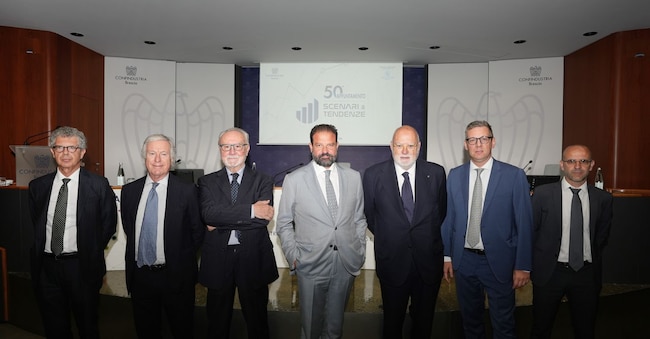
The meeting in Brescia. Streparava said: ‘Energy costs for businesses are too high.’

4' min read

Translated by AI
Versione italiana

4' min read

Translated by AI
Versione italiana

Almost one and a half billion – more than double the pre-Covid figure. Although it has not reached the peaks seen in 2022, the cost of energy bills for businesses in Brescia is rising again, with gas and crude oil prices being driven up by the crisis in Iran.

These were the key topics of discussion in Brescia at the 50th edition of “Scenari e Tendenze”, Confindustria Brescia’s economic observatory launched in 2008.

Loading...

At the heart of this in-depth analysis are the renewed tensions between the United States and Iran, which have once again disrupted shipping through the Strait of Hormuz: an event that highlights the extreme vulnerability of modern economies to geopolitical shocks. This is a particularly critical situation for Italia, a country heavily dependent on global markets and with a manufacturing sector that requires massive amounts of energy.

According to the analyses presented during the proceedings, hedge funds are also contributing to the worsening of the situation. Mistakenly convinced that supplies from the Persian Gulf would recover quickly, even leading to a surplus of supply, the funds had drastically reduced their long positions and accumulated a record number of short positions. The sudden resurgence of the crisis is forcing speculators to scramble to cover their positions: a sudden change of course that is already causing a sharp rebound in market prices, set to intensify in the coming weeks if tensions do not ease. The initial effects are as follows: oil +7 per cent, gas +25.8 per cent, polyethylene +4 per cent, polypropylene +5 per cent, non-ferrous metals +2 per cent. The only sector experiencing a downturn is the steel industry, which has been hit by falling demand and high energy costs over the past month: iron ore -12 per cent, ferrous scrap -5 per cent. Companies are also being weighed down by the rapidly rising freight rates on the Shanghai–Genoa route (+128 per cent) and the Shanghai–Rotterdam route (+140 per cent).

As regards the Brescia area alone, in the first three months of 2026 the province’s manufacturing sector showed a consolidation of the progress made in previous periods (+3.5 per cent year-on-year). The outbreak of the conflict in the Middle East does not appear to have had a significant impact on production trends recorded between January and March this year, apart from the sharp rise in the prices of energy inputs and certain raw materials typically used by local businesses.

In this regard, businesses have reported increases not seen since the second half of 2022. Against this backdrop, the new projection for 2026 regarding the energy bill paid by industrial firms in Brescia (1,464 million) represents a slight downward revision on the forecast made last March, in the 49th edition of Scenari & Trends, although the current level is two and a half times higher than the 2019 estimate, when expenditure was less than 600 million euros. The underlying picture therefore remains unchanged, with expenditure on electricity and natural gas not dissimilar to that of 2021.

“Italian and European businesses,” said Antonio Gozzi, Confindustria’s vice-president for European Strategic Autonomy, the Mattei Plan and Competitiveness Policies in relations with European institutions – are today facing an unprecedented phase, in which geopolitical tensions, global competition and the energy transition are deeply intertwined. In this context, we cannot allow decarbonisation targets to become a further factor in the loss of competitiveness. The challenge is to combine sustainability with industrial development, ensuring that businesses have access to secure, abundant and competitively priced energy. This is why Europe must support the transition with a strong industrial policy, investment in energy infrastructure, regulatory simplification and a review of policy instruments – starting with the ETS – to ensure they support investment rather than penalising those who manufacture in Europe. Europe’s strategic autonomy also depends on its ability to preserve and strengthen its manufacturing base: without

‘Without innovation in industry, there are no skilled jobs, and there cannot be a truly sustainable ecological transition.’

“Scenarios & Trends,” comments Paolo Streparava, president of Confindustria Brescia, “stems from a very simple conviction, one that is more relevant today than ever, just as it was in 2008 at the start of this journey: businesses need reliable tools to understand the environment in which they operate. We are living through a historic period characterised by constant change. Geopolitical tensions, international conflicts, new trade policies, market volatility, and the cost of energy and raw materials make every business decision more complex than in the past. On the one hand, Brescia’s manufacturing sector continues to demonstrate remarkable resilience. On the other, factors exerting significant pressure on businesses remain. I am thinking in particular of energy costs. The latest estimates indicate that in 2026, Brescia’s industrial firms will face a total energy bill of 1 billion 464 million euros. This figure remains very high and illustrates just how much the issue of energy continues to affect the competitiveness of our production system.”

“The current economic landscape,” adds Roberto Saccone, President of the Brescia Chamber of Commerce, “is characterised by a slowdown in global growth, the possible return of inflationary pressures linked to energy tensions, and a geopolitical context that is affecting investment, trade and confidence.” Moreover, recent years have accustomed us to rapid and profound changes in the economic landscape, capable of significantly affecting businesses’ day-to-day operations and strategic planning. In order to help businesses make more informed decisions and draw up coherent action plans, it is therefore essential to be able to rely on reliable analyses and projections of possible future scenarios. In this context, the work carried out as part of ‘Scenarios & Trends’ proves to be of immense value, making a significant contribution to the competitiveness of our production system. It should be noted, however, that Brescia’s economic system still possesses the energy, skills and creativity to transform this complex phase into opportunities for development and competitiveness, especially if we continue to invest in the modernisation of the production system and in the training of the younger generations.”

Copyright reserved ©
Loading...

Brand connect

Loading...

Newsletter

Notizie e approfondimenti sugli avvenimenti politici, economici e finanziari.

Iscriviti