Spanish Grand Prix

Formula 1, will it be the last race for Barcelona?

A stop in Barcelona for F1, which after the announcement of Madrid's entry from 2026 seems destined to leave the calendar. But as with Imola, there are no certainties for the Montmelò circuit. With the entry of Madring, a trend is confirmed that sees F1 leave permanent circuits and enter urban contexts, to strengthen the union between city and sport.

by Massimo Ruberti and Glenda Mecaj

8' min read

8' min read

The Munich Grand Prix once again saw the Formula 1 single-seaters race through the narrow streets of the Principality without the possibility of overtaking, except by undercut. Indeed, the new double pitstop rule did not produce the desired results in terms of spectacle, but it did highlight how complex strategy is in F1 and the interpretation of the new rule varied from team to team. In terms of shrewdness, the choices of the Red Bull - Racing Bull family and those of the Mercedes team were at both extremes.

The first ones have masterfully interpreted the possibilities offered by the new rule: Max Verstappen, in full Casino atmosphere, bet on the red of a flag that would have made him start on pole; the two Faenza cars on the other hand have optimised the double start in the top 10 bringing home twelve precious points thanks to the choice of slowing down Lawson to favour the double pitstop of Hadjar, first driver at the arrival behind the big teams. On the contrary, the two Mercedes (starting 14th and 15th) were protagonists of a Sunday to forget and did not know how to read the race. The stable in Brackley rarely shines at the strategic level and Toto Wolff appeared very frustrated by Williams' choice to brake the pack. Slowing the pace on a lap by 4-5 seconds is certainly unsportsmanlike, but in Formula 1 you don't win by being a horseman.

Loading...

Ferrari, often criticised for its strategy because it is media overexposed, adopted (as did McLaren) a conservative strategy. Starting at the front, there is more to lose than to gain at Monte Carlo and the result (Leclerc second, Hamilton fifth) reflects the true values seen on the field. The Monegasque driver with a heart-stopping qualifying took the front row just 109 thousandths behind Lando Norris, once again showing all his talent. His only chance of victory would have been to have a team mate capable of keeping a pace closer to his own.

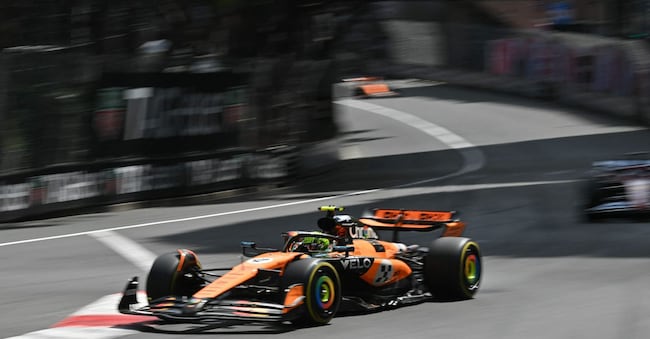
Pitch number 1 brought great joy to Norris, who despite a risky blocking at the start coolly managed the race. The British driver not only won the most famous Grand Prix in Formula 1 but also moved considerably closer to the top of the world championship (-3). Who knows if this victory can give him for the rest of the season that confidence that he has often lacked, leading him to obtain excellent results but below expectations.
LE CLASSIFICHE

Il campionato piloti e costruttori dopo il Gp di Monaco

Loading...

From 2026 the Spanish GP will be run at Madring

.

The 2026 Spanish Grand Prix could be, at least for a while, the last to be raced on the Montmeló circuit. Following the agreement between Formula 1 and IFEMA MADRID, it has been made official that from 2026 the Spanish Grand Prix will in fact abandon the permanent Catalan circuit and move to Madrid, at least until 2035. IFEMA, a consortium made up of the Community of Madrid, the Madrid City Council, the Chamber of Commerce and Industry and the Monte Madrid Foundation and founded in 1980, has created the Madring, a street circuit that will run through the streets of the Spanish capital. This event will bring Formula 1 racing to a European metropolis for the first time, replicating the experiences of Formula E, which among others also crosses the streets of Rome.

Designed to accommodate between 110,000 and 140,000 fans and to allow at least 90 per cent of them to reach the track by public transport, the Madring was built in a strategic location, i.e. five minutes from Madrid-Barajas airport and outside the city centre, but well connected to transport. This makes it easier for visitors to reach the circuit and complies with modern environmental sustainability policies.

The alternation of Barcelona and Madrid in the F1 calendar is nothing new. In fact, already in the early days of the championship, in 1951 and 1954, the street circuit of Pedralbes in Barcelona was chosen to represent the Iberian country. After a few years without grand prix on Spanish soil, an alternation was created between the permanent circuit of Jarama in Madrid (1967) and the urban Montjuïc in Barcelona (1969). This rotation was interrupted in 1981 with the last victory at Jarama by Gilles Villeneuve.

Between 1986 and 1990 the Spanish Grand Prix was raced in Jerez de la Frontera (the last victory in the Andalusian GP was won by Alain Prost in a Ferrari), but since 1991 with the construction of the Montmelò circuit Formula 1 has always chosen Barcelona as a fixed stop on the calendar. It is worth mentioning that the Valencia street circuit was also on the calendar (2008-2012), but under the aegis of 'European Grand Prix'. Again, the last edition saw a Ferrari victory, with the success of Asturian Fernando Alonso.

The Montmeló circuit has been strategic for the development of Formula 1 single-seaters as it has long been the site of seasonal testing. In fact, the track can be described as complete with high and low-speed corners and a long straight. The layout of the Madring, on the other hand, is anything but typical: 5.4 kilometres long with 20 corners, two straights and two tunnels and an estimated average lap time of 1:34, it will be a sort of hybrid circuit between a street circuit and a permanent circuit.

But why did Formula 1 choose Madrid?

First and foremost, one must consider that Spain has almost always hosted at least one Formula 1 race, in addition to the double stage between 2008 and 2012 (Barcelona and Valencia), and that the Spanish fans of the championship are steadily increasing, especially thanks to the two drivers on the grid who represent the country, two-time world champion Fernando Alonso and former Ferrarista Carlos Sainz, now in Williams. It is no coincidence that the driver, along with his father Carlos Sainz Senior, have been chosen as Madring Project Ambassadors as they originate from the capital.

According to Formula 1 itself, in 2023 Spain recorded a television audience of 77 million users, an average of 3.5 million per race, registering an increase of 84% compared to the previous year. Spain's social media following of the world championship par excellence also continues to increase with 882,000 followers and 4 million unique visitors to the official Formula 1 website in the same year.

In addition, Madrid is a popular destination due to its vitality, culture and even sporting events it hosts such as the ATP Masters 1000 and WTA 1000 tennis tournaments. The project proposed by IFEMA MADRID, with the support of national, regional and local authorities, has also won the support of Formula 1 with its ideas for building one of the most sustainable circuits in the championship.

In the words of Stefano Domenicali, Formula 1 President and CEO: 'I would like to thank the IFEMA MADRID team, the Regional Government of Madrid and the mayor of the city for putting together an exceptional proposal. It perfectly represents Formula 1's vision: to create a multi-day sporting and entertainment spectacle that offers maximum value to the fans and embraces innovation and sustainability'.

Furthermore, Mohammed Ben Sulayem, President of the FIA, said: "As we approach the introduction of the new 2026 FIA technical regulations, designed to achieve the Net Zero emissions target by 2030, it is encouraging to see that local organisers have placed a strong focus on environmental sustainability in their plans for the event.

Regarding the new project, the Mayor of Madrid, José Luis Martínez-Almeida, remarked: 'With the announcement of the Grand Prix, Madrid looks to the future and joins the exclusive group of cities that now host F1, positioning itself at the forefront of world capitals in attracting major events. I am confident that Madrid will rise to the challenge, not only because we deserve a spectacle of the magnitude of Formula 1, but also because Formula 1 deserves a city with the energy, character and passion of Madrid'.

The number of urban circuits has quadrupled in 45 years: the evolution of the tracks introduced in the calendar

.

The introduction of the Madring to replace the Montmelò opens up a reflection on the change taking place in Formula 1, a change in the very nature of the competition that is slowly abandoning the historic and permanent circuits, preferring to race in urban settings such as Monaco, Singapore but also Baku and Melbourne. An analysis of the data collected since 1980 shows that in addition to the increase in the number of Grand Prix on the calendar, there is a more than proportional increase in city circuits. There is, in fact, a gradual increase in the number of urban circuits on the Formula 1 calendar, a trend that has been on the rise especially in recent years, from four city circuits in 2010 to eight this season, twice as many as fifteen years ago.

Underlying this increase is the consistency of Liberty Media's strategic choices. The American company, in fact, aims at the globalisation of the championship and the attraction of different targets in the motorsport market, and racing on the streets of the most glamorous cities in the world, including Las Vegas, Miami and Singapore, certainly attracts the attention of the media and fans, directly involving the inhabitants of the cities involved.

These are not mere preferences, but rather, strategic choices that aim at closeness with the public and, above all, with investors: this is not just about sport, but about marketing, business and the continued growth of Formula 1. With the calendar for the 2026 season still to be confirmed, it cannot be said with certainty whether the number of urban tracks will increase or not, but we will certainly see a new one, Madrid.

EVOLUZIONE DEL NUMERO DI CIRCUITI CITTADINI E PERMANENTI NEL CALENDARIO F1

Negli anni come è evoluto il numero di GP nei circuiti cittadini e in quelli permanenti. Si nota un aumento generale di entrambe le categorie, ma una percentuale superiore dei circuiti cittadini

Loading...

New wing flexibility rules in force since the Barcelona Grand Prix: what does it mean for the racing teams?

From the Spanish Grand Prix the new FIA regulation on front wing deflection comes into force: specifically, the allowed deflection goes from 15 mm to 10 mm under symmetrical loads, and from 20 mm to 15 mm under asymmetrical loads. This is the result of the change that began as early as the Melbourne Grand Prix and with the tightening of controls as early as this year's Chinese Grand Prix.

For the teams, the new regulations involve the re-design of the wings through the use of materials and structures that allow for a reduction in deflection but still maintain aerodynamic efficiency. This is no small challenge, especially considering the need to stay within the constraints imposed by the budget cap. The teams will also be subjected to stricter controls by the FIA, which will apply greater loads to check the stiffness of the wings. From a performance point of view, the reduction in flexibility could result in lower overall aerodynamic efficiency. Teams are therefore called upon to review set-ups and aerodynamic configurations generating a possible reshuffling of performance.

In any case, it is difficult to speculate on the real difference this technical directive will have on the championship. McLaren, the championship leader, has already found itself having to make its wings less flexible after the Baku Grand Prix in 2024. The consequences have been obvious, with a negative performance in Las Vegas, where that aerodynamic configuration would have proved to be a winner. However, some more and some less, all the teams in 2025 showed wings "contrary to the spirit of the FIA regulations" and so it is not a choice of the federation to penalise one team and revolutionise the championship. McLaren's advantages are in fact to be found elsewhere, such as the brake cooling system.

In this regard, in a creative but bureaucratic manner, Red Bull is investigating what might be the grey area of the regulations exploited by the Woking stable. The Anglo-Austrian team is repeatedly asking the Federation if it is possible to use a certain system to cool the brakes (e.g. the driver's drink) and the FIA has so far answered in the negative. As usual in Formula 1, the difference in winning world championships is not only technical ability but also guile and creativity.

Copyright reserved ©
Loading...

Brand connect

Loading...

Newsletter

Notizie e approfondimenti sugli avvenimenti politici, economici e finanziari.

Iscriviti

Tutto mercato WEB