
Grande Brera, Milan's dream comes true after 50 years

5' min read
5' min read
Milan, 1972: the superintendent Gian Alberto Dell'Acqua bought the eighteenth-century Palazzo Citterio for the State, a stone's throw from the historic Brera building, and for Franco Russoli, then director and soon to become superintendent, the dream of bringing the Pinacoteca into the twentieth century was realised (at least it seemed that way), giving rise to the long-dreamed of 'Great Brera' project.
Milan, 7 December 2024: Palazzo Citterio opens with two superb collections of 20th century art: the collection of Emilio and Maria Jesi, donated by the couple, and that of Lamberto Vitali, left to Brera by the collector who died in 1992. Of those that Russoli had notified, allocating them precisely to Palazzo Citterio, only the Jesi is here: Gianni Mattioli's has meanwhile been deposited by the heir at the Museo del Novecento in Milan, while the Jucker collection was purchased in 1992 by the City and is now in the same (beautiful) museum.
Between the two dates, 52 years of passion - in the evangelical sense of the word - made up of projects approved and then never realised, of changes of destination of the various areas, of questionable restorations, of legal stumbles, of stops and restarts.
As of today, St. Ambrose's Day, Palazzo Citterio is a reality, after a frantic race against time accomplished by the entire staff of the Brera Art Gallery under the leadership of general director (installed on 15 January) Angelo Crespi. Who received the heavy legacy of the less than happy restoration conducted between 2015 and 2018 by the Superintendency. And if certain realities (for all, the modest access staircase) could not be remedied, the initial sadness of the large flat on the piano nobile, destined for the two collections, was resolved by Mario Cucinella, Compasso d'Oro 2024 for the Luigi Rovati Foundation Art Museum project in Milan, who restored elegance and functionality to those rooms by designing the display cases and the large metal table for Vitali's archaeological pieces and replacing the glacial white of the walls with a palette designed to enhance the works. Magnificent works, which have long featured in all the art history manuals: after the entrance hall, which, with Pellizza da Volpedo's Fiumana, a direct predecessor of the Quarto stato (it was donated to Brera by Angelo Abbondio years ago and remained in storage for a long time), and with other works from the late 19th century, creates a link with the Pinacoteca's collections, which are still in the middle of that century, one enters the world of Jesi and Vitali, first coming across the 79 Jesi masterpieces: milestone works by Boccioni (the double Self-portrait, the Rissa in the gallery, the sketch of the Città che sale), Severini, Carrà, Modigliani, Arturo Martini, Marino Marini, de Pisis (a quantity: they were in their bedroom). And Morandi, much loved by collectors, represented by 13 selected works, which from the moving Fiori of 1916, through the brief, rare and precious metaphysical season, reach the famous Nature morte. And then, the long corridor dedicated to Sironi of his happiest years, to the metaphysical Carrà, to Scipione and Mafai, joined by a work by Braque and a tragic Picasso, Head of a Bull, 1942: the height of the war. Then it is the turn of the eclectic, extremely valuable collection formed by Lamberto Vitali, who was indeed a friend and one of Morandi's most profound connoisseurs but who, animated as he was by a vast culture and unrelenting intellectual curiosity, collected Predynastic Egyptian vases and Mycenaean objects, portraits from Fayyum and mediaeval mosaics, gold-ground panels and canvases by the Macchiaioli and, of course, works by Morandi, all of the highest quality, from the poetic paesaggino of 1911 to the famous Natura morta con tavolino rotondo (Still Life with Round Table), 1920, to the paintings of the 1940s. To which is added Modigliani's famous Enfant gras. But beware: there is also a drawing by Leonardo, a Man's Head in Profile from 1510-1511, recognised by Vitali and confirmed as such by the world's leading experts. In the last two rooms, we then come across Cesare Zavattini's curious collection of micro-portraits of 20th-century artists; the dramatic cycle of Mario Mafai's Fantasie, 1939-1942, and donated by Aldo Bassetti; and the paintings made in 1929 by de Chirico, Savinio and Severini for the great Parisian dealer Léonce Rosenberg.
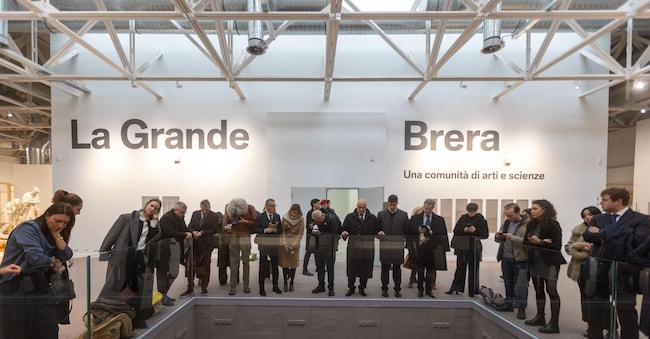
Palazzo Citterio now (finally) also offers two new exhibition areas: one is the Sala Stirling, underground, where Mario Ceroli, the indomitable 87-year-old (and great artist, whom we all know) has created, under the curatorship of Cesare Biasini Selvaggi, the powerful site-specific exhibition-installation entitled La forza di sognare ancora, which will move to the Galleria Nazionale d'Arte Moderna e Contemporanea in Rome in the spring, forming the most recent nucleus of the large exhibition dedicated to him. The other, on the top floor, hosts until 10 March the exhibition La Grande Brera. A community of arts and sciences, curated by Luca Molinari, which tells the story of Brera from 1300, when here, around the church of Santa Maria in Brera, there was the community of the Umiliati, down through the centuries to the present day: all the incredible historical, artistic, architectural and scientific palimpsest stratified in this area where, in addition to the Pinacoteca, the Braidense National Library and the Academy of Fine Arts, five other cultural institutions coexist, almost all of them with very rich library and archive collections, such as the Astronomical Observatory (here its director, Giovanni Virginio Schiaparelli, drew the first map of Mars in the second half of the 19th century), the Botanical Garden, the Institute for Science and Letters, the Friends of Brera and the Ricordi Foundation. An exhibition of documents, historical images, models; but do not think of it as something specialised, because the curator and the layout (by Francesco Librizzi) have given it an unthinkable attractiveness.

