Books

Grazia Deledda: 100 years since a free woman won the Nobel Prize

He held the view that women had the right to aspire to lofty ideals and ‘dreams of glory’

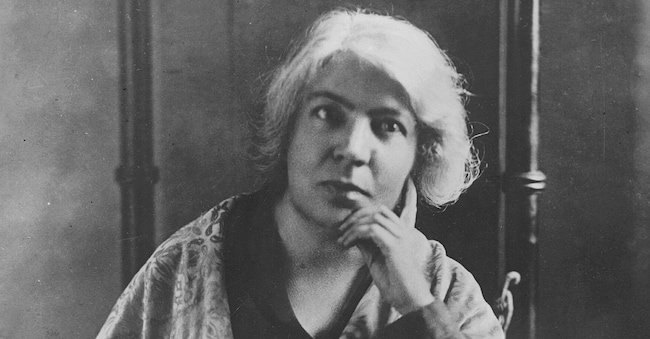
Grazia Deledda (1871-1936), (Reuters)

4' min read

Translated by AI
Versione italiana

4' min read

Translated by AI
Versione italiana

When, in modern-day London, Virginia Woolf wrote that a woman must have money and a room of her own if she is to become a writer, Grazia Deledda had already put this principle into practice more than thirty years earlier in the remote village of Nuoro. This is demonstrated by an episode from her early youth. She had been entrusted with the task of selling the family’s olive oil, and every time a customer paid, she would put a small sum in her pocket to cover the costs of sending short stories and letters.

The women of Nuoro were scandalised because Grazia was determined to become a writer at all costs, but they would never have imagined that she had begun an extensive correspondence with several men, both for intellectual exchange and in the hope of finding a husband.

Loading...

The boyfriend

In a letter dated 1899 to her then-fiancé, Andrea Pirodda, she expressed her firm belief in her own rights: ‘It seems you are forgetting that I am a writer and that, whilst remaining an honourable woman, I have the right, once married, to a certain freedom of action. Even if I were not a writer, I would still demand this freedom, especially from you, who claim to defend women’s rights.”

A few years later, now married to Palmiro Madesani, she wrote to Baroness Christine Heuningen-Hüne that her husband was a distinguished civil servant, that they loved each other deeply, that they worked together in perfect harmony, and added: ‘He is my secretary; he looks after all my affairs and handles my correspondence with publishers and translators.’

In order to support his wife, Madesani had given up his own career – a decision he probably did not regret, given that he was able to accompany her to Stockholm for the Nobel Prize ceremony. This collaboration, however, was not well regarded in Roman literary circles. Ugo Ojetti wrote in a scathing review of the novel Nostalgie that Deledda had ‘dared’ to set the story in the Rome of civil servants, and years later Pirandello sketched, in Her Husband, the character of a husband who seeks to achieve fame through the success of his wife, a writer. It was not difficult to see who he was targeting, and, naturally, the writer was not pleased.

But Deledda’s modernity also lies in her connection with the ancestral world she had left behind. As a young woman, she had enthusiastically joined Angelo De Gubernatis’s project to collect Italia’s folkloric heritage. The modern perspective she gained through their intellectual exchange led her to adopt a liberated outlook and to recognise that women had the right to aspire to lofty ideals and ‘dreams of glory’. This new perspective also enabled her to recognise the value of rituals still practised in Sardinia that had been passed down through the millennia. In *i* *La via del male* */i*, she depicted *attitidos*, the poetic improvisations of the mourners during funeral lamentations. In Dopo il divorzio, she depicted the Argia ritual, in which seven young women, seven married women and seven widows danced in a circle around a man buried up to his neck to cure him of a tarantula bite. In The God of the Living, she described the water rituals on the eve of St John’s Day, which James G. Frazer had discussed in The Golden Bough.

Exhilaration

The narrative draws the reader into the emotions, into the euphoria – akin to a kind of intoxication – that overwhelms the participants: the celebration of water becomes a moment of euphoria akin to intoxication; the sacred and the profane merge, giving rise to a religious sentiment in which pagan elements coexist with Christianity. The body receives its blessing from the river, from the night’s dampness, from the darkness teeming with life that the day’s scorching sun cannot overcome. It was often the women who presided over the ceremony as officiants. At the same time, archaic Sardinian society recognised a responsibility in male behaviour. In Fire in the Olive Grove, the mistress’s reply to the servant who asks her about the morality of the girl he intends to marry is significant: ‘You know that better than I do’. Only he knows whether he has treated her with respect.

The subjugation of women in Sardinia was not as absolute as in other parts of the Mediterranean. As early as the Middle Ages, the Carta de Logu of Eleonora d’Arborea had recognised women’s right to inherit and own property and to pass it on to their daughters.

‘Sardinian-style’ matrimonial law

Sardinian matrimonial law (‘alla sardisca’) stipulated that a wife’s assets remained hers to dispose of as she saw fit, and did not automatically pass to her husband, as was the case with the dowry. The Carta de Logu also punished rape, permitting a marriage of convenience only with the woman’s consent. In modern Europe, however, women were still subject to their husbands’ authority; they could not own property, bequeath assets, inherit property or sign legal documents. In Italia, the code of honour existed – it was only abolished in 1981 – and rape was considered a crime against morality. In the event of an extramarital pregnancy, the man was under no obligation to acknowledge paternity.

In an article published in 1893 in De Gubernatis’s journal Natura e arte, Deledda spoke of the great changes that were taking place in Sardinia too, concerning the status of women, acknowledging that there were women attending secondary school and preparing themselves for the challenges of science and the arts, women who painted, sang, played music, studied, thought and wrote. More than thirty years later, this would also become Virginia Woolf’s vision; she would urge women to write all manner of books, without hesitating over any subject. As for ‘a room of one’s own’, Grazia Deledda had already gone further: with the proceeds from her literary work she had built her villa in Rome, and with those from the Nobel Prize (10 December 1926) she had purchased Villa Caravella in Cervia.

Copyright reserved ©
Loading...
Loading...

Brand connect

Loading...

Newsletter

Notizie e approfondimenti sugli avvenimenti politici, economici e finanziari.

Iscriviti