
Supreme Court denies trans people legal status as women. Payback for Rowling, the 'mother' of Harry Potter
British Supreme Court denies trans people legal recognition as women, prompting positive reaction from J.K. Rowling

2' min read
Key points
2' min read
LONDON - Under British law, a person's sex is a biological matter established at birth, the Supreme Court ruled. The five justices unanimously ruled that the legal definition of woman in the Equality Act 2010 does not include transsexuals who have obtained a 'gender recognition certificate' attesting to their sex change.
The Supreme Court wanted to shed light on a complex and controversial issue, but emphasised that the ruling 'should not be seen as a triumph for one group of people at the expense of another'.
The law in fact protects gender reassignment and direct and indirect discrimination against trans people remains illegal, 'without the need to extend the definition of women to them and to force the Equality Act'.
This is a defeat for the Scottish Autonomous Government, which had passed a law putting transsexuals on an equal footing with women, granting them the right, for example, to access positions and places reserved for women. Yesterday, John Swinney, the Scottish premier, accepted the ruling of the Court of Final Instance and said that the government in Edinburgh had always "acted in good faith."
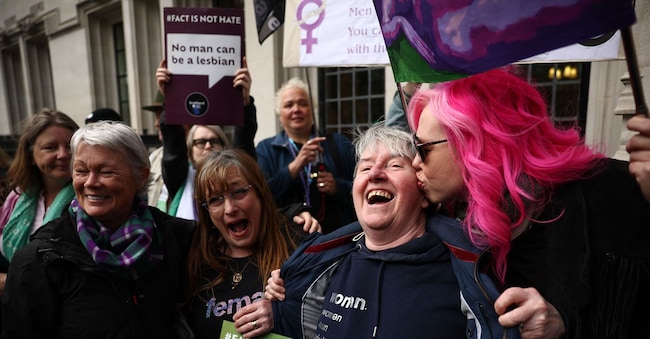
Instead, it celebrated victory for the feminist group For Women Scotland, which had sued the Scottish Government arguing that trans women's rights should not trump the rights of women, who should feel protected and safe in the spaces reserved for them.

