
Great cinema returns to its former glory: a journey through IMAX 70
In Toronto to watch *Odyssey* for the third time and see if there’s any difference compared to other cinemas. There certainly is.

Key points
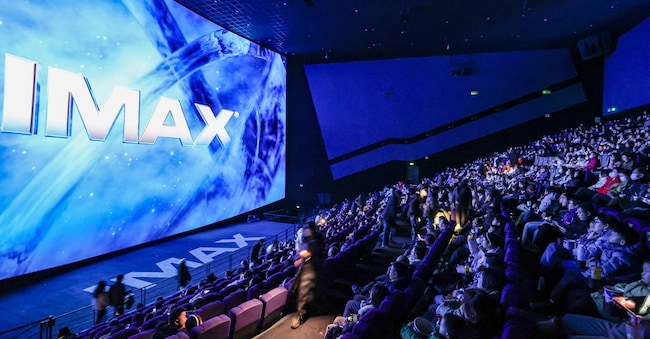
The reclining seats at the IMAX 70 in Toronto have a rather childlike quality to them; they allow for a rocking motion that can be intensified thanks to a footrest fixed in front of the audience member. The curved screen envelops the tiered auditorium, which is furnished with comfortable, wide black armchairs, offering plenty of space for food and drink. And, indeed, the audience, who file into the auditorium right up until the opening credits and beyond, are laden with gigantic tubs of popcorn, which they devour with gusto, heedless of their neighbours. Here, the screening is viewed as an all-encompassing pleasure, a far cry from the sacred silence of certain European cinephilia, and comes with all the trimmings, including shouted commentary. Whilst waiting for the tub of popcorn to empty, the sound system, thankfully, drowns out the incessant munching. The screening is at 11.30 pm (the time difference helps us stay awake) and the audience is mostly young.
Christopher Nolan’s Odyssey
The film in question is Odissey, which I’ve now seen three times: the first screening was in the provinces, dubbed into Italian with an excellent stereo sound system and a huge screen – far preferable to the second, in the capital, shown in the original language on a medium-sized screen. It’s not that the Toronto screening was specifically planned during a trip to Canada, but it was almost as if it had been. My curiosity to understand why Christopher Nolan decided to shoot on film – lugging a 130-kilo IMAX camera around six countries – outweighed the 80-kilometre round trip from the hotel to the Cineplex Vaughan. Was it worth it? Absolutely.
The Cineplex Vaughan in Toronto
The exterior has a certain temple-like quality: nothing surrounds the modern building with its cylindrical glass core except for a vast car park. On either side, like the claws of a crab, the auditoriums stretch out. The IMAX theatre is just one of these and is the most valuable, as it allows the 70-millimetre film to be projected horizontally (it is usually projected vertically) inside the projector, illuminated by a special lamp. Normally, an image area is 48.5 millimetres wide and 22.1 millimetres high and comprises the space of 5 perforations; with the IMAX system, the images are 69.6 mm wide and 48.5 mm high and occupy 15 perforations.The other special theatres include the UltraAVX, featuring a wall-to-wall panoramic screen, advanced surround sound and extremely spacious seating; the ScreenX in UltraAVX, a 270-degree immersive theatre that extends the film’s images onto the side walls of the auditorium; the D-BOX, featuring seats with a motion system synchronised with the action on screen; and RealD 3D, the latest innovation in three-dimensional viewing. One might say it is more of a playground than a cinema. And yet, once past the vaulted ceiling frescoed in striking colours and the cardboard cut-outs allowing you to have your photo taken with Odysseus/Matt Damon, the lack of charm typical of shopping-centre multiplexes gives way to a marvel.
Details
Nolan’s Odyssey, for us children of Greco-Roman culture who regard Homer as a sort of relative, begins with scenes set in Ithaca that are of a pornographically banal nature. But in IMAX, the viewer – bored by the information overload – is captivated by the wooden latticework of the screen separating Penelope from the suitors, by the delicacy of the golden necklace adorning the queen’s neck, and by the precision of the folds in her tunic. Alongside these, the ravages of time on Anne Hathaway’s face also stand out, revealing the burden of a solitary reign: a white widow consumed by the doubt that her husband, rather than being unable to return, simply does not wish to. The camera also reveals the full strain on his nerves, the contraction and expansion of Matt Damon’s muscles – for this role, he had to train extensively. Damon had no stunt doubles, except for the Laestrygonians scene, in which a woman 1 metre 37 tall played him from behind to create the effect of giants.
Realism and Fear
Nolan loves realism and rejects the use of green screens and CGI. It is precisely during the battle against the Laestrygonians that the audience leans back in fear. When the monsters arrive to drive those who escaped the flogging in the woods back into the water, the viewer finds themselves in the sea, almost drowning, alongside the warrior who cannot dodge the blows. They feel a chill in Polyphemus’s cave when they hear the Cyclops blocking the exit with a colossal boulder: their ears are deafened by the deep rumble of the ‘bottle effect’. Why did we follow Odysseus into this futile war? We had believed in him when, as the gates of Troy swung wide open, Agamemnon appeared majestically, his helmet towering above all others. It was for him that we entered the Horse alongside Odysseus and, in silence, heard the enemy probing its hollow, as if a sword were wounding our arm. And we realised, when the grave Tiresias emerged from the sand, that none of the deaths in battle had made any sense. The writer was seated in the front row to feel even more immersed in the film, but when she tried moving to the middle of the auditorium, she had the sensation of watching a stage play, as if she were sitting on stage with the actors. Cinema began as a diversion prior to live performances. Strongmen, magicians and illusionists later used it, becoming protagonists in films, to reach public squares without having to endure gruelling tours. And now cinema is once again taking centre stage in a theatrical dimension: the circle is complete. At the end of the screening, this writer was struck, moved and in awe, wondering what Ashes and Diamonds or Cleo from 5 to 7, shot in IMAX 70, would have been like. There are only a few dozen cinemas in the world capable of screening IMAX 70; in Europe there are seven, including Brussels, London and Prague.


