Climate and economy

Green in the city, from climate to water increasingly a resource

Green areas reduce rising temperatures and act as reservoirs of Co2, as well as dams for water and pollution.

by Anna Migliorati

26 marzo 2026

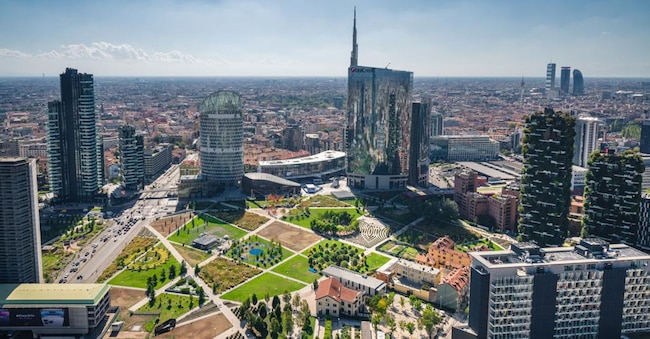
Milano, la biblioteca degli alberi Luigi Narici / AGF

4' min read

Translated by AI
Versione italiana

Key points

  • - Urban parks contain rising temperatures by up to 3-5°C
  • - Green areas absorb up to approximately 32.6 kg of CO₂ per square metre
  • - New York, Seoul, Paris, Madrid and Valencia, the advantages in scientific studies
  • - Survey on Milan's parks: one in five willing to pay to maintain them

4' min read

Translated by AI
Versione italiana

(Il Sole 24 Ore Radiocor) - With spring, urban parks are becoming crowded again, increasingly the social heart of cities. But their economic and environmental weight is increasing with climate change, so much so that they are now an indispensable bulwark. And citizens for one are increasingly aware of this.

The benefits for climate and emissions

Every year now records record after record of rising temperatures and this is even truer for cities with urban areas seeing the thermometer rise by up to +3°C in metropolitan areas compared to surrounding areas. Well, the green areas are on average almost 1°C cooler than the rest of the city, so much so that it is estimated that increasing tree cover by 10% can reduce temperatures by as much as 3-5°C. "This is not only an environmental fact, but has direct effects on daily life, as well as on energy consumption: less heat also means less need for air conditioning. Systems such as green roofs can reduce the energy consumption of buildings by between 2% and 17%, and green walls by between 10% and 30%," says Benedetta Lucchitta of Bocconi University's Green Research Centre.

Loading...

Scientific literature shows that urban green areas are no longer just 'decorative': it is estimated that they can absorb up to around 2.4 tonnes of CO₂ per hectare each year. If we look at the total stock, i.e. how much CO₂ they manage to store over time, parks and green areas can get up to around 32.6 kg of CO₂ per square metre. "Translated into more intuitive terms, this means that a single urban park can function as a true diffuse carbon sink, which on a city scale becomes comparable to that of much larger areas of forest," he explains.

Added to this is the issue of water. Green infrastructure, such as drainage beds or natural rainfall management systems, can reduce rainwater runoff by up to 26-52 per cent. "In practice, this means less water in roads and drains during intense events, and therefore less risk of flooding," Lucchitta adds.

Not to mention the economic benefits. Ecosystems are a fundamental component of the global economic system: it is estimated that over 50% of the world's GDP depends directly or indirectly on ecosystem services. Which means that cities that invest in their parks, even more so by redesigning their landscapes in the context of urban regeneration, are not just making an environmental investment, but activating a real strategic economic lever.

From New York to Paris, stories of urban regeneration

Of course, it is the social dimension that leaps to the fore: a walk outdoors reduces stress, a jog cuts health costs, socialising reduces risks and makes cities more liveable. "That's why it is a factor that is anything but marginal," says Benedetta Lucchitta. There is no shortage of examples. A case in point is the High Line in New York, where a disused elevated railway line has been transformed into a green infrastructure. More than in the numbers of people walking on it, the value lies in the ability to restore green public space in a context of very high urban density, contributing to the reduction of impermeable surfaces and the improvement of local environmental quality.

Even more significant is the case of Cheonggyecheon in Seoul, where an urban highway was removed to revive a historic river. An intervention that cascaded into a reduction in vehicular traffic, a decrease in air pollutants of up to about -35% and a reduction in urban temperatures of up to 3-5°C. At the same time, it restored public space and natural surfaces to the city, transforming a grey infrastructure into an urban ecological corridor.

In Europe, in Paris, the Promenade Plantée transformed a disused railway line into an elevated green space, contributing to the creation of new accessible public space and the improvement of urban environmental quality. In Madrid, the Madrid Río project led to the burial of a large road infrastructure, resulting in a reduction of surface traffic, local pollution and noise, as well as the creation of a large continuous system of green spaces along the river. In Valencia, the Parque del Turia converted the old river bed into an urban green infrastructure, significantly increasing the availability of public space and contributing to the climate resilience of the city.

"These examples clearly show that urban regeneration, when integrating Nature-based Solutions, does not just improve physical space, but reduces environmental pressures, returns space to nature and improves urban living conditions. In this sense, urban regeneration can be read as the main vehicle," says the Bocconi researcher.

In short, a park is not just a green area, in the face of challenges: 'its distinguishing feature is its multifunctionality: it is able to address different urban challenges simultaneously,' concludes Benedetta Lucchitta. 'However, to fully realise this potential, we need to strengthen the link between scientific evidence, social perception and policy instruments, making the value of urban nature increasingly visible, measurable and integrated into decision-making processes.

Citizens increasingly aware

A measurement that citizens are ready for, and living in green spaces they are, indeed, the most aware of. A survey carried out by Bocconi University's Sur-Lab Observatory on 2,007 Milanese shows how very different green areas influence well-being, safety and daily life. in different ways: from the Trotter, a real social hub, to Monte Stella, perceived as less safe, to BAM and CityLife, frequented by office workers.

The analysis shows how perceptions of the benefits of urban parks vary according to demographic and socio-cultural factors: students, residents, women and the elderly recognise their value more, especially for health, sociality and the environment. Families and low-income groups value them for practical and community functions, while the more educated favour aesthetic and cultural dimensions, confirming the role of parks as inclusive spaces for the city. As many as 19% of those interviewed, i.e. one in five, would be willing to contribute financially to the management and maintenance of Milan's parks, with an average willingness to pay around 22 euros per year per person.

Copyright reserved ©
Loading...

Brand connect

Loading...

Newsletter

Notizie e approfondimenti sugli avvenimenti politici, economici e finanziari.

Iscriviti