
'Green Deal and energy costs put businesses at risk'
Streparava: 'The EU changes course, in Italy decouple electricity and gas'. Orsini: 'Working to reduce prices, hope for news soon'

3' min read
3' min read
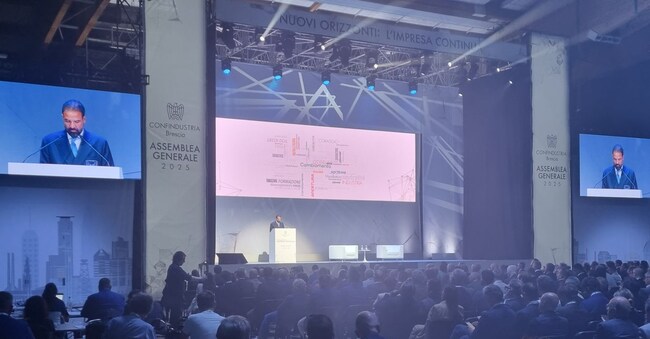
Energy, whose costs must be reduced. And then Europe, where the Green Deal rules must be changed. For Paolo Streparava, the new president of Confindustria Brescia, these are the main urgencies to be tackled to safeguard the competitiveness of companies, put at risk by an uncertain context full of complexity, 'a world changing at a speed never seen before'. In front of the entrepreneurs gathered for the annual assembly that marked the handover of the baton from outgoing number one Franco Gussalli Beretta, Streparava outlined the priorities of his mandate, starting with the hope that the drive for sustainability, while remaining central and necessary, can be reoriented, 'with the EU Commission that must represent an engine of innovation, growth and union, not a regulator'.
In the crosshairs are the timing and methods of the Green Deal, for 'a transition to electric power that in the absence of a technology-neutral approach risks compromising automotive competitiveness'. While the new guidelines set out by president von der Leyen are appreciable, he explains, "what is needed now are facts, a few things done well and immediately", such as the total revision of the Fit for 55, the Ets and Cbam mechanisms, and the postponement of the 2035 deadline for endothermic engines. "A deadline that goes in the opposite direction to the one we wanted of neutrality: there is no real technological development if only one way is imposed by law, it is competition that leads industry to perform at its best".
Another node is that of energy, faced with a price gap with other countries that is now considered unsustainable, linked not only to geopolitical tensions but also to a structural pricing system based on the absence of effective decoupling between sources. "After our Premier's statements in a public assembly," Streparava explains, "the government has no more alibis: we need decoupling between electricity and gas. We are fed up with paying 38 per cent more for electricity than our German colleagues, 73 per cent more than Spain, 88 per cent more than the French'.
Issues, those of the pathways towards sustainability and energy, which pose difficulties for the Brescia system, one of the largest manufacturing clusters in Europe, 153,000 employees in 13,000 companies, realities called upon to adapt to the new EU environmental provisions of the Green Deal, "one of the most ambitious but at the same time complex and unsuccessful strategies of the European Commission".
At the same time, the industrial system faces a growing skills gap, "a labour shortage that is holding back industrial development", as well as a demographic winter, "which without migration and structural adjustments could bring the working population down to 642,000 in less than 20 years, from the current 814,000", creating a cumulative loss of 90 billion in lost growth for the territory.


