
Green Deal, 'no more green follies': here are Meloni's stops and three stakes
The Prime Minister outlined the Italian government's three conditions for proceeding with the ecological transition and the European climate law

Key points
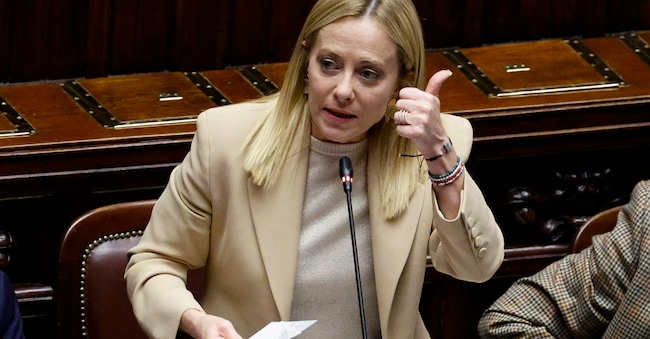
The ecological transition is also on the agenda of the European Council in Brussels today and tomorrow, preceded by the Italian government's full stop to the EU Commission's proposed revision of the European climate law, announced yesterday by Giorgia Meloni, and by a series of barriers to the Green Deal put in place by the Prime Minister, who, after the attack on "ideological environmentalism" at the UN General Assembly in New York, harshly stigmatised the "green follies" that damage Italian and European industry, starting with the automotive industry.
Italian 'no' to the Brussels proposal
Meloni made it clear that Italy will not support the EU executive's amendment to the European climate law that aims to set a new intermediate target to cut net emissions by 90% by 2040 compared to the 1990 level, as a step towards the final target of 100% by 2050. The prime minister assured that Italy will continue to support an "ambitious emissions reduction pathway", but never again by chasing "an ideological and therefore unreasonable approach, which imposes unsustainable and unattainable targets, which produce damage to our economic-industrial fabric, weaken European nations and risk definitively compromising the very credibility of the European Union".
The call for a new pragmatism
"We want to abandon the ideological approach that characterised the Green Deal season," the Prime Minister said in her speech in the House on the eve of the European Council, "to embrace a serious pragmatism that is firmly anchored in the principle of technological neutrality. Italy's request is therefore clear: not to limit ourselves to small revisions of the imagined process, but to turn the page and change paradigm. For the government, the Union's credibility is at stake: "How can we be credible in the eyes of our international partners and investors if we set ourselves far-fetched, even harmful objectives for those who want to do business in Europe and Italy?
Three areas to turn over a new leaf
Meloni pointed out three areas in which this change of approach should take shape, considering renewable energies as a component, but not the only one, of a 'balanced system, technologically equipped to contain emissions as much as possible'. The first, to justify the introduction of the intermediate 2040 target, concerns the guarantee of 'enabling conditions': instruments - Meloni defined them - that allow the goals to be achieved 'without irreparably compromising the European economy, to the advantage, moreover, of an ever-increasing number of strategic global competitors, who are jumping for joy in the face of the green follies that we have imposed on ourselves and that we want to continue to impose on ourselves'.
International Credit Counting
Il Governo chiede di poter conteggiare fino al 5% (degli obiettivi a livello Ue e nazionali) i “crediti internazionali”, ossia quei progetti di cooperazione internazionale anti-emissioni di carbonio che l’Ue e gli Stati membri finanziano in Paesi terzi. Considerando che le emissioni europee valgono circa il 6% di quelle globali, «non è trascurabile - per Meloni - il valore che ha, ai fini dell’obiettivo finale, favorire un’economia sostenibile nei Paesi in via di sviluppo». Scontato l’interesse italiano: far valere il peso del Piano Mattei e del suo focus sui progetti ambientali. Come il sostegno alla strategia internazionale di rafforzamento dell’accesso all’energia elettrica “Mission 300”, i progetti dalla Costa d’Avorio al Congo, le iniziative Ascent cofinanziate con la Banca mondiale in Tanzania e in Mozambico per ampliare l’accesso all’energia da fonti rinnovabili. Non solo: l’Italia sollecita la massima flessibilità nella contabilizzazione dei ta


