Greenhouse gas emissions, numbers (and culprits) in road transport of people and goods
After the pause of the pandemic year, climate-changing gas emissions have resumed. The role of the transport sector
by M.Fr.
2' min read
2' min read
The contribution of road transport to greenhouse gas emissions is substantial. According to data in the European Commission's Statistical pocketbook of 2021, the share of emissions attributable to the transport sector is 29% (26% excluding international maritime traffic). The figure refers to 2019 and is quoted in the Green Book produced by Autostrade per l'Italia with Il Sole 24 Ore.
As is well known, in the pandemic year emissions were reduced worldwide, but today we know that the trend is on the upswing. On the contrary, according to the GHG Emissions of all World Countries, 2022 was globally the year with the highest level ever recorded, with Co2 emissions increasing by 1.4 per cent compared to the year before.
Also according to GHG, in the Europe of 27 the increase in emissions in 2022 was 4 per cent over 2021 while the global figure is slightly higher: +5 per cent. Italy in the global scenario is very little, but within the EU-27 it has a certain importance. In Italy, the road sector is responsible for 78.5 per cent of emissions while the similar figure for the EU-27 is 71.7 per cent (year 2019, European Commission, Transport in figures: Statistical pocketbook, 2021). The Green Paper also points out that 'the results of the estimates referring to 2019 (pre-Covid-19 year for which more consolidated data is available), show that overall, cars, with over 386 billion vehicle kilometres, account for about 77% of road mobility in Italy (again expressed in vehicle kilometres) and of these 15% (about 77 billion vehicle kilometres) are driven on motorways'.
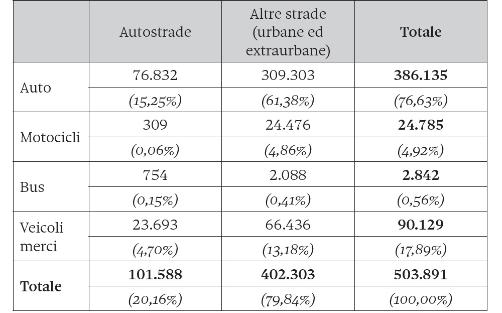
Furthermore, "goods vehicles cover about 18 per cent of the total with over 90 billion vehicle kilometres and of these about 5 per cent (about 24 billion vehicle kilometres) are driven on motorways. Freight vehicles cover about 18 per cent of the total with over 90 billion vehicle kilometres and of these about 5 per cent (about 24 billion vehicle kilometres) are driven on motorways'.
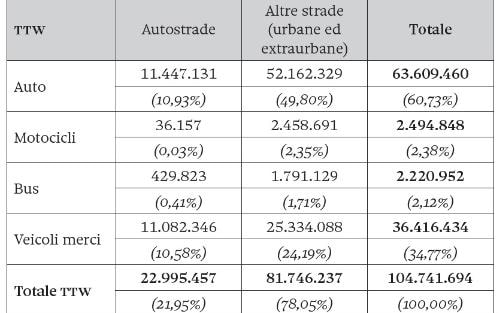
Going into even more detail, the Green Paper aims to identify the individual categories with their respective emission shares, applying the so-called TTW criterion (which considers emissions 'from tank to wheel'). Still stopping in 2019, overall, 'on motorways there is an almost 50 per cent split between the emission contribution of goods vehicles and passenger vehicles, a percentage that on other roads (urban and extra-urban) is decidedly more unbalanced in favour of passenger vehicles (70 per cent against 30 per cent)'.