
Greenland, new EU security strategy and troops from seven European countries
However, Von der Leyen still points to dialogue: on the Arctic we continue to work with partners, including the US
by our correspondent Beda Romano
 Aggiungi Il Sole 24 Ore
ai preferiti su Google
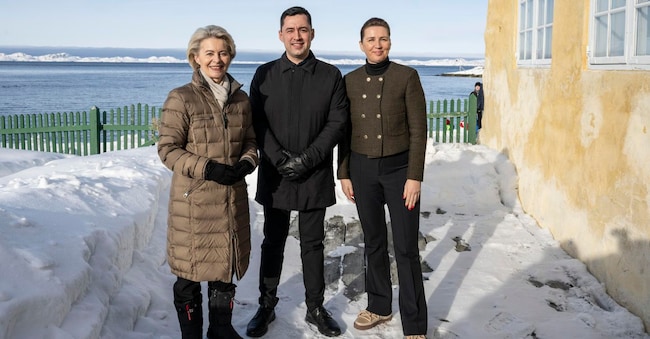
LIMASSOL (CYPRUS) - Faced with American aims for Greenland, the European Commission announced yesterday the forthcoming publication of a new European security strategy. The announcement came as several European countries decided to send a (symbolic) troop presence to the island, under Danish sovereignty. Still on the subject of defence, the EU executive approved the plans of eight member states for the SAFE financial programme.
'In the light of the current security and defence context, we have decided that the time has come (...) to draw up a new European Security Strategy,' European Commission President Ursula von der Leyen said here in Limassol at the opening of Cyprus' six-month European presidency. Asked about the contents of this new document, the former German Defence Minister remained vague.
Mrs von der Leyen's announcement comes after Defence Commissioner Andrius Kubilius proposed in a speech in Sweden last Sunday the creation of a European Security Council. The body 'could consist of permanent members, together with several rotating members, including the Member State holding the Council Presidency. To these would be added the EU leadership: the presidents of the Commission and the Council'.
On this occasion, Commissioner Kubilius also proposed the creation of 'a permanent European military force of 100,000 soldiers'. The military topic is always a sensitive one at the European level. At the same time, there is a growing awareness among the Twenty-Seven that they must join forces in a turbulent historical phase. Just yesterday Brussels approved eight national military investment plans (submitted by Belgium, Bulgaria, Denmark, Spain, Croatia, Cyprus, Portugal and Romania).
On the Greenlandic side, Ms von der Leyen reiterated that the island 'can count on us, politically, economically and financially'. She recalled that the European budget proposal 2028-2034 envisages 'a doubling' of investments in the region. He went on to note that "Arctic security is a central NATO issue". He added: "We will continue our work in the field of Arctic security, with our allies, our partners, including the United States".


