
Gucci, the brand's evolution passes through Florence
To present the Cruise 2026 collection, while awaiting Demna's official debut as creative director, the Kering brand chooses the city where it was founded in 1921, and where the Archive becomes the starting point

3' min read
3' min read
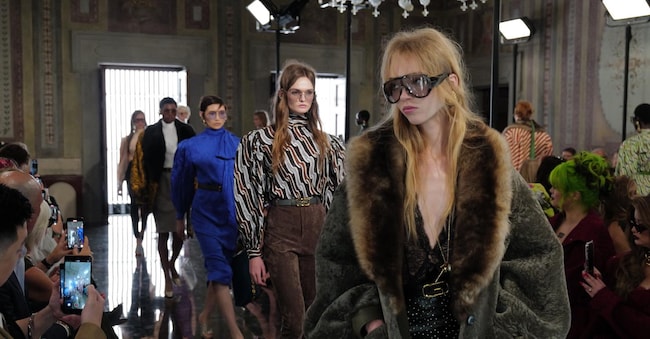
"Gucci is Florence, Florence is Gucci": with this easy slogan, if not exactly self-evident, albeit historically accurate and certainly perfect for the media hammering that, when well orchestrated, today can do more than anything else, the Florentine maison that is the flagship of the Kering group returns home, where it all began in 1921, for the Cruise 2026 collection fashion show.
It's that time of year again: travelling shows and locations chosen with painstaking care to convey specific messages, with Italy at the moment leading the way. In the city that is the cradle of the Renaissance, and yet too often sits motionless in contemplation of the good old days, justifiably boasting of having been a nerve centre of culture as well as a forge of the Italian language itself, Gucci chooses a place tied to its history, but also to local industriousness: Palazzo Settimanni, the 15th-century building that houses the House's archives and is located in Oltrarno, in the heart of the industrious Santo Spirito district. The mention of Florentine immobility is not specious. The archive, for Gucci, is anything but immobile; rather than offering itself as a space in which history is preserved and contemplated, it is an active and proactive place in which the new is imagined in constant and never subordinate dialogue with what has been done.
While waiting for the official debut of Demna as creative director, whose prodromes are expected in the coming months, Gucci, in short, obviates the idea of a suspended star in transition by reaffirming the specific weight and granitic certainty of over one hundred years of history. It is a narrative, this one, to which fashion has lately often resorted - when it has the right and the documents - and which appears effective because it props up the uncertainty of the present time with the certainty of tradition. The fact that this is then translated into a series of signs, or a simple logo is only a consequential aspect, the result of the current hegemony of marketing. In the Gucci collection, in fact, the amount of GG is exorbitant, pervasive, enveloping: it even extends onto tights, intertwines with sequins, takes on the mantle of a brocade.
The course of the test is zigzagging: a collage of historical references, drawn from Gucci fashion - from Tom Ford to Alessandro Michele, Demna's predecessor and now creative director of Valentino -, but also from fashion in general - Yves Saint Laurent -, as well as from the imagery of certain Italian cinema of the 1960s and 1970s, mixed with a postmodern flair and scorn for harsh, heedless, unheard-of conjunctions.
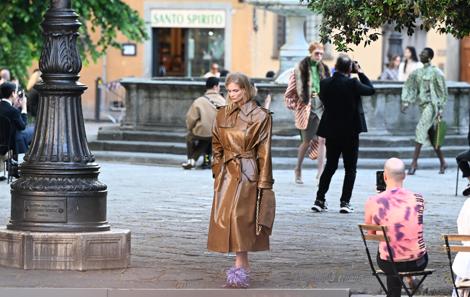
It is legitimate to look for traces of Demna, whose hand already seems to be seen in the dramatic and masculine tailoring, as well as in the chemisiers and the perversion of a slight bon ton. On the subject, Gucci CEO Stefano Cantino is clear, and speaks of continuity and dialogue: 'The way things are done matters more than how many are made. This fashion show authentically expresses Gucci's identity, in the place that more than any other guards our history. Today we celebrate creativity, craftsmanship and our heritage through a collective effort, guided by shared values and visions," he explained. "It is thanks to this common force that we trace a new chapter in Gucci's history, a continuous evolution, consistent with our past, rooted in the present and projected with impetus towards the future.

