
15 August 2026
Latest war news. Attacks in Lebanon: 11 dead. IDF: Hezbollah headquarters hit
Two air strikes, north of Nabatieh and Ansar, have resulted in the highest death toll since the June ceasefire. Hezbollah calls on the Prime Minister to respond to Netanyahu. Spats between the US President and the Pasdaran: Trump: ‘The Strait of Hormuz will be US territory’. Tehran: ‘You can’t conquer it with a social media post’
For feedback, please contact
english@ilsole24ore.com
 Aggiungi Il Sole 24 Ore
ai preferiti su Google
Summary by points
- Lebanon: 7 killed in Israeli attack in the south of the country
- Trump: ‘The Strait of Hormuz will be US territory’. Tehran: ‘You can’t conquer it with a tweet’
- Iran: oil spill in the Strait of Hormuz leaves the coastline of Qeshm Island blackened
- Aoun on the attacks in Lebanon: ‘A clear message regarding the negotiation process’
- Trump: ‘I will soon declare the Strait of Hormuz US territory’
- Lebanon: death toll from Israeli attacks rises to 11
15 August 2026
Iran: three of our pilots were captured by Qatar in March; Doha has released them
Iran is calling on Qatar to release three of its fighter pilots who were captured during an attack in March on the US Al-Udeid base in Qatar. “Three Iranian pilots were captured alive by Qatari forces after their Su-24 aircraft crashed” on 2 March, said General Mohammad Bagherzadeh, head of the Committee for the Search for Missing Persons within the country’s armed forces, as quoted by the Fars news agency.
“Javad Salehi, Abdolmajid Dashtian and Omran Behraveshian are being held by Qatari forces, and the Qatari government has not yet allowed them to meet or contact their families or the authorities,” added Bagherzadeh in a letter addressed to the International Committee of the Red Cross (ICRC), asking it to “meet with the Iranian pilots as soon as possible, enquire about their state of health and facilitate their release”. “The Qatari government’s approach, including the ban on meeting family members or relevant officials, is regarded by Iran as a war crime,” Bagherzadeh added in the letter, as quoted by Tasnim. At the end of July, the Iranian military had announced that the three were missing, whilst the body of another Iranian pilot, Majid Kazemi, who had been killed in the attack, had been recovered.
15 August 2026
IDF: Hezbollah headquarters struck; Ali Hassan, commander of the Radwan forces, killed
“Overnight, the IDF struck the headquarters of Hezbollah’s Radwan unit in the Ansar area of southern Lebanon. In the attack, Ali Samir Al-Haj Hassan, a battalion commander in Hezbollah’s Radwan unit, and several other ‘terrorists’ were killed.” This was stated by the IDF spokesperson in a statement, adding that the raid was carried out “following Hezbollah’s attack on soldiers operating in the Security Zone during the night”. Three soldiers were seriously injured in the Ali Taher ridge area. According to the IDF, “at the time of the attack, members of Hassan’s family were also inside the headquarters and, according to reports, were hit.” It is important to emphasise that the family members were not the target of the attack. The attack was specifically directed against Hassan, who was a legitimate target under international law. The terrorist used his family as human shields, hiding with them inside the military headquarters.”
15 August 2026
Lebanon: Prime Minister calls on Israel to halt the escalation; the people’s security is non-negotiable
Lebanon’s Prime Minister, Nawaf Salam, has criticised the Israeli air strikes that hit the south of the country, stating that they intimidate “residents in their homes” and undermine efforts to stabilise the situation in the south. “The seven martyrs of the Israeli air strike on the town of Ansar were not part of any military infrastructure, and the children and women killed were not military targets,” Salam said in a statement published on X. He added that it is the responsibility of the Lebanese state to deal with any military infrastructure present in the country. “Israel must put an end to this escalation,” Salam said. He added that the security of the Lebanese people and their right to life on their own land “are not subject to negotiation or bargaining”.
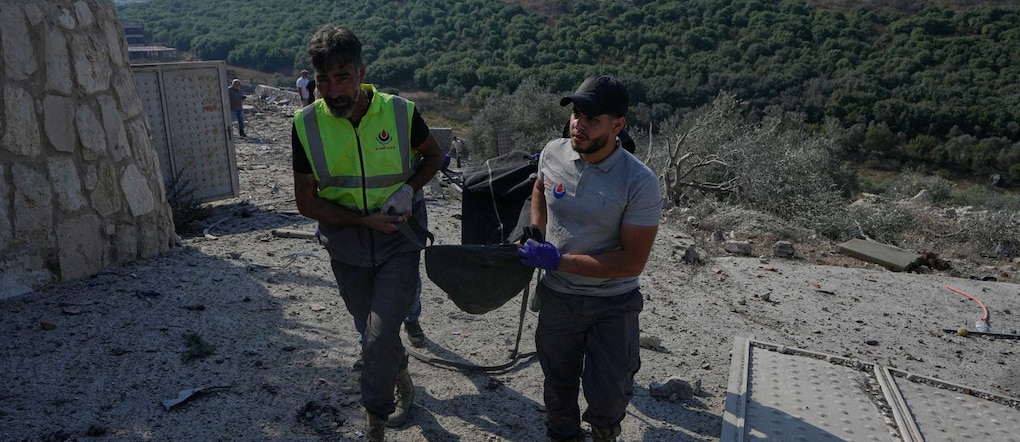
I soccorritori trasportano il cadavere di una persona, rinvenuto all’interno di un sacchetto di plastica, rimasta uccisa in un’abitazione colpita da un attacco aereo israeliano nel villaggio di Ansar, nel Libano meridionale, sabato 15 agosto 2026. (Foto AP/Mohammed Zaatari) Associated Press/ LaPresse Solo Italia e Spagna APN
Ask the editorial team
Have questions or feedback about this article? Contact our editorial team.
15 August 2026
West Bank: in Qusra, settlers attack a municipal team that had arrived to restore the electricity supply
A team from the municipality of Qusra, south of Nablus, was attacked today by a group of Israeli settlers whilst on its way to the Abu Rida family’s home in the village to repair the electricity supply, which had been damaged by the settlers earlier this week. This was reported by the Wafa news agency and also by the owner of the house, speaking to Ynet. This morning, despite the IDF’s military closure of the area, a group of 15 extremist settlers once again approached one of the houses that had been under attack since the start of the week, as documented by footage from the homes’ security cameras.
15 August 2026
Lebanon, Hezbollah: Israeli attacks will be met with an appropriate response
Hezbollah has stated that Israeli attacks on Lebanon will receive an “appropriate” response, following the deadly raids carried out on Saturday in the south of the country, and has urged the Lebanese authorities to halt the “humiliating” negotiations with Israel. “Israel must clearly understand that its attacks, violations and attempts to impose a fait accompli cannot continue and will be met with an appropriate response,” the Iran-backed group said in a statement. Hezbollah also added that the Lebanese authorities “must not persist in pursuing the humiliating path of direct negotiations and in making gratuitous concessions to the enemy”.
15 August 2026
Lebanon: death toll from Israeli attacks rises to 11
The death toll from the Israeli attack on the town of Deir al-Zahrani, in southern Lebanon, north of Nabatieh, has risen to four, according to Lebanese media reports. The total death toll from Israeli attacks in Lebanon today has thus risen to 11. An attack in Ansar, north of Tyre, had left seven people dead and three injured, again according to Lebanese media reports.
15 August 2026
Third attack in 24 hours on Emirati oil tankers in the Strait of Hormuz
Attacks attributed to Iran have targeted three oil tankers belonging to the UAE’s state-owned company ADNOC over the past 24 hours, as they were attempting to pass through the Strait of Hormuz. Two oil tankers were attacked on Thursday evening and another on Friday evening.
The United Arab Emirates have blamed the attacks on Iran, which has blocked the Strait of Hormuz since the start of the war in the Middle East at the end of February, whilst the United States has imposed a blockade on Iranian ports.
ADNOC and the authorities have reported no casualties or damage resulting from the three attacks. “The United Arab Emirates strongly condemns the hostile Iranian attack that targeted a vessel affiliated with ADNOC on Friday evening,” the UAE Ministry of Foreign Affairs said in a statement.
“Targeting merchant ships and using the Strait of Hormuz as a means of economic coercion or blackmail constitutes an act of piracy by Iran’s Islamic Revolutionary Guard Corps,” the ministry reiterated, following similar statements issued on Friday after Thursday evening’s attack on two other vessels.
15 August 2026
Trump: ‘I will soon declare the Strait of Hormuz US territory’
Remarks by the US President in Garden City, New York.
15 August 2026
Does Trump consider the Strait of Hormuz ‘US territory’? ‘He was joking’
US President Donald Trump was “joking” when he said he would declare the Strait of Hormuz US territory following a war with Iran. Trump did not meet with his advisers to discuss such a move, according to Wall Street Journal journalist Brian Schwartz on social media platform X, citing an anonymous senior White House official.
“President Trump did not meet with his advisers regarding the declaration that the Strait of Hormuz would become US territory after the war, and he was joking during his speech in New York today,” wrote Schwartz.
Trump made this statement during a political rally at the Nassau County Police Academy in Garden City, New York.
“After defeating Iran – which is suffering a crushing defeat – I will very soon declare the Strait of Hormuz to be US territory,” he said with a chuckle. “It’s true,” he added.
15 August 2026
Aoun on the attacks in Lebanon: ‘A clear message regarding the negotiation process’
The Lebanese President Joseph Aoun has stated that the Israeli attacks in the south of the country over the past few hours represent a ‘clear message’ regarding the negotiations between the two countries, ahead of the next round of US-sponsored talks, scheduled for early next month in Rome. Aoun condemned the “continuous Israeli attacks” in the south and the “repeated violations of the framework agreement... and of international law on the protection of civilians, which have led to the death of an entire family in the village of Ansar”, according to a statement from his office, adding that “these violations send a clear message regarding the negotiation process”.
15 August 2026
United States: the aircraft carrier USS George Washington is heading for the Middle East
15 August 2026
Beirut: ‘Two dead and nine injured in a new attack north of Nabatieh’
Lebanese media are reporting a new Israeli attack on Deir al-Zahrani, north of Nabatieh, which is said to have left two people dead and nine injured, according to the Lebanese Ministry of Health. This is reported by the Times of Israel. The Israel Defence Forces (IDF) have not yet commented on the attack, but had previously stated that they had carried out night-time strikes in southern Lebanon against Hezbollah in response to an ‘action’ by the terrorist group against their troops.
15 August 2026
Beirut: the seven victims of the Israeli attack were not ‘military infrastructure’
The Israeli attack that killed seven people, including women and children, in the village of Ansar in southern Lebanon in the last few hours did not target “military infrastructure”, said Lebanese Prime Minister Nawaf Salam. “The seven victims of the Israeli attack on the village of Ansar do not constitute ‘military infrastructure’, and thewomen and children killed were not military targets”, he said after the Israeli army claimed to have struck “Hezbollah terrorist infrastructure”.
15 August 2026
Afghanistan’s fragility five years after the Taliban’s arrival


L’aereo si appoggia sulla pista di atterraggio e la valle di Kabul lo accoglie avvolgendolo tra le montagne dell’Hindu Kush. I passeggeri scendono dal veivolo e scompaiono nel terminal internazionale. Sono circa due milioni ogni anno, esattamente come durante il periodo della presenza militare statunitense e della Nato, finita dopo 20 anni - il 15 agosto del 2021 - con l’ingresso dei talebani nella città. Le immagini dell’aeroporto assediato dalla popolazione che cercava di scappare dal Paese hanno...
15 August 2026
Lebanon: IDF strikes Hezbollah infrastructure in response to attacks
The Israeli army has confirmed that it carried out air strikes in southern Lebanon overnight, stating that it had targeted Hezbollah infrastructure in response to an attack by the pro-Iranian Lebanese group against its troops. An attack on Ansar, north of Tyre, left seven people dead and three injured, according to Lebanese media reports.
A series of attacks on Nabatieh have also been reported, including heavy bombardment of the Ali Taher ridge, beneath which Hezbollah has an extensive underground network. According to The Times of Israel, the IDF has stated that it struck Hezbollah infrastructure both in the Nabatieh area and in Ansar, towns situated approximately 15 kilometres apart.
“The attacks were carried out in response to an operation by the terrorist organisation Hezbollah against our forces in the Ali Taher ridge area, which is located within the security zone where IDF troops are operating,” the Israeli army emphasised, without immediately providing further details on the Hezbollah attack.
15 August 2026
Iran: oil spill in the Strait of Hormuz leaves the coastline of Qeshm Island blackened
15 August 2026
The olive tree war: how settlers in the West Bank are destroying the Palestinian economy

From our correspondent in QUSRA (WEST BANK)
Pointing, across the road to 505, at his olive trees still laden with fruit that will never be harvested, Abdel al-Hakim Wadi suggests that here, in the West Bank, to survive one must abide by an unwritten rule: getting used to living with oppression, without giving up the fight. ‘It’s got off to a terrible start. This year is even worse than last year, which was already the worst year in the last fifty years. Not to mention 2023: in that year, there was no harvest here at all,’ he sighs, somewhat resigned. The cause of all this is not adverse weather conditions, a lack of labour or a shortage of equipment. The reason is always the same: those little white houses, or those clusters of prefabricated buildings clinging to the tops of almost every hill that encircle, like an embrace, the Palestinian village of Qusra, near Nablus, in the heart of the West Bank. The increasing attacks by settlers – often armed with M16 rifles – are all too frequently met with indifference, if not active complicity, from the Israeli armed forces who are, in theory, tasked with rushing to the scene to restore order. ‘I can’t even touch those trees. There are 85 of them, but they’re too close to the new outpost. For the past few months, the settlers have been treating the field as a security zone. And they’re armed,’ continues Abdel al-Hakim, aged 55. This is the oxymoron of this land. The outpost — illegal even under Israeli law — relies on the assistance of the security forces to obstruct what is, by law, legitimate and what the security forces are supposed to protect: the olive harvest, even in Area C. It is autumn. The olive groves that cloak the hillsides in silvery green, as well as those on the plains, just a few metres from Palestinian villages, have become battlefields. The silence of this bucolic landscape is shattered by the roar of stun grenades fired by the Israeli army; the blue sky is streaked with the black smoke of fires set by the settlers and the grey smoke of tear gas. Abdel al-Atheem Wadi, aged 53, brother of Abdel al-Hakim, lives on the highest hill in Qusra. This small village of 1,400 inhabitants is now one of the areas hardest hit by attacks from settlers. His house has only just been completed. That tall concrete wall, which blocks the view of the hills, immediately catches the eye. ‘It’s to protect us from the settlers’ raids. We’ve even been forbidden from going up onto the roof. The reason: the Israeli military base is too close, and the nearest settler outpost is less than a kilometre away.’ Living in Qusra also means watching your business go up in smoke right before your eyes. “I can’t even go to my chicken farm, just 200 metres away. Nobody has removed the carcasses: there were ten thousand of them. The same thing happened at the other seven farms,” continues Abdel al-Atheem, who then shows us the meagre harvest of the day. Two sacks of olives. Too little time was allowed for the harvest, and too few workers were authorised to pick them. “At night, the settlers poison the roots of the trees and saw off the branches; at other times, they set fire to them or uproot them with private bulldozers. It’s not uncommon for them to do this right in front of the soldiers,’ explains Ghassan Najjar, an activist from the village of Burin, fifteen minutes from Nablus. ‘Yesterday we went back to the fields to resume the harvest. They pointed their rifles at us. We left. We face extremely strict restrictions on our olive groves in Area C. But also on those in Area B, which is theoretically safer. The Israeli authorities have postponed our days’ leave — in truth, just a few hours for so many trees — until 11 November,” say the two brothers. A, B, C. Three letters sum up how the spirit of the Oslo Accords, signed in 1993 and implemented in 1995, has been betrayed and bent to the logic of the strongest. In 1995, three zones were created in the West Bank to set the Palestinian Territories on the path towards the creation of an independent state: Zone A, under the full civil and security control of the Palestinian Authority; Zone B, under Palestinian civil administration but with security shared with Israel; and Zone C (approximately 60 per cent of the territory) under full Israeli control. Anyone with olive groves in Zone C must apply for a permit to access them every year, often to no avail or subject to severe restrictions. Like many other families, the Wadis update their list of bereavements almost every year. A tragedy has cut short the lives of the two brothers. Four days after the massacre of 7 October 2023, settlers, fuelled by anger and a desire for revenge, stormed a house in Qusra. They opened fire: four people were killed. The third brother, Ibrahim Wasa, was killed less than 24 hours later, along with his son Ahmed, whilst driving the convoy taking the bodies back to the village. Abdel al-Hakim watches footage of that senseless death on his smartphone. He then lists those injured in the ‘Olive War’ of 2024 and hopes there will be fewer this year. The two brothers, like so many other Palestinians, rely on volunteers. This year, there are more foreign – and Israeli – activists who have rushed to defend the trees, offering themselves as human shields. The settlers have not been intimidated: the army and police have arrested and deported dozens of activists, more than 30 in the village of Burin alone. The recent truce proposed by Donald Trump and signed between Israel and Hamas is viewed by the most extremist settlers as an act of betrayal. It has thus acted as a trigger for their anger. The sense of impunity they enjoy has made them even more unscrupulous. Yesh Din — an Israeli human rights organisation that collects and disseminates information on violations of Palestinian rights in the West Bank — documented, during the 2024 harvest, 113 separate incidents of violence, harassment, sabotage of the harvest or damage to olive trees and crops, involving Israeli civilians and soldiers on land belonging to 51 Palestinian villages, towns and communities. ‘Israeli security forces appear to have played a more significant role in obstructing the olive harvest.’ And that is not all. “In around 70 per cent of cases where access to the fields was blocked, soldiers, border police officers and civilian settlement coordinators (CSCs) were present,” wrote the NGO. Footage of young settlers, their faces covered, viciously beating an elderly Palestinian woman and a Swedish activist whilst they lay on the ground on Sunday has gone viral. On the way back from Qusra, *Il Sole 24 Ore* also witnessed an attack first-hand: a convoy of settlers’ cars, between Road 458 and the turn-off for Jericho, rammed a stationary Palestinian car, smashing the door. They then used iron bars to strike another car and smashed the windows of a van. Since 7 October 2023, over a thousand Palestinians – the vast majority of them civilians – have been killed. The settlers have killed 11 of them this year alone. Yet for many Palestinians, the annual olive harvest is a special time, a celebration, a way to reconnect with nature and spend time with relatives. The olive trees. Many Palestinians have an almost reverential attitude towards these centuries-old trees: they look after them, they embrace them. They are their history, their tradition. Seeing them desecrated, poisoned, cut down, sometimes set alight or uprooted is a pain that is hard to comprehend. And yet, they know that in a year’s time they will still be there, amongst the olive trees, picking olives by hand. Adhering to that unwritten rule: to live alongside the injustices, but to resist. Just as their trees have done for centuries, with a few more scars on their bark.
15 August 2026
Tehran: US foreign policy towards Iran is based on self-deception
The spokesperson for the Iranian Ministry of Foreign Affairs, Esmaeil Baghaei, stated that US foreign policy towards Iran and the region in general is “deeply rooted in self-deception and false narratives”. In a post on X, Baghaei also quoted a famous line from Fyodor Dostoevsky’s novel *The Brothers Karamazov*, saying: “A man who lies to himself and listens to his own lies reaches a point where he can no longer distinguish the truth within himself or around him, and thus loses all respect for himself and for others.” “The excessive use of disinformation has blinded American politicians, preventing them from seeing regional realities,” he added.
15 August 2026
UKMTO: Ship struck in the Strait of Hormuz on Friday; crew safe
A “projectile” struck the hull of a bulk carrier in the Strait of Hormuz on Friday. This is according to the United Kingdom Maritime Trade Operations (UKMTO). “The crew are safe. No assessment of the damage has been provided at this stage, and the potential environmental impact is not yet known,” added the British maritime agency. Commercial vessels attempting to navigate the Persian Gulf and surrounding areas face a dual threat: violence in the Strait of Hormuz and attacks by the Houthis in the Bab al-Mandeb Strait. This means that “at present there is no truly ‘safe’ area on the Arabian Peninsula”, according to the maritime intelligence group Marisks in its latest update on the situation, as reported by CNN. According to the UKMTO, since 28 February, when the war between the United States and Iran began, 56 vessels have been reported damaged in the Strait of Hormuz and surrounding waters. Maritime traffic in the Strait of Hormuz, the UKMTO added, remains at a fraction of the levels recorded before the war.
15 August 2026
The War in Pictures
Guerra in Medio Oriente - 15 agosto 2026
Photogallery19 foto
War in the Middle East – 15 August 2026
15 August 2026
Trump: ‘The Strait of Hormuz will be US territory.’ Tehran: ‘You can’t conquer it with a tweet’
“Iran has been soundly defeated” and very soon “we will declare the Strait of Hormuz US territory”, said Donald Trump. Tehran responded: “The Strait cannot be conquered with a tweet”. And whilst the aircraft carrier Lincoln is returning to the US after a mission lasting over 260 days, Acting Secretary of the Navy Hung Cao acknowledged the crew’s difficulties, such as supply issues and mental health problems, but highlighted the “small” number of mental health cases dealt with “without any loss of life” and that meal plans were “adjusted when fresh produce was unavailable, without ever missing a meal”.
15 August 2026
Lebanon, Qassem in Beirut: ‘At least respond to Katz and Netanyahu’
Hezbollah leader Naim Qassem has called on the Lebanese authorities to “take a stand” regarding the statements made by the Israeli Defence Minister, Israel Katz, and Prime Minister Benjamin Netanyahu, who “repeat every day that they will not withdraw” from southern Lebanon. “Don’t you hear what Katz and Netanyahu say every day, namely that they will not withdraw? At least respond to Katz and Netanyahu by taking a stand”, said Qassem, adding: “We know that the Americans are telling you behind the scenes that they cannot do anything against the Israeli enemy because they support its actions”.
15 August 2026
Lebanon: 7 killed in Israeli attack in the south of the country
An Israeli attack in southern Lebanon, which took place in the early hours of today, has killed seven people. This was reported by the Lebanese news agency NNA. It is the deadliest toll recorded since the June agreements led to a truce in hostilities between Israel and Hezbollah. NNA reported that an attack carried out by Israeli fighter jets “targeted a house on the outskirts of the village of Ansar” and that it had “killed seven people and injured three others”, completely destroying the house.

