
Live
War, latest news. CBS: ICE has been negotiating secretly with Iran to deport Iranians until early 2026
Washington and Tehran, at a time when tensions between the two countries were running high following the 12-day war in June, are said to have worked together to organise three repatriation flights, in September and December 2025 and then in January 2026
For feedback, please contact
english@ilsole24ore.com
 Aggiungi Il Sole 24 Ore
ai preferiti su Google
Summary by points
20 August 2026Pinned update
Oil: how the US cut off supplies from the Strait of Hormuz


The oil markets have lost their bearings, thrown off course by the difficulty of accurately estimating supplies coming out of the Persian Gulf. This problem risks fuelling volatility in oil prices, causing sharp spikes or, conversely, steep falls when – with the benefit of hindsight – a correct assessment of supply is finally reached. On Wednesday 19th, Brent continued to rise, surpassing $92.
Estimates of the actual availability of crude oil are complicated by the use of increasingly sophisticated tactics by a growing number of countries bordering the Gulf to ‘conceal’ the passage of cargo through the Strait of Hormuz, in order to minimise the risk of attacks, which is extremely high.
Yemen, Al-Madhaji: 'So the Houthis could become the heart of the Axis of Resistance'

In the Red Sea, ships change trajectory and crews avoid certain coordinates. Bab el-Mandeb, the strait between Yemen and the Horn of Africa that connects the Red Sea to the Gulf of Aden and thus to routes between the Mediterranean and Asia, remains open but crossing it has become more risky. An important part of global trade and energy traffic passes through here and, in recent months, attacks and threats have affected time and costs. "If I had to explain Yemen today I would start with this image, nothing photographs the country better than this crisis," Maged Al-Madhaji, co-founder of the Sana'a Centre for Strategic Studies and its former Executive Director (2014-2022), as well as one of Yemen's most prominent political and human rights activists, tells us. "Yemen is being dragged into a confrontation that is not its own. It is increasingly sucked into a broader regional agenda dictated by the Houthis, whose priorities are shaped by ideology, transnational alignments and a constant projection onto larger political battles."
For more than a decade, the Yemeni conflict has been narrated as a civil war that began in 2014, when the Houthi political-military movement - which calls itself Ansar Allah ("Partisans of God") - seized the capital Sana'a, forcing the internationally recognised government to reposition itself in the south of the country, based in Aden, and giving rise in 2015 to the military intervention of the Saudi-led coalition. "Yemen has become the central hub of the "Axis of Resistance" (the Iranian-led network of actors moving between Lebanon, Iraq and Gaza, ed.)," Al-Madhaji explains. Controlling part of Yemen, on the other hand, means being able to strike or threaten Bab el-Mandeb. "Within this framework,the Houthis have become one of the most important and enduring instruments of Iranian strategy in the region. Over the past decade, they have evolved into a military force that poses a growing threat not only domestically, but also to international interests, particularly maritime security, global trade routes, and energy flows'.
Yemen: Houthis claim responsibility for two drone attacks in Saudi Arabia
The Yemeni Houthi group has today claimed responsibility for two ‘military drone operations’ against Saudi Arabia. In a statement, military spokesman Yahya Saree said that ‘the first targeted a sensitive site at Najran airport and the second targeted Aramco in Najran’, a city in the south-west of the country, near the border with Yemen. The operations were launched “in response to the Saudi enemy’s violation of the airspace over Saada province with its drones”, added Saree.
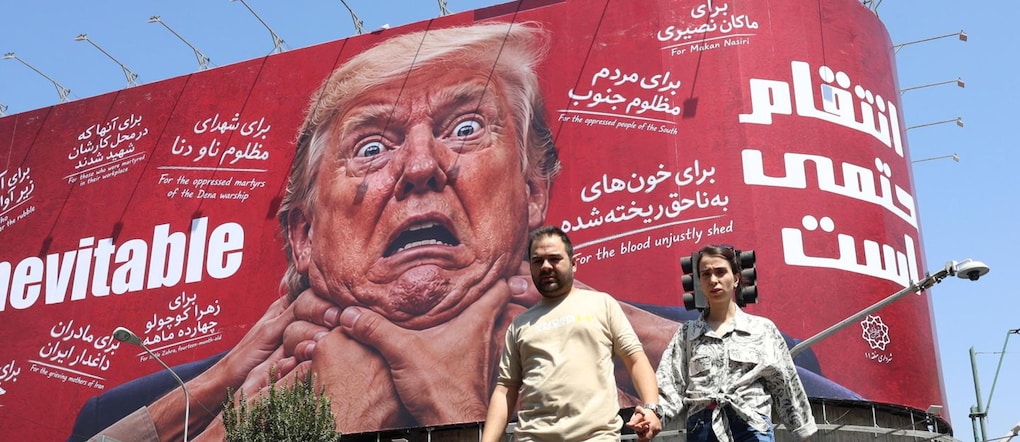
Alcuni iraniani passano accanto a un cartellone contro Trump a Teheran, in Iran. EPA
Ask the editorial team
Have questions or feedback about this article? Contact our editorial team.
Media: The US could seize Iranian assets ahead of D-Day
The United States may seek to seize Iranian assets under its jurisdiction as part of the economic war launched by Donald Trump to crush Tehran. The move is modelled on the Bush administration’s initiative following the 2003 invasion of Iraq. According to reports by the Bloomberg news agency, however, the Iranian assets within the United States’ reach are limited, and seizing them would be more complicated both legally and diplomatically. Most of Iran’s wealth is, in fact, held in third countries, and Washington would need the cooperation of foreign governments to seize it. Another way to increase economic pressure on Iran involves Dubai and the United Arab Emirates, a crucial hub for the regime’s trade and access to foreign currency. When Iran sells oil, it needs currency exchange bureaux and intermediaries to convert payments – often in yuan – into a currency that Tehran can use.
US Ambassador to Israel: Settlers could face US sanctions
The US Ambassador to Israel Mike Huckabee has stated that extremist Israeli settlers who took part in the siege of several houses in the village of Qusra, in the West Bank, including one belonging to the Palestinian-American Loui Ridi, could face US sanctions. Huckabee made the remarks in an interview with Reuters quoted by Israeli media. “I believe the message goes beyond the Trump administration alone. It is a message of civilisation and civilised behaviour. You do not take possession of something that does not belong to you,” said the ambassador, who is also a Baptist pastor and a supporter of Israeli settlements.
20 August 2026
IDF: Hamas is using the Nasser Hospital in Khan Younis for interrogations and torture
The IDF and Shin Bet reveal that Hamas ‘has identified a decline in support amongst the population of Gaza and, fearing it will lose control over the population, is stepping up the activities of its security apparatus in an attempt to impose its rule through intimidation, interrogation and torture’. Intelligence reports – according to the IDF – show that the terrorist organisation is exploiting the Nasser Hospital in Khan Younis for interrogations and torture. Hamas is operating out of the Yassin building, on the second floor of the hospital’s outpatient clinics, and is using the hospital as a government centre for purposes unrelated to its medical function. Patients and hospital staff report the constant presence of Hamas terrorists, some of whom are masked, in various areas of the hospital complex. Further interrogations are being carried out in a building that previously housed hospital offices, which had subsequently been used as a canteen and then converted into a prayer room.
20 August 2026
CBS reveals: ICE has been negotiating secretly with Iran to deport Iranians until early 2026
US immigration authorities have been working secretly with Iran to deport hundreds of Iranian immigrants to Tehran between late 2025 and early 2026. This was revealed today CBS News on the basis of hundreds of emails obtained by the National Iranian American Council (NIAC), which prove that Washington and Tehran – at a time when tensions between the two countries were running high following the 12-day war in June – worked together to organise three repatriation flights, in September and December 2025 and then in January 2026. This was just a few weeks before the attack was launched against the Iranian ‘extremist dictatorship’, as Donald Trump put it in his speech on 28 February, in which he promised ‘the proud Iranian people’ that ‘freedom was within reach’. The emails reveal that Iranian officials apparently even had a say in deciding which immigrants to deport back to their home country, with ICE officials seemingly having no qualms about accepting last-minute changes to the deportation lists requested by Iran, in what appears to be a clear departure from US policy of welcoming dissidents and others fleeing the Islamic Republic, even following instructions from Tehran on who to return to a country notorious for its persecution of women, political dissidents and religious minorities. ‘At the request of the Iranian Embassy, I have added a few cases’, wrote an ICE official in August, whilst preparations were under way for the September flight, referring in fact to the Iranian Interests Section which, as there have been no diplomatic relations between Iran and the United States since 1980, operates under the auspices of the Pakistani Embassy in Washington. A week later, another official made a change to the list after meeting the director of the Interests Section: “Iran requested that I correct the previous list and speed up the deportation process”, he wrote in an email. On 26 September, three days before the flight, the Iranian Interests Section asked ICE to add three further names to the list of deportees, and requests continued to arrive right up until the day of departure.
20 August 2026
The olive tree war: how settlers in the West Bank are destroying the Palestinian economy
From our correspondent in QUSRA (WEST BANK)
Pointing, across the road to 505, at his olive trees still laden with fruit that will never be harvested, Abdel al-Hakim Wadi suggests that here, in the West Bank, to survive one must abide by an unwritten rule: getting used to living with oppression, without giving up the fight. ‘It’s got off to a terrible start. This year is even worse than last year, which was already the worst year in the last fifty years. Not to mention 2023: in that year, there was no harvest here at all,’ he sighs, somewhat resigned. The cause of all this is not adverse weather conditions, a lack of labour or a shortage of equipment. The reason is always the same: those little white houses, or those clusters of prefabricated buildings clinging to the tops of almost every hill that encircle, like an embrace, the Palestinian village of Qusra, near Nablus, in the heart of the West Bank. The increasing attacks by settlers – often armed with M16 rifles – are all too frequently met with indifference, if not active complicity, from the Israeli armed forces who are, in theory, tasked with rushing to the scene to restore order. ‘I can’t even touch those trees. There are 85 of them, but they’re too close to the new outpost. For the past few months, the settlers have been treating the field as a security zone. And they’re armed,’ continues Abdel al-Hakim, aged 55. This is the oxymoron of this land. The outpost — illegal even under Israeli law — relies on the assistance of the security forces to obstruct what is, by law, legitimate and what the security forces are supposed to protect: the olive harvest, even in Area C. It is autumn. The olive groves that cloak the hillsides in silvery green, as well as those on the plains, just a few metres from Palestinian villages, have become battlefields. The silence of this bucolic landscape is shattered by the roar of stun grenades fired by the Israeli army; the blue sky is streaked with the black smoke of fires set by the settlers and the grey smoke of tear gas. Abdel al-Atheem Wadi, aged 53, brother of Abdel al-Hakim, lives on the highest hill in Qusra. This small village of 1,400 inhabitants is now one of the areas hardest hit by attacks from settlers. His house has only just been completed. That tall concrete wall, which blocks the view of the hills, immediately catches the eye. ‘It’s to protect us from the settlers’ raids. We’ve even been forbidden from going up onto the roof. The reason: the Israeli military base is too close, and the nearest settler outpost is less than a kilometre away.’ Living in Qusra also means watching your business go up in smoke right before your eyes. “I can’t even go to my chicken farm, just 200 metres away. Nobody has removed the carcasses: there were ten thousand of them. The same thing happened at the other seven farms,” continues Abdel al-Atheem, who then shows us the meagre harvest of the day. Two sacks of olives. Too little time was allowed for the harvest, and too few workers were authorised to pick them. “At night, the settlers poison the roots of the trees and saw off the branches; at other times, they set fire to them or uproot them with private bulldozers. It’s not uncommon for them to do this right in front of the soldiers,’ explains Ghassan Najjar, an activist from the village of Burin, fifteen minutes from Nablus. ‘Yesterday we went back to the fields to resume the harvest. They pointed their rifles at us. We left. We face extremely strict restrictions on our olive groves in Area C. But also on those in Area B, which is theoretically safer. The Israeli authorities have postponed our days’ leave — in truth, just a few hours for so many trees — until 11 November,” say the two brothers. A, B, C. Three letters sum up how the spirit of the Oslo Accords, signed in 1993 and implemented in 1995, has been betrayed and bent to the logic of the strongest. In 1995, three zones were created in the West Bank to set the Palestinian Territories on the path towards the creation of an independent state: Zone A, under the full civil and security control of the Palestinian Authority; Zone B, under Palestinian civil administration but with security shared with Israel; and Zone C (approximately 60 per cent of the territory) under full Israeli control. Anyone with olive groves in Zone C must apply for a permit to access them every year, often to no avail or subject to severe restrictions. Like many other families, the Wadis update their list of bereavements almost every year. A tragedy has cut short the lives of the two brothers. Four days after the massacre of 7 October 2023, settlers, fuelled by anger and a desire for revenge, stormed a house in Qusra. They opened fire: four people were killed. The third brother, Ibrahim Wasa, was killed less than 24 hours later, along with his son Ahmed, whilst driving the convoy taking the bodies back to the village. Abdel al-Hakim watches footage of that senseless death on his smartphone. He then lists those injured in the ‘Olive War’ of 2024 and hopes there will be fewer this year. The two brothers, like so many other Palestinians, rely on volunteers. This year, there are more foreign – and Israeli – activists who have rushed to defend the trees, offering themselves as human shields. The settlers have not been intimidated: the army and police have arrested and deported dozens of activists, more than 30 in the village of Burin alone. The recent truce proposed by Donald Trump and signed between Israel and Hamas is viewed by the most extremist settlers as an act of betrayal. It has thus acted as a trigger for their anger. The sense of impunity they enjoy has made them even more unscrupulous. Yesh Din — an Israeli human rights organisation that collects and disseminates information on violations of Palestinian rights in the West Bank — documented, during the 2024 harvest, 113 separate incidents of violence, harassment, sabotage of the harvest or damage to olive trees and crops, involving Israeli civilians and soldiers on land belonging to 51 Palestinian villages, towns and communities. ‘Israeli security forces appear to have played a more significant role in obstructing the olive harvest.’ And that is not all. “In around 70 per cent of cases where access to the fields was blocked, soldiers, border police officers and civilian settlement coordinators (CSCs) were present,” wrote the NGO. Footage of young settlers, their faces covered, viciously beating an elderly Palestinian woman and a Swedish activist whilst they lay on the ground on Sunday has gone viral. On the way back from Qusra, *Il Sole 24 Ore* also witnessed an attack first-hand: a convoy of settlers’ cars, between Road 458 and the turn-off for Jericho, rammed a stationary Palestinian car, smashing the door. They then used iron bars to strike another car and smashed the windows of a van. Since 7 October 2023, over a thousand Palestinians – the vast majority of them civilians – have been killed. The settlers have killed 11 of them this year alone. Yet for many Palestinians, the annual olive harvest is a special time, a celebration, a way to reconnect with nature and spend time with relatives. The olive trees. Many Palestinians have an almost reverential attitude towards these centuries-old trees: they look after them, they embrace them. They are their history, their tradition. Seeing them desecrated, poisoned, cut down, sometimes set alight or uprooted is a pain that is hard to comprehend. And yet, they know that in a year’s time they will still be there, amongst the olive trees, picking olives by hand. Adhering to that unwritten rule: to live alongside the injustices, but to resist. Just as their trees have done for centuries, with a few more scars on their bark.
20 August 2026
Six people injured in an attack by settlers on a village in the West Bank
Six people were injured in violent attacks carried out by Israeli settlers in the Palestinian village of al-Mughayyir, near Ramallah, in the West Bank. This was reported by Haaretz, citing the Palestinian Red Crescent. According to the Palestinian news agency Wafa, the settlers allegedly attacked a car, causing it to overturn.
20 August 2026
Syria, Ankara: no Turkish delegation at the base struck by Israel
“No Turkish military delegation was present at the Abu al-Duhur airbase”, in north-western Syria, “either before or during the Israeli attack” two days ago. The Ministry of Defence made this statement today during a press briefing, asserting that the Israeli raid aims to “undermine Syria’s stability, security, unity and territorial integrity, as well as its infrastructure”. “We emphasise at every opportunity that attacks which violate Syria’s sovereignty and territorial integrity are unacceptable,” the ministry added, as quoted by the Anadolu news agency – “For the peace and stability of Syria and the region, it is essential that Israel puts an end to these reckless attacks and respects its obligations under international law”. “Turkey will continue to support Syria’s efforts to develop its infrastructure and military capabilities in accordance with the principle of ‘a single army’,” the Ministry of Defence concluded.
For further reading: Syria, the long road to recovery: 216 billion to rebuild a country in ruins
20 August 2026
Lebanon: Aoun meets the Pope – calls for support to halt Israeli attacks
The Lebanese President Joseph Aoun today thanked Pope Leo XIV for “all the efforts he is making to support Lebanon in its calls to end the Israeli occupation and attacks”, inviting him to “continue to support these demands, first and foremost that of compelling Israel to implement the framework agreement, to immediately cease attacks on villages, infrastructure and civilians in the south, and to withdraw from the occupied areas”. This is according to a statement issued by the Lebanese Presidency following Aoun’s visit to the Vatican, as reported by the Lebanese news agency NNA. In addition to the Pope, Aoun met with the Secretary of State, Cardinal Pietro Parolin, and the Secretary for Relations with States and International Organisations, Monsignor Paul Richard Gallagher, with whom he discussed the “latest developments in Lebanon and the repeated Israeli attacks on Lebanese villages, infrastructure and civilians”. “During the meetings, President Aoun thanked the Holy See for all the efforts it is making in support of Lebanon, particularly since the Holy Father’s last visit to the country”, the statement continues.
20 August 2026
Tehran: The US must leave the region and accept our new order
“We are monitoring your every move. Any further mistake or miscalculation will have far more serious consequences than before.” This was posted on X by Ebrahim Azizi , chair of the Iranian Parliament’s National Security and Foreign Policy Committee, addressing the United States. “Put an immediate end to your presence in the region, before it is too late, and accept Iran’s new regional order,” added Azizi.
20 August 2026
Funerals in Gaza for 50 people recovered from the rubble after three years of war
Funerals were held in Gaza for 50 people killed during these three years of war, whose bodies had recently been recovered from the rubble. The victims belonged to three different families.
20 August 2026
Oman: for security in the Strait of Hormuz, lasting peace is needed, not escalation
Oman has stated that lasting security in the Strait of Hormuz requires permanent peace in the region and has rejected any further escalation or conflict. This was stated by its Foreign Minister to his Japanese counterpart, as reported by Al-Jazeera. Iran has stated that an agreement with Oman on new shipping routes through the Strait is being finalised.
20 August 2026
Gaza, Netanyahu: no approval for an international force in the Strip
“Contrary to media reports, the political leadership has not approved the entry of an international force into the Gaza Strip. Israel has made it clear that there will be no reconstruction in the Strip until Hamas has been completely disarmed”. This was stated by the office of the Israeli Prime Minister Benjamin Netanyahu in a statement published by The Times of Israel.
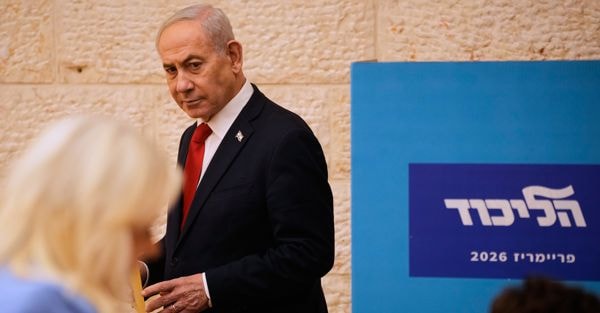
Il primo ministro israeliano Benjamin Netanyahu vota alle primarie del suo partito, il Likud, in vista delle elezioni generali israeliane di ottobre, a Gerusalemme, lunedì 17 agosto 2026. (AP Photo/Ohad Zwigenberg, Pool)
20 August 2026
Egypt is working with Iran and Oman to reopen the Strait of Hormuz
Egypt is in contact with Iran and other regional and international parties as part of efforts to ease tensions and restore navigation in the Strait of Hormuz, and is pushing for a resumption of negotiations. This was stated by the Egyptian Foreign Minister, Badr Abdelatty, to Al Arabiya. Cairo, he added, is also working with Oman to draft a joint statement to restore freedom of navigation in the Strait of Hormuz. Abdelatty warned that “further escalation could have serious consequences for regional security and the global economy, particularly as disruptions to maritime routes threaten supply chains and energy markets”. Egypt has also taken part in discussions on a proposal for a multinational maritime coalition to protect shipping in the Red Sea and at Bab el-Mandeb from Houthi attacks. Cairo, he clarified, “is carefully assessing the proposal”, said Abdelatty, particularly the agreements that might involve military commitments, before deciding whether to participate. Turning to the situation in Gaza, the minister reported that “progress has been made among the Palestinian factions on the principle of registering and handing over weapons”, which would be handed over to the National Committee for the Administration of Gaza (CNAG). However, the details and implementation mechanisms are still under negotiation. Cairo is working with Doha, Ankara and Washington to encourage the Palestinian parties to honour their commitments. Finally, it has asked the CNAG to temporarily administer Gaza pending the deployment of an international stabilisation force.
20 August 2026
The war in the Middle East in pictures
Guerra in Medio Oriente - 20 agosto 2026
Photogallery16 foto
20 August 2026
Tehran: economic war will be the US’s next failure
“Military war has failed to deliver results, so now they’ve dubbed the next failure ‘economic war’.” This was the comment posted on social media by Iran’s Deputy Foreign Minister, Kazem Gharibabadi, following US President Donald Trump’s announcement. “They claim that Iran is on the brink of collapse and hanging by a thread, yet they are begging all their allies to help them! The problem is their miscalculations. Every time they try to cover them up, they end up creating an even bigger failure for themselves,” he said.
20 August 2026
IDF evacuates West Bank outpost; clashes with settlers
Overnight, the IDF evacuated an illegal outpost near the Palestinian village of Deir Istiya, in Area B, south of Nablus in the West Bank, and violent clashes broke out with settlers. This was reported by military radio. Following the evacuation, some of the settlers erected a roadblock using stones at the adjacent junction and threw stones at Palestinian vehicles and law enforcement officers, who responded with crowd-control measures. Some Israelis attempted to set fire to Palestinian trees. Four Israelis were arrested by the police.
20 August 2026
General Camporini: Italia must remain vigilant; the EU must find defence strategies, but I am cautious about offensive action
“Iran does not currently have the capability to strike US bases in Europe directly from its own territory. Nor does Europe. But this does not rule out the possibility that it could do so through terrorist acts, given its links with proxies throughout the West. Nothing prevents a sleeper cell from carrying out such an action, but it is a different matter from a missile attack”. This was stated by General Vincenzo Camporini, former Chief of the Defence and Air Force Staff, in an interview with *Il Corriere della Sera*, adding that the threat “from a ballistic point of view does not exist, at least for the time being. They do not have the capability to strike Europe from a distance of over 3,000 kilometres. With the arsenal at its disposal, Iran could reach as far as the centre of Greece, at most, in the worst-case scenario”. “Currently, there are attack systems – including drones – that offer a wide range of options for striking European bases, but this assumes an attack carried out by individuals who are already in the vicinity of the targets. Let us imagine, for example, someone who wants to launch one of these devices at a complex such as the one at Sigonella and who is already in the vicinity of the base. But here, as mentioned, we are entering the realm of terrorist risk, which can be countered by intelligence and police services. “This is an area in which, to date, Italia has proved to be one of the best countries in terms of prevention, whilst some partners have been somewhat less so,” added Camporini.
20 August 2026
Pasdaran: ‘In the event of another war, our weapons will be more destructive’
“The destructive power of the warheads used in the missiles of the Revolutionary Guards far exceeds that of the models used in previous wars and, should a war break out, our weapons would be completely different from those of the past in every respect. Should a new war break out, we will use more destructive weapons.” This was stated by Brigadier General Hossein Mohebi, spokesperson for the Revolutionary Guards. The news was reported by the Iranian state broadcaster IRIB. “We are making progress day by day in all areas of armaments and are producing weapons that are more precise, more destructive and technologically more advanced,” he added. “Should a new war break out, our weapons would certainly be different from those of the past; this difference could be reflected in the type of warheads, the accuracy of the strike, the range of the missiles or in any other area.” The Revolutionary Guards’ spokesperson stated that the Islamic Republic of Iran has never ceased to produce and develop weapons, adding: “We are making progress every day, and any possibility in this regard is conceivable.”
20 August 2026
Tehran executes man who took part in the January protests
Mizan, the Iranian judiciary’s news agency, has announced that the death sentence handed down to Qaem Hosseini, a protester involved in the demonstrations last January, has been carried out. The man was described as a “foreign national”, without his nationality being specified. Hosseini had been accused of “involvement in the crime that took place in Alikhani Square in Isfahan”. According to reports, he allegedly “drew a weapon and spread terror, created widespread public insecurity, and acted against the physical integrity of individuals and national security”.
20 August 2026
Iran: CNN reveals war toll: over 750 American soldiers wounded and 18 killed
The number of American military personnel wounded 757 since the start of the war against Iran stands at 18. This is according to CNN, citing the US Department of Defence, which has updated the figure to include over 50 new casualties. According to the Defence Casualty Analysis System (DCAS), combining the data relating to Operation ‘Epic Fury’ with that included in the new ‘Overseas Operations’ category, since the start of the war against Iran on 28 February, 18 American service personnel have died and 757 have been wounded. Last month, the Pentagon created the ‘Overseas Operations’ category to record service personnel killed or wounded ‘from 7 July’. This date coincides with the day on which President Donald Trump’s administration notified Congress, via a notification required under the War Powers Act, of the start of a new conflict with Iran.
20 August 2026
Araghchi: ‘Economic D-Day’ is a US ploy to hide its own crisis
The so-called ‘economic D-Day’ announced by US President Donald Trump against Iran “is a diversion to draw attention away from the crisis in the US: unprecedented debt and sky-high interest costs”. This was written on X by the Iranian Foreign Minister, Abbas Araghchi. “Insisting on failed policies will only lead to further defeats and the hostility of the Iranian people. US economic terrorism threatens the global economy and worldwide sovereignty,” he added.
The so-called "Economic D-Day" is a diversion from America's own crisis: unprecedented debt & surging interest costs.
— Seyed Abbas Araghchi (@araghchi) August 20, 2026
Doubling down on failed policies will only bring further defeat—and enmity of Iranians. US economic terrorism threatens global economy and sovereignty worldwide pic.twitter.com/Qj5SzVBjvX
20 August 2026
Ambassador Fertitta: “The situation in Hormuz will be resolved”
During the Genoa leg of his tour of the Italian coastline, the US Ambassador to Italia, Tilman J. Fertitta, stated: “I think we all know that the situation will be resolved”, referring to the Strait of Hormuz. “Of course, the situation is very complicated”, he continued, explaining that “the president wanted to get rid of a horrific regime that does not allow people to protest”. “As journalists,” Fertitta continued, “you have read the stories of young people, such as the wrestler or the young athlete, who were executed.” The ambassador said, “I respect Donald Trump and I appreciate his leadership in saying that we must get rid of this regime, and I support him 100 per cent.”
20 August 2026
Iran: US covert operation to transport oil through the Strait of Hormuz
According to Axios, the US military “has quietly established a shipping corridor into and out of the Strait of Hormuz to transport millions of barrels of oil every day”. Two officials told Axios that this was “a remarkable success, even though the war as a whole remains at a standstill”, saying that “As part of the operation, which has been underway for several weeks, 15–20 oil tankers enter and exit the strait every night via a southern channel along the coast of Oman”. “Around 10 million barrels of oil a day – roughly half the pre-war volume – are being transported out of the strait and fed into the global energy market,” the officials said. Axios reports that “The US-led operation is mitigating one of the most painful aspects of the war: the disruption to oil supplies that has sent crude prices soaring”. Although the volume of oil passing through the strait is still below pre-war levels, according to officials quoted by Axios, it is having a tangible impact on global supplies. “The US military is helping empty oil tankers to enter the Gulf from the Arabian Sea via the strait, to load oil from countries in the region and then to leave.” It has been revealed that the Americans have been controlling the southern corridor of the Strait of Hormuz for two months. “The Islamic Revolutionary Guard Corps may be a problem, but it does not control the strait. We control it”, the officials concluded.
20 August 2026
Trump declares economic war on Iran
“No one has offered the Islamic Republic of Iran a better opportunity than mine to reach an agreement. Tragically for them, they failed to seize it. Therefore, today I am announcing the most devastating economic operation ever undertaken against a country! It will be an economic war and an unprecedented isolation.” These are the words of US President Donald Trump on Truth, in which he announced that “any country that allows its financial institutions, businesses, airports or government bodies to offer Iran a lifeline will in turn face tremendous economic consequences”.
Trump went on to say: “Oil smuggling, money transfers, currency exchange bureaux, shipping registers, front companies: all of this must stop now. You know full well who you are. This will be an economic D-Day, and we need all our allies to stand shoulder to shoulder with the United States to isolate and defeat the threat posed by Iran. These fanatics are on the ropes; these historic measures will bring them to their knees, paralysing their ability to spread terror across the world. Iran will never have a nuclear weapon.”
