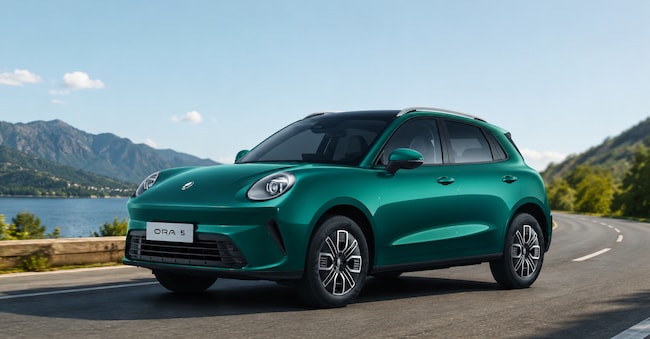
Interni Ora 5
Stepping into the Ora 5 evokes mixed feelings. On the one hand, one appreciates the attention to detail in terms of materials, fittings and technology. On the other, there are some reservations regarding the amount of space relative to the car’s external dimensions, as it doesn’t feel like you’re in a car nearly four and a half metres long. In detail, the layout features a 14.6-inch central display, a 10.25-inch digital instrument cluster, a dashboard and seats in synthetic leather with recycled materials on the higher-spec versions, a retro-inspired physical gear selector, ambient lighting with up to 64 colours, and 50W wireless charging (on the Premium trim). With a screen measuring almost 15”, connectivity features include wireless Android Auto and Apple CarPlay, online navigation, over-the-air updates, a remote control app, front USB ports (Type A and C) and rear USB ports (Type C), and smart voice control. There’s no shortage of practical features, such as 33 storage compartments, a dual-level centre console and an illuminated mirror, with lighting levels fit for a beauty influencer.
Now available with 5 engine options
A key strength is its truly multi-energy range, starting with the 1.5-litre petrol engine producing 160 cv, paired with a 7DCT gearbox. The most interesting version is the Full Hybrid, delivering 223 cv and 476 Nm, which combines a highly efficient 1.5-litre turbo engine, a 1.09 kWh lithium-ion battery and a two-speed DHT gearbox, automatically switching between six different operating modes that alternate between electric and combustion power. The result is a 0–100 km/h time of 7.7 seconds with average fuel consumption of 5.1 l/100 km and a total range of over 1,000 km on a single tank, with no need for plug-in recharging: the battery recharges itself during braking. The 100% electric variant, producing 204 cv, is fitted with a 58.3 kWh battery, offering a range of up to 435 km in the WLTP combined cycle, with DC charging from 10% to 80% taking around 30 minutes, and a V2L function to power external devices.
Fine-tuning for European roads
One of the main problems with Chinese cars is their road tuning. The reason for this is linked to differences in road conditions and driving habits. The result? Soft suspension set-ups, imprecise steering and significant body roll. To resolve this issue, the Ora 5 has been fine-tuned in Italia and Spain by Racing Syn, a motorsport engineering firm, to align its handling and driving pleasure with European preferences. The car features MacPherson strut front suspension and multi-link rear suspension, optimised with stabiliser bars to reduce body roll, Bosch electric power steering, and Kumho tyres have been chosen for the European market (avoiding Chinese tyres of dubious quality) to strike a balance between grip, comfort and quietness, in line with the driving pleasure expected by customers on the Old Continent. The multi-layered sound insulation and carefully engineered aerodynamics ensure a quiet, premium-feel interior.
Current Prices 5
Starting with the petrol version, prices start at around 27,000 euros for the Origin trim and rise to around 29,000 euros for the Premium. Moving on to the full hybrid, prices start at 28,600 euros and go up to 30,600 euros. Finally, the all-electric version ranges from €36,000 to €38,000. Standard features across all versions include automatic headlights and LED rear lights, automatic windscreen wipers, 18-inch alloy wheels, roof rails, an active front grille, keyless entry with push-button start and a Smart Key. Digital features include a dual-display setup with a 10.25-inch instrument cluster and a 14.6-inch multimedia screen, wireless Android Auto and Apple CarPlay, smart online navigation, front and rear USB sockets, and a climate-controlled storage compartment. Comfort features include a 6-way power-adjustable driver’s seat, heated front seats, a 4-way adjustable leather steering wheel, automatic climate control, rear air vents, automatic demisting, a dual-level boot and a boot cover. The Premium trim adds electrically folding wing mirrors with automatic locking and defrosting, an electric tailgate, a 9-speaker audio system, 50 W fast wireless charging, eco-leather seats with 3D-Mesh inserts, electric adjustment for the front passenger seat as well, ventilated front seats, driver’s seat memory with easy-entry function, heated steering wheel, an auto-dimming rear-view mirror, dynamic 64-colour ambient lighting, one-touch windows on all four windows, tinted rear windows and a panoramic sunroof – the latter of which can only be operated via touchscreen and not via the overhead light, despite the presence of physical buttons; the mysteries of Chinese cars.
Hour 5: How does it handle on the road?
Tested in the 100% hybrid version, it is fitted with a 160 cavalli 1.5-litre turbo petrol engine combined with an electric motor, delivering a total power output of 223 cavalli and 476 Nm of torque. Paired with a two-speed automatic gearbox and a 1.09 kWh battery, it has a top speed of 185 km/h, acceleration from 0 to 100 km/h in 7.7 seconds, combined cycle fuel consumption of 5.1 litres per 100 km, CO₂ emissions of 117 g/km and a kerb weight of 1,660 kg. On the road, its greatest strength lies in the smooth operation of the hybrid system, which is capable of running on electric power for most of the time thanks to the battery’s high charging and discharging speed, despite its limited capacity. In terms of driving dynamics, the tuning carried out in Italia and Spain is commendable, offering a higher standard than many Chinese cars, particularly for a debut model. It remains, of course, an SUV designed for comfort rather than sporty driving, with steering that could be improved in terms of precision. During an initial test drive of around 100 kilometres, carried out almost entirely on extra-urban roads, the Ora 5 proved to be well-balanced, with good overall sound insulation and moderate fuel consumption, confirmed by an average of 6 litres per 100 kilometres achieved without any particular focus on economy. The infotainment system also performed well, having become a key strength of most cars imported from China.