
Dia in the hackers’ sights; alleged anti-Mafia files on sale on the dark web: ‘222 MB archive’
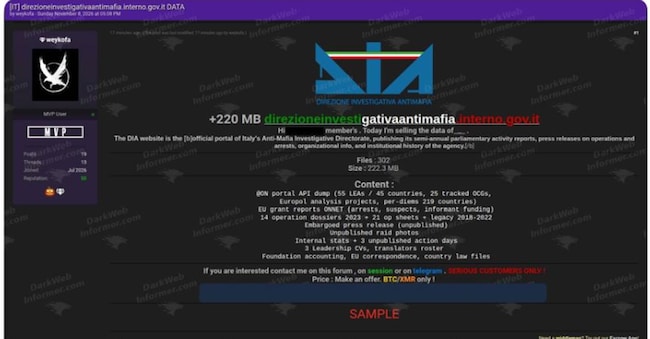
A seller going by the name “weykofa” claims to have stolen 302 files from the Anti-Mafia Investigation Directorate. The list includes operational dossiers, information on 25 criminal groups and Europol material. However, there is currently no confirmation of the authenticity of the documents

Key points
A 222-megabyte archive. According to the person who put it up for sale, it is said to contain part of the Anti-Mafia Investigation Directorate’s information resources: operational dossiers, investigation files, information on 25 organised crime groups, reports relating to Europol and even internal material that has never been published.
The advert appeared on the dark web under the name of a seller who goes by the handle ‘weykofa’. On Sunday 8 November, at 6.41 pm, the alleged breach was reposted on X by Dark Web Informer, an account specialising in monitoring underground online markets. However, the same account included a crucial caveat: the claim remains unverified.
What might the data allegedly stolen from the DIA contain?
The seller mentions 302 files. If confirmed, the description of the archive reveals the scale of the potential target: intelligence information relating to 25 criminal organisations, operational dossiers and investigative documents, correspondence with European institutions, and material linked to Europol.
The list also includes photographs of operations that have never been published, press releases still under embargo, internal statistics, personnel data and financial documentation.
However, the material made public does not contain a sample of documents that is legible enough to allow for independent verification. This means that it is currently impossible to determine whether the archive actually exists, whether the files are genuine, or whether the seller has pieced together documents already in the public domain to fabricate a false data leak.

