
Hands, factories and the art of craftsmanship: the product takes centre stage once more
In the age of AI, brands are rediscovering the value of production processes, skills and craftsmanship. From Nike to Volvo, and from Apple to Mulberry, the behind-the-scenes story is taking centre stage in their campaigns

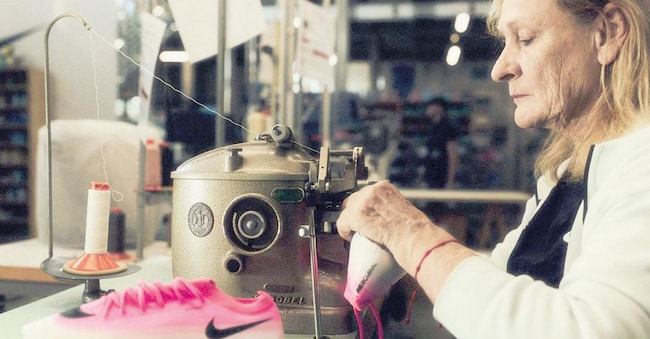
Thirty-five production stages over three hours of work. Nike chooses to convey speed through its apparent opposite: time. The time taken by expert hands, millimetre-precise stitching, materials crafted with precision, and repeated movements. It does so by allowing cameras to enter its workshops in Montebelluna, a town of thirty thousand in the Treviso area, where technical footwear is crafted for top-level athletes. The docutelling piece ‘Where speed takes time’ brings together craftsmanship, innovation and production. We see hands, materials, tools, details, testing and the manufacturing process. The speed of the champions stems from the patience of the artisans and is portrayed over the time it takes to create it. The American giant has been operating here since 1996, housing 300 pairs of bespoke lasts, made to the exact measurements of footballers such as Cristiano Ronaldo and Kylian Mbappé. Despite all the technology involved, the human touch is still needed to transform a prototype into a masterpiece, as the documentary emphasises. This is a shift that is sweeping through contemporary marketing: in the age of generative artificial intelligence, which allows perfect images to be produced in a matter of seconds, there is growing interest in what requires skill and experience.
Her Majesty Matter
In short, marketing is getting its hands dirty again. Fewer pixels and more substance. The product is taking centre stage once more, and the ‘making of’ has become the new advertisement. In America, the latest issue of *Vogue* has popularised the concept of ‘effort signalling’. It is the choice to make visible the effort and human labour required to create a product. It is the era of ‘real marketing’, a return to substance after years dominated by imaginary worlds and synthetic content. ‘It is a reaction to a world in which telling stories has become infinitely easier than doing. For over a decade, brands have built value through purpose and experiences. Today, however, images, stories and symbolic worlds can be produced by anyone, at virtually no cost and on an infinite scale,” says Stefania Siani, President of the Italian Art Directors Club and CEO and CCO of Serviceplan Italia. The most interesting campaigns no longer build a story around the object, but uncover the story already contained in the way it is designed, built or used. What becomes scarce – and therefore precious – is that which cannot be generated by a prompt. This is why the product is returning to centre stage. Not as a commercial demonstration, but as a source of truth.’ The behind-the-scenes becomes the content in a new creative grammar in which hands become the medium. ‘Showing a workshop or a factory makes visible the system of knowledge behind a product. This is why the process becomes storytelling. The ‘how it’s made’ is an increasingly important part of the ‘why choose it’. The production process becomes content for economic and cultural reasons: it reveals the origin of value,’ adds Siani.
Inside the factories
This journey around the world begins with a bar of soap. In India, Pears opens the doors to its factory and shows how its transparent soap is made: from liquid glycerine to the moulds, right through to cutting and quality control. For the past few days, Apple has been showcasing the features of the MacBook Air through ‘Tabs’: the product itself becomes a demonstration of its performance. In England, the historic leather goods brand Mulberry sets its ‘Rooted in craft’ campaign amongst the workbenches of its factory. Artisans’ hands cut, sew and assemble bags under the lens of photographer Tim Walker. In Sweden, Volvo showcases design, engineering and safety in its campaign for the EX60, transforming the factory into a documentary-style narrative. In Italia, Altagamma has launched “Noi, made in Italy”, even highlighting the sounds of the manufacturing processes. This trend also emerged at the latest Cannes Lions: there, Adidas developed Supernova Adaptive in collaboration with athletes with Down’s syndrome and other disabilities. Plenitude, with Dark Mode Ads, has redesigned digital communication to help reduce the energy consumption of LED billboard screens and turned the project into an open innovation platform. De’Longhi has transformed working machines into handcrafted ‘Tiny Coffee Shops’. “Innovation by design has emerged: creativity is not limited to conveying a value, but incorporates it into the design. In a world saturated with content, an idea becomes surprising again when it does not merely produce a message, but tangibly alters an object, a process or a behaviour,” says Siani.
Antidotes to craft-washing
The challenge is to take the time needed. “The lesson for brands and creative agencies is that the product is not a limitation, but their most credible territory. We need to get to know it in depth once again: visit factories, talk to designers, technicians and craftspeople, and understand materials and manufacturing processes. Advertisers will need less superficiality and more curiosity about design, industrial culture and the ability to observe.’ But we must sift authentic communication from the risk of ‘craft-washing’, that is, craftsmanship that is merely for show. ‘It is not enough to film a hand or use an artisanal aesthetic: we must show who does what, with which materials, skills and consequences for the final product. The aim,’ concludes Siani, ‘is not to make the production process spectacular, but to find within it a truth capable of becoming an idea. Because the most surprising communication does not obscure the product. It reveals it.’

