
Harnessing restorative justice as an opportunity for inclusion and a future
The Mariuccia Nursery School Foundation has honoured Marta Cartabia for her commitment to this cause

Key points
See restorative justice as an opportunity for a fresh start, change and inclusion does not mean turning a blind eye to the offence or abolishing punishment, but rather attempting to forge a path towards holding offenders accountable, recognising victims and strengthening social bonds.
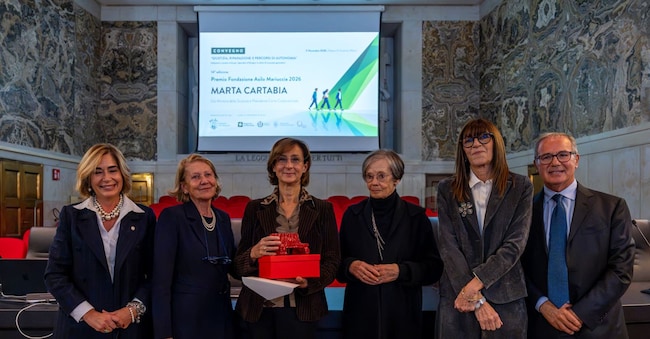
This was the central theme of the debate that characterised the meeting ‘Justice, redress and pathways to independence’, organised by the Fondazione Asilo Mariuccia and held in conjunction with the presentation of the award of the same name to Marta Cartabia. The legal scholar, former Minister of Justice and former President of the Constitutional Court, was recognised for her great commitment – thanks to her well-known reform – to systematising a concept that already existed in potential within the Italian legal system, as enshrined in the Constitution. And, as Emanuela Baio, president of the Foundation, emphasised, this embodies the importance of ‘not dwelling on mistakes or vulnerability, but instead creating the conditions for everyone to regain confidence in themselves’.
Repair and refurbishment
This is nothing new: it is gaining ground in courtrooms, yet draws on ancient culture, runs through the works of Dante Alighieri, and extends right up to the present day. ‘Restorative justice moves away from the logic of action and reaction to align itself, instead, with the need for reconstruction. One could almost speak of “regenerative justice”’, commented Cartabia in her lectio magistralis. “Especially with young people, it is not through fear, nor by harsher penalties that change is achieved, but through tools that can open the door to a different future and by attempting to understand the motivations behind their actions’.
The idea of reparation, which, in Cartabia’s words, is not a contradiction but a complement to the need for justice, takes the form of ‘a process that focuses on the responsibility of the perpetrator, the victim’s suffering and the possibility, for both, of freeing themselves from a cage. A path full of obstacles, twists and turns, and setbacks, yet aimed at restoring a sense of perspective to those who risk becoming trapped in a present that could become the limit of their lives’.
Creating value for society
Because reintegrating and starting afresh involves coming to terms with reality, not forgetting or repressing it. And it depends on the chance to pursue a new life: ‘Making amends means facing up to the harm one has caused; it is not a form of protection,’ insisted Chiara Valcepina, vice-chair of the Lombardy Region’s Planning and Budget Committee. “We must certainly recognise the punishment, but we must create the conditions so that the ‘guilty’ person can become an asset to society. Reintegration is not do-goodism but a clear policy of social cohesion. And those who are left behind, those who are abandoned, almost inevitably end up posing a security risk to the community, because they reoffend’.

