
Hatfield House: a dialogue between music and architecture
From Mozart to Brahms, via Britten and Shostakovich: four musical worlds for the opening concert of the Hatfield House Music Festival

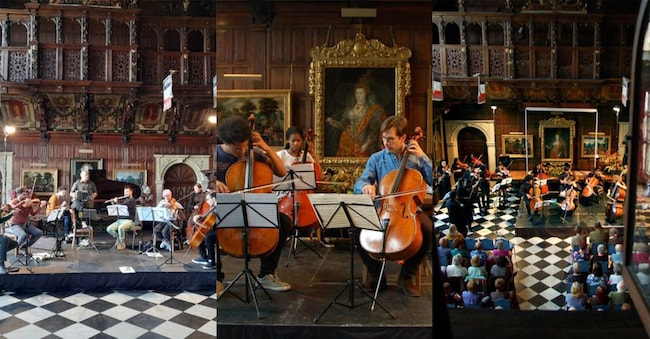
There are places where music seems to take on an extra dimension. The architecture is not merely the backdrop to the performance, but becomes part of the listening experience, suggesting connections, evoking memories and altering one’s perception of sound. This is the case at Hatfield House, where the fifteenth edition of the Music Festival, directed by Guy Johnston, opened on 8 October with a chamber music programme spanning three centuries of musical history, bringing together works by Mozart, Benjamin Britten, Dmitri Shostakovich and Johannes Brahms.
Within the grandeur of the Marble Hall, music encounters a space steeped in history, where the architectural splendour invites a listening experience that engages both auditory perception and aesthetic sensibility. One is invited to step inside the soundbox of an instrument, which captivates both performers and audience. The relationship between the venue and the repertoire thus becomes a key to understanding the concert: four different languages, four ways of conceiving form and expression, united by chamber music’s ability to transform the dialogue between instruments into an experience of intense concentration.
Mozart: the grace and intimacy of the flute
The programme opens with Mozart’s Flute Quartet in D major, K. 285, in which melodic grace, transparency and expressive restraint find their ideal expression in the dialogue between the flute and the strings. The flautist Katherine Baker is called upon to weave her voice together with those of the strings, without ever compromising the ensemble’s balance. The Adagio in B minor is particularly intense, in which the melancholy and delicacy of the phrasing reveal the emotional depth concealed behind the apparent simplicity of Mozart’s composition.
Britten: Form as Transformation
In Benjamin Britten’s *Phantasy Quartet*, Op. 2, the musical language becomes more fluid and articulate. Christopher Cowie’s oboe engages in a dialogue with the violin, viola and cello in a single movement, where rhythmic contrasts and thematic transformations combine to create a constantly evolving form. The performers are required to pay particular attention to the relationships between the parts, so that the variety of moods maintains coherence and continuity.

