
Headshots: the hidden neurological risks in contact sports
Tommaso Clerici's investigation into the cerebral consequences of disciplines such as boxing, football and rugby

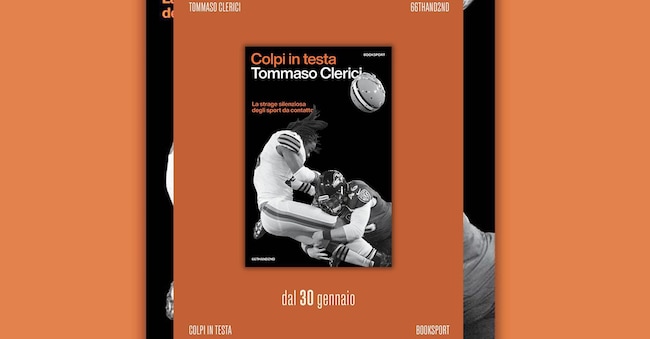
At first glance, Tommaso Clerici's book might seem a little disturbing. 'Blows to the head', the silent massacre of contact sports, in fact points the spotlight on those sports that, in some cases, can cause undesirable effects - sometimes transient, sometimes chronic - on the brain, on the central nervous system with its reverberations on the mind-body whole of an athlete. Clerici, with a very well-documented book-investigation, goes to select precisely those sports where physical contact is strongest, especially to the head, to understand and explain if, but above all when, the consequences for athletes are too high a price to pay for a spectacle that is beautiful, noble and enthralling: when, in short, the price of the ticket and the enjoyment of the public do not justify the (self)destruction of a person, who is making a free choice when he decides to devote himself to a certain sport, and perhaps to make a (more or less lavish) financial gain from it.
Boxing, first and foremost, but also American football, wrestling, mixed martial arts (MMA), rugby, hockey, even football. For each of these disciplines, the author - a writer and journalist for the online sports magazine 'Ultimo Uomo', himself a boxing enthusiast and practitioner - recounts the stories of athletes, some of them very famous, who have seen their lives turned upside down by the effects of the blows they received in the numerous matches of a career that may have been luminous, but which - once the limelight went out - turned into a nightmare and a burden that was sometimes too heavy for their health.
The worst bogeyman is the so-called Cte, i.e. chronic traumatic encephalopathy, a neurodegenerative disease that is, unfortunately, currently only detectable post mortem, but whose signs are alarm bells even in life: fading memory, depression, unmotivated anger, outbursts of anger and violence, confusion, unconscious gestures and more. Episodes of which the book speaks, naming and shaming athletes from the four corners of the globe, and whose stories are compared and assessed by numerous experts and top sports physicians.
An honest approach to the problem
Clerici's approach is, we believe, of great interest and intellectual honesty: the author is not an opponent as such of the sporting disciplines recounted in the book, on the contrary: he is a sincere enthusiast of them. The introduction to the text recounts his love for boxing and his knowledge of this environment from the inside. This does not detract from the fact that - precisely in order to ensure that these disciplines live on, limiting the disabling consequences for athletes as much as possible - a documented and honest investigation must and can make readers and athletes themselves understand what is at stake in the delicate but fundamental balancing act between health and career. Precisely so that in no context should one have to choose between work and life, between success and the possible harmful consequences of sporting competition pushed to the extreme limit.
Concussions, the book reminds us, have been investigated since the days of ancient medicine, but it was a number of US doctors who, during the 20th century, came to the decisive realisation that single or repeated blows to the head cause multiple haemorrhages in the deepest parts of the brain, causing damage to the brain tissue (which appears bruised, swollen and atrophied), up to Dr Bennet Omalu, who identified the Cte syndrome: the American doctor discovers that, over time and after repeated trauma, the tau proteins present in the brain leak out and accumulate, creating clots that suffocate the brain cells, decreasing their effectiveness and efficiency, before killing them outright in an effect very similar to that seen in Alzheimer's patients.


