
Health record: online booking, ticket payment and access to reports by 2024
It will also be possible to choose or revoke a general practitioner. Artificial intelligence is also in the field

5' min read
Key points
5' min read
The Electronic Health Record 2.0, one of the great bets on digital health, together with telemedicine, launched by the National Recovery and Resilience Plan that invested 1.3 billion, after years of dormancy since its first launch back in 2012, has - the Government guarantees - finally been put into turbo mode, and by the end of this year Italian citizens will be able to access a package of four basic services: consulting documents, booking services, choosing and withdrawing a family doctor, and paying for services through the Pago PA platform or App IO. While a 'dashboard' accessible to all on the website of the Digital Transformation Department will offer a detailed overview of the use of the ESF by users and professionals of the SSN.
Butti and Gemmato's ad
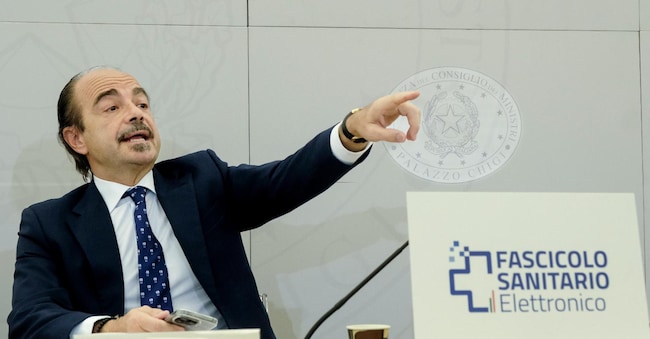
The announcement was made by Alessio Butti, undersecretary to the Prime Minister's Office for Innovation, and Marcello Gemmato, undersecretary to the Ministry of Health, with promises to bring the regions that are still struggling up to speed with the seventeen that are already well underway. Who in Rome also presented the new logo of the Fse 2.0, to mark the change of pace that - they promise - in 2026 when the Pnrr expires will crown Italy 'the first country in Europe to create a new medium for Italian healthcare, equipped with a complete Personal Health Record,' warned Butti. Translated: a 'container' available and accessible to every citizen throughout Italy, repository of crucial health information such as hospital discharge letters, emergency room records, laboratory reports, and electronic prescriptions. In full protection of privacy, while the National ESF Portal, which, integrated with those of the Regions, "will represent the unified access point to the regional ESFs, simplifying the consultation of health information by citizens and operators throughout the country", announced Butti, should already be off the ground by the end of this year.
Software Adaptation
.A decisive factor in the change of pace of a tool such as the electronic health record, which was dormant until two years ago and mirrors the different speeds at which our healthcare system travels, is the sprint in the technological upgrading of the software that produces the documents that feed the ESF and that must necessarily be communicating (in jargon 'interoperable'): if in June 2023 only 23% of installations had been updated, today the figure has risen to 50% and the prospect is that between June and July of this year all the regions will comply with the targets set in the first step of the NRP. In detail, the snapshot after the flanking action by the Digital Transformation Department certifies more than one thousand hospitals, ASLs, and other territorial structures - 51% public and 49% private - involved by 2023 in the adaptation of software to the new national ESF 2.0 standards, while 'thousands more' are in the process of being enlisted.
How much is the Electronic Health Record used
.But taking on board and using the Health File is also a matter of 'culture', for citizens as well as for doctors and other professionals - 666,000 are to be trained according to the NRP - and for healthcare companies. And here we are at work in progress, as the latest data (May 2024) of the Osservatorio Sanità digitale (Digital Health Observatory) of the School of Management of the Politecnico di Milano show: in the last year, 35% of specialist doctors and 48% of family doctors have accessed the Fse, which is considered a useful tool because it reduces the time needed to retrieve information, simplifies the reading of exchanged documents, provides critical information for the management of patients in emergency situations, and allows more personalised decisions to be taken based on the patient's entire medical history. Despite the fact that the availability of information on the ESF is still limited, the number of citizens who have accessed it has risen from 35% to 41% in one year. However, according to the Observatory Report, there is still a high percentage of facilities that do not feed the ESF with the data collected or that often upload data in an unstructured format.
Monitoring
.These are the main critical issues that are still open and need to be addressed, in order to design the new Health Data Ecosystem (HED) by 2024, the 'federated architecture' between central administrations, regions and healthcare companies, which is necessary to manage standardised data at national level, accessible both to doctors - who will also be able to use artificial intelligence algorithms in the future - and to the regions, which will then be able to design prevention campaigns based on 'real time' data of their patients, rendered anonymous to protect privacy. "Standardised 'big data', also useful for scientific research bodies.

