
Hearts made in Vicenza for the training of young surgeons
Reanatomy 3D prints organs so realistic and detailed that the surgical act can be simulated, even in preparation for complex operations
by Barbara Ganz
3' min read
3' min read
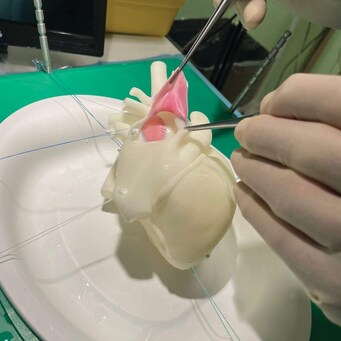
An industrial paint factory in Castegnero, countryside south of Vicenza, between the Berici Hills and the Euganean Hills, has been home since the end of 2023 to a high-tech innovative start-up with accounts already in the black. Here, in a laboratory housed in the industrial space of one of its four partners, they produce 3D-printed human hearts so realistic and detailed that they allow the simulation of the operating act. They are intended for hospitals, universities and research centres, to enable young heart surgeons to be trained, but are also made on request, to enable particularly delicate operations to be prepared on an organ that exactly reproduces the pathology to be treated.
The objectives
.Reanatomy was born from two different skills that turned out to be complementary: that of Alessandro Meggio, an illustrator from Vicenza, and Alessandro Frigiola, an internationally renowned heart surgeon and founder of 'Children with heart disease in the world', which has been on the front line for decades to reduce child mortality due to heart disease, promoting the training of young colleagues especially in less developed countries. "I started with manga, then I specialised in human anatomy," says Meggio, "I illustrated articles and covers of international magazines. I have known Frigiola for 30 years, and at one point he explained to me that there was a need to print anatomical organs as similar as possible to the human heart, but potentially also to other organs. For a surgeon in training, this means a higher learning curve than silicone models allow'.
Frigiola is also the creator of the Esculapio Project, for the training of young cardiac surgeons from different parts of the world: "Training by means of simulators realised in 3D Printing," he explains, "is a valuable resource to accelerate the training of qualified medical personnel. These aids allow heart surgeons to practice an unlimited number of times to improve their operating technique and can be produced in different sizes, recreating the real pathological conditions they will encounter in the operating theatre'.
The Outlook
.In addition to faithfully replicating morphologies and tissue characteristics, in fact, Reanatomy models offer an extremely accurate representation of cardiac pathologies. The products therefore - which achieve 90-95% affinity with human organs - are not only used for training young surgeons, but also for increasingly accurate surgical planning.
And that's not all: in the lab, Meggio has just put down his mask and gloves: 'I finished by printing a heart with a specific pathology, tetralogy of Fallot, a complex congenital heart disease. More and more often we receive requests from clinics and hospitals to solve very complicated clinical cases, such as paediatric malformations, which involve operating with very small margins. In these cases, the surgeon asks to have 'in hand' the 3D-printed reproduction of the anatomical part to be operated on, taken from the patient's CT scan, in order to understand how to intervene". The result is available within a few days.

