News

Heat, wind and rain: increasingly extreme weather events

From the 2010-2023 trends based on 3bmeteo data, extreme events are on the rise, the North is affected

by Marta Casadei and Michela Finizio

4' min read

4' min read

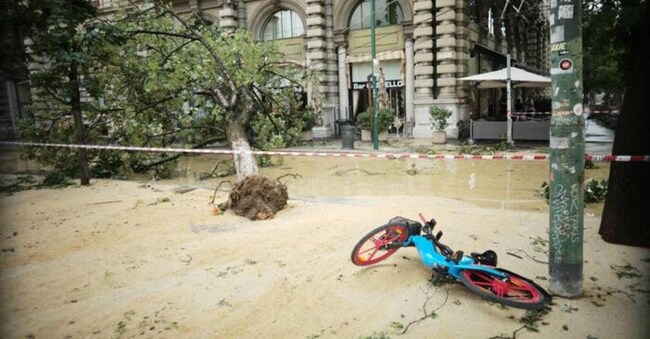
Peaks of 300 millimetres of rain in 48 hours caused the overflowing of 21 rivers and widespread flooding in 37 municipalities in the provinces of Forlì-Cesena and Ravenna last May, with damage to the territory amounting to some nine billion euro. The flooding in Emilia Romagna was just one of the extreme weather phenomena of 2023: on 24 July, Syracuse reached a temperature of 47° C, while only a few hours later in Pordenone the largest hailstone ever recorded on the continent fell. On the same night, around 4 a.m., the province of Milan was scourged by winds of over 100 km/h and torrential rain.

Recording the growth of extreme events are the 3bmeteo data processed by the Sole 24 Ore research office: from the analysis of climate surveys in 112 capital cities emerges the moving average of weather indicators by macro-area and its trend from 2010 to 2023. "For scientific findings, more years would be needed. But the 10-year time series already offers numerous indications of the changes taking place in recent years," says Alessandro Conigliaro of 3bmeteo.

Loading...

Extreme heat

.

First of all, over the past thirteen years, rising temperatures have led to an increase in heat waves - which are defined as such when the temperature exceeds 30 degrees for at least three days in a row - and extreme heat peaks, i.e., the exceedances above 35 degrees perceived during summer periods. "The arrival of very sultry subtropical air masses has accentuated these phenomena in the North, where the low ventilation rate increases the perceived temperature and reduces people's climatic comfort," says the 3bmeteo expert.

Last year in the cities of the North there were on average 19 consecutive days over 30 degrees more than in 2010 (6.4 heat waves of three days each), for a total of 47.4 consecutive days of heat: in practice 15.8 waves compared to 9.4 in 2010. Thus, the North is gradually aligning itself with the data of the other regions, where these phenomena were already more frequent: in the Centre, the number of heat waves recorded rose from 15.4 to 19, while in the South the increase was 3.5 events in 13 years.

The increase in temperatures also translates into increasingly marked extreme heat events: there were 17.4 more days on which temperatures reached (or exceeded) 35 degrees in the South, which rose from 3.2 to 20.6 per year; 14 more in the Centre, where they rose from 3.2 to 17.2 episodes; and 11.7 more in the North, where temperatures rose more than in the South as a whole. Here, days of extreme heat in 2010 had been virtually absent, a total of just 0.2 days on average in northern cities.

Less rain but more intense

Even when analysing the rainfall figures - which are also decreasing, across the board - the focus falls on the most intense phenomena. The number of rainy days with an accumulation of more than two millimetres per hectarage band is in sharp decline in all geographical areas. The most worrying situation is in the North, where rainy days have dropped from 109 to 65 on average per year (-44 over the period), while in the Centre and South there are 24.5 and 11 fewer respectively. In this scenario, however, extreme rainfall, i.e., days on which more than 40 millimetres of rain fall in six hours, is down considerably less in the North (-3.4) and in the Centre (-2.1) with substantial stability in the South (-0.9). "In the North," explains meteorologist Conigliaro, "the persistence of periods of high pressure in winter causes a lower daily circulation of the air mass, trapping pollutants in the lower layers of the atmosphere, with negative consequences on air quality. In addition, higher temperatures during winter result in greater amounts of precipitation when the weather is unstable, due to the greater availability of water vapour that an air mass can hold'. In short, less rain but more 'extreme', with extraordinary accumulations in just a few hours, which soil and basins are not always able to retain or absorb.

The (also) economic damage

.

According to the European environment agency (Eea), between 1980 and 2022 extreme weather- and climate-related events caused economic losses estimated at EUR 650 billion in the EU Member States. The economic damage would be attributable in 42% of cases to hydrological risks (floods), in 29% to meteorological ones (storms), and for about 20% to heat waves. In detail, Italy in 42 years would have lost 111 billion euro, equal to about 1,900 euro per person, third in Europe behind Germany and France in this negative record.

Damage has increased in the last two years of the analysis: losses of EUR 112 billion are concentrated in 2021-2022. And 2023 would confirm this trend: "We have just had the data and even last year the damage would have exceeded EUR 50 billion in Europe," explains Hans -Martin Füssel, climate risk and adaptation expert at Eea, one of the authors of the first Europe climate risk assessment published at the beginning of March. "Our work has shown that the combination of certain events including, for example, increased heat waves and intense rainfall in the same territories will create even higher risks than today." In concrete terms, according to the expert, 'efforts must be increased with long-term planning involving institutions at different levels, national and local, but also industries. It is people who will pay the price: farmers, but also families who cannot afford to pay for insurance due to rising costs'.

Copyright reserved ©
Loading...

Brand connect

Loading...

Newsletter

Notizie e approfondimenti sugli avvenimenti politici, economici e finanziari.

Iscriviti