
Heavy goods vehicles and trailers in the EU’s sights
Europe is taking a hard line on emissions cuts in freight transport: the measures affect not only lorries but also trailers. Anfia and Anita: an urgent review of the EU regulation is needed

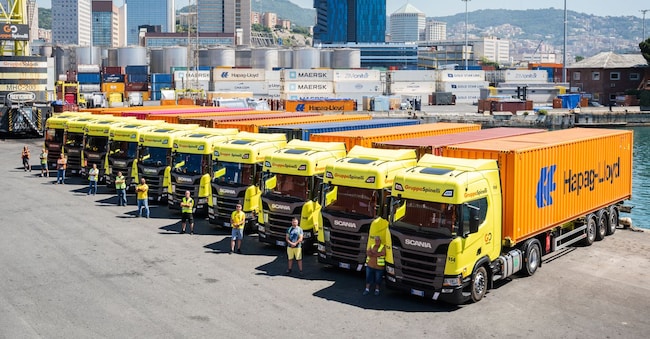
Europe is taking a hard line on the green transition of heavy goods transport (HGVs). EU Regulation 2019/1242 on the CO₂ reduction targets that manufacturers must meet focuses not only on new truck fleets (-45 per cent by 2030 compared with 2021; -65 per cent by 2035; -90 per cent by 2040), but also semi-trailers (-10 per cent in CO₂ emissions by 2030, with 2025 as the baseline) and trailers (-7.5 per cent by 2030 compared to 2025). Brussels is aiming for climate neutrality through the gradual electrification of fleets. These are market-based targets which, if not met, will result in hefty fines for manufacturers: missing the 2030 target by just three percentage points could lead to fines totalling around 2.2 billion euros. The warning comes from ANFIA (manufacturers) and ANITA (road haulage and logistics companies).
In particular, according to the two associations, ‘trailers and semi-trailers can help improve the efficiency of the vehicle combination and reduce fuel consumption, but there are objective technological limitations that prevent these targets from being met, and which the European legislator must take into account if we are to avoid seeing the production costs of these vehicles double. “A revision of the European regulation is urgently needed,” state Anfia and Anita, “but so too is strong support from governments to facilitate the transition of heavy-duty fleets through structural and long-term incentives, enabling investments to be planned in a way that combines environmental sustainability with economic sustainability.”
Trailers and semi-trailers are part of a wider problem: the enormous uncertainties surrounding the green transition of road freight transport, which affect both lorry manufacturers and haulage companies – in other words, the operators of heavy goods vehicles. The crux of the problem, for the entire supply chain, is not knowing what fuel lorries will run on in the years to come. And without knowing this, they cannot plan their investments. Just as in the car sector, Brussels is staking everything on electric motors for heavy-duty fleets, whilst manufacturers and hauliers are calling for technology neutrality, which includes biofuels (HVO and biomethane), synthetic fuels (e-fuels) and hydrogen. Which vision will ultimately prevail?
In Italia, fleet renewal – where the average age of vehicles on the road exceeds 15 years and diesel accounts for 97 per cent of the market – continues to be driven primarily by traditional engines (+4 per cent in the first half of 2026, compared with the same period in 2025, totalling over 18,000 new registrations), whilst zero-emission vehicles are struggling to gain a foothold due to high purchase costs and the limited availability of dedicated charging infrastructure (-51 per cent in the share of zero-emission vehicles in the first six months of 2026 compared with 2025, totalling just 229 units registered in 2026).
Gianmarco Giorda, Director-General of Anfia, says: “We cannot penalise companies that invest millions in developing products that the market is not yet ready to buy. The transition, particularly in heavy goods transport, must also be economically sustainable: at present, the TCO (total cost of ownership) of electric vehicles (i.e. the total cost of purchasing, operating and maintaining a vehicle throughout its entire life cycle) remains significantly higher than that of traditional lorries powered by renewable fuels. We therefore need a rapid review of CO₂ targets, for both lorries and trailers and semi-trailers. And we need structural support to incentivise sustainable investment.”


