
Heirs to Nothing: The Youngest Generation’s Public Spaces and the Pact Between Generations

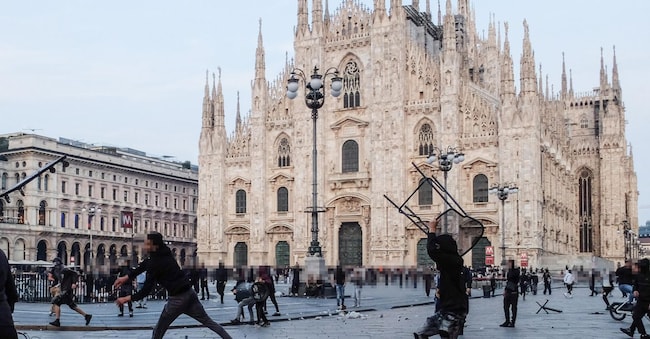
The images from Piazza del Duomo on 17 and 18 October depict a scene that the usual categories struggle to make sense of. In Milan, as in Bologna and Turin, it was not organised activists who broke away from the peaceful demonstrations against the high cost of living, but very young people, often under-18s, with no political affiliations or group affiliations. Among those detained in Milan, the vast majority were not yet eighteen; among those identified, there were even twelve-year-olds. They organised themselves via TikTok, WhatsApp and Telegram, filmed everything and shared the videos as if they were trophies. Intelligence sources speak of a ‘nihilistic spontaneity’ that is difficult to monitor.
A week later, the scene was repeated. On Saturday 24 October, despite cities being placed under lockdown and preventive searches, clashes broke out in Turin, Bologna, Florence and Rome, where the police used water cannons and a group forced their way into the Colosseum. Among those arrested across Italia, one in three was a minor. On the one hand, there are those inciting them to take to the streets via social media; on the other, adults who arrive too late: caught in the middle are young people whom deterrence alone fails to reach.
Condemning violence is a duty and leaves no room for ambiguity. But those demonstrations raise an important question for those concerned with generational transitions: what are we passing on, and to whom? One of the young people at the demonstration summed up his anger as follows: if you’re poor, you can’t have anything. It is a statement that speaks of ownership, in the broadest sense: of access, of belonging, of the possibility of feeling like the heir to something. When a generation does not see itself as the heir to anything – neither a legacy, nor a vision, nor a community – the streets become the only place to take centre stage, and the screen the only mirror in which to exist.
Then there is one image that stands out more than the others: fathers chasing their hooded children through the streets of the city centre. It is a snapshot of a broken bond. The adults arrive too late, after the deed has been done, when the bond can only be re-established through authority and no longer by example.
Family businesses are well aware of this risk. For decades, they have treated young people as heirs-in-waiting: kept on the sidelines until they were ‘ready’, rarely listened to, and only involved at a late stage. The result is often a lack of commitment: children who drift away or who join the business without feeling it is their own. Yet, when they find something worth safeguarding, young people do not shy away from it. This lesson applies to society as a whole. Engaging the younger generations is not achieved through the rhetoric of inclusion, nor through repression alone, but through three concrete choices.

