
"Help 2": doing something to serve
Music once again rallies around War Child with twenty-three tracks created to remind us that the emergency is never over

The sixties had closed and taken the Beatles with it, but John Lennon looked forward to the new decade with confidence: nothing would ever be the same again. Not even the often interminable time it took to release an album. On 27 January 1970, Lennon telephoned George Harrison and invited him to take part in the recording of 'Instant Karma': from the initial idea to its arrival in the shops some ten days passed. It takes five for the compilation 'Help', released twenty-five years later, inspired by Lennon's pacifist urgency and the Beatles' cry for help in their song. It sold 70,000 copies on its first day and donated £1.2 million to War Child, in support of children affected by the war in Bosnia Herzegovina. The project involves many artists - from Oasis to Radiohead, Massive Attack to Sinéad O'Connor - including the supergroup The Smokin' Mojo Filters, formed by Paul McCartney, Paul Weller and Noel Gallagher.
A generation raised in the noise of war
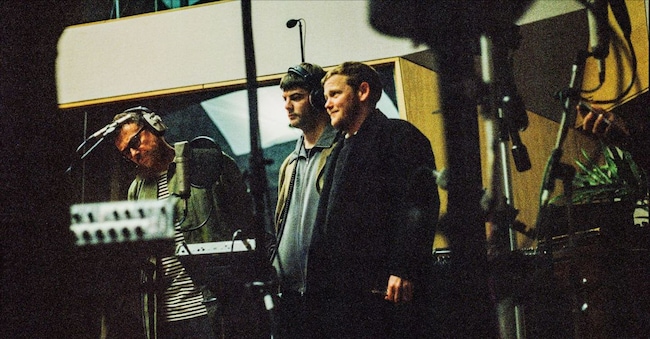
When 'Help' came out on 9 September 1995, about 10% of the world's children were involved in armed conflict. Thirty years later that percentage has almost doubled: 1 in 5 children, or 520 million, more than at any time since World War II. So music is doing something concrete again. 'Help 2', with its twenty-three tracks, collects the work of a week in November 2025 at the Abbey Road studio with James Ford as producer. Its sonic range is broader than the previous compilation, conceived in the midst of the Britpop era, although the presence of Oasis with their version of 'Acquiesce' recorded live at Wembley is the link.
Between improvised moments, old glories and new names
The opening marks the return of the Arctic Monkeys, who synthesise the evolution of the last three albums in a nocturnal track, a futuristic idea with a Bowie-style Turner, an acoustic atmosphere pierced by erosive guitars and more melody than in the past. "Flag" is definitely the sum of the names involved: the melancholic eclecticism of Damon Albarn, the restlessness of Grian Chatten, the metrics of Kae Tempest. Ballads - "Lilac Wine" with Beck and Arooj Aftab, Arlo Park's "Nothing I Could Hide" - alternate with more experimental moments, such as those of King Krule, dub ("Helicopters", Ezra Collective and Greentea Peng) and a more unpredictable "Eleanor Rigby" staged by Cameron Winter in "Warning", confirming his moment of creative grace. There is the elegance of Sampha, Wet Leg in a minimal key, the dramatic voice of Bat for Lashes, Pulp seduced by garage in "Begging for Change", Depeche Mode true to themselves in the dark electronics of "Universal Soldier", a cover of Canadian singer-songwriter Buffy Sainte-Marie. Between collaborations, unreleased tracks and reinterpretations, the album has its own homogeneity, despite the 30 or so artists involved and the different nature of the tracks. For example, the Foals conceded 'When the War is Finally Over', inspired by a reading of British war poets - the 'Trench Poets', Wilfred Owen and Rupert Brooke - and written in 2019. The formats change, not the urgency: yesterday a 45 rpm, today twenty-three tracks recorded in a week. In between, the same need to do something that really serves, or at least try.

