
Helsinki Biennale 2025: art that listens to the non-human world
The third edition of the event is a dialogue between public art and nature to build new forms of ecological coexistence

6' min read
Key points
6' min read
In recent years, Biennials have multiplied in every corner of the planet, transforming themselves from exclusive events to global platforms of cultural exchange. But what role do they really play in the local contexts in which they take place? The third edition of the Helsinki Biennial, running from 6 June to 21 September, tries to answer this question with an ambitious and necessary approach. Entitled "Shelter: Below and Beyond, Becoming and Belonging", the event does not merely offer contemporary art: it becomes a tool for raising awareness and education, shifting the gaze from the human being to the rest of nature, and strengthening the link between art and community - especially among the young.
The city and institutions around the project
.The Helsinki Biennial is much more than an art event: it is a city-wide project that is fully in line with the city's strategy to make Helsinki an increasingly attractive destination for the arts, while strengthening the international profile of the Finnish art scene. In 2025, the Biennial will expand further: in addition to the island of Vallisaari, which will host 25 artists, and the HAM Helsinki Art Museum, with 15 works in a dedicated section, contemporary art is also on display in the city, at Esplanade Park, where five public art installations are installed, including 'Light and Shadow' (2014), a sculpture by Giuseppe Penone.
The project enjoys strong institutional support: with a budget of EUR 4.2 million, it is financed by the Helsinki Municipality, the HAM Helsinki Art Museum, and important Finnish foundations. "The Biennial was born from the unique combination of art, nature and the maritime city," explains Arja Miller, director of the HAM. The wilderness of Vallisaari, the urban heart of Esplanade Park and the HAM museum spaces create a stage where art can live, breathe and transform." Among the main supporters is the Jane and Aatos Erkko Foundation, which has allocated EUR 900,000 to the HAM for the three-year period 2025-2027. For the project of artist Hans Rosenströn, famous for his enigmatic sound spaces, the Tiftö Foundation contributed. For the Biennale, Rosenström created an installation in which sounds, inspired by the nature of Vallisaari, are activated by the movement of the viewer. One of the key aspects is the accessibility of the biennale: the city is committed to making contemporary art accessible to all. During the summer, the ferry ticket to Vallisaari will be offered at a reduced price (EUR 10.90), as will admission to the HAM museum, which is reduced from EUR 20 to EUR 12.
Contemporary institutional offerings range from the Amos Rex, a private museum offering "Staged Cir¬cum¬stances and Piles of Things", a retrospective of the Catalan-born but Finland-based artist Anna Estarriola who works with sculpture, sound, moving image, bodies and electronics to create multimedia sculptural installations and performances. At the Kiasma, the star is Monira Al Qadiri with "Deep Fate", the central theme of which is the dual role of oil in generating wealth and causing crises (the artist works with König Galerie, Berlin, and prices range from EUR 3,000 to 200,000).
The Artists, the Works and Nature
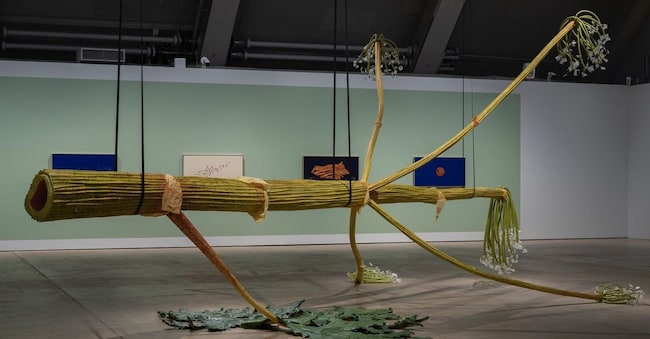
.The two curators, Blanca de la Torre, who directed the 15th International Cuenca Biennial, and Kati Kivinen, head of exhibitions at the HAM Helsinki Art Museum, selected 37 artists, representing 30 different cultures, from the Nordic countries, with a good representation from Latin America and Asia. Thirteen new works were commissioned, including multi-material installations paying homage to traditional crafts, musical sculptures and ceramics. The title 'Shelter: Below and Beyond, Becoming and Belonging' draws inspiration from the ecological disputes on Vallisaari Island, whose habitat has been partially protected from human settlement. Thus, considering the idea of "shelter" not as a "physical barrier" but as "a nurturing space - psychological, social or ecological - in which all forms of life can find protection and thrive", the exhibition explores ideas of coexistence and re-imagines the place of humans in nature. The artists include names from the art world such as the Danish-Icelandic Olafur Eliasson and the Japanese Yayoi Kusama, the Brazilian Ernesto Neto who has created a sculpture in homage to the birds of Vallisaari. Peruvian artist Ana Teresa Barboza, known for her textile works and large-scale multisensory installations that combine traditional craft techniques with modern technologies, created a site-specific installation supported by the Saastamoinen Foundation that unites two cultures through the common theme of tree bark. Indigenous Amazonian communities have used yanchama bark for centuries to create everyday and ritual objects, and similarly, birch bark has a long tradition of craftsmanship in the North. Also on Vallisaari Island, 'Subterra (Subterranean)', 2025 the work of Mexican artist Tania Candiani focuses on the underground connections within forests and the interdependencies that sustain ecosystems. The installation features a sound composition, a video work based on scans of growing roots and living roots suspended in glass jars (working with Galeria Vermelho, São Paulo, Brazil, with a price range between $15,000 and $150,000).

