
Hera, technology to triple yield of green waste in biogas production
It is called 'steam explosion' and regenerates wood resources by treating them with steam. The group evaluates a plant capable of treating 50,000 tonnes per year
2' min read
2' min read
Tripling the yield in the production of biogas from grass clippings and prunings: this is the result of the experimentation by the Hera group of an innovative technology that for the first time on an industrial scale has managed to implement the valorisation of green waste in the production of gas, alongside that of fertilisers for agricultural use. The experimentation took place at the Ozzano dell'Emilia (Bologna) composting plant as part of the Life Steam project, co-funded with 1.4 million euro by the European Union and coordinated by the Hera group.
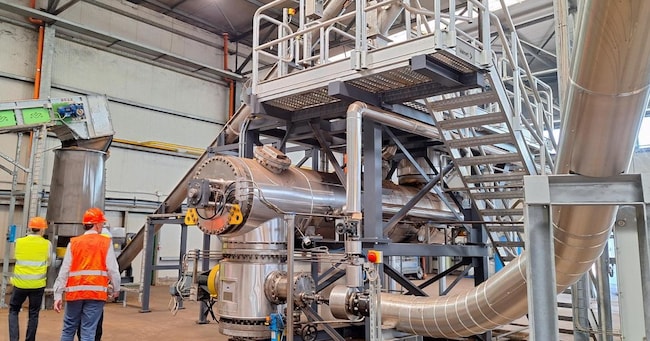
A pilot plant capable of handling 10,000 tonnes per year of clippings and prunings from the maintenance of public or private parks was built at the Ozzano site. The green waste was pre-treated with steam explosion technology, a process that uses high temperature steam to significantly increase the biogas yield. The pre-treated materials were then sent to the anaerobic digestion plant in Voltana (Ravenna), where the biomass was converted into biogas. The remaining solid residue was transformed into compost, a natural fertiliser useful for agriculture.
Loading...
Tripled yield
.The steam explosion produced more than three times as much biogas as untreated material. The trial demonstrated the technical and economic feasibility of the process on an industrial scale and an economic analysis indicated that a full-scale plant could process 100,000 tonnes of green biomass per year, producing 9.3 million cubic metres of biomethane.
Evaluation for industrial plant
.The project has made it possible to regenerate wood resources by treating them with steam to make them suitable for the production of biomethane and green compost in a totally innovative process. It is fully in line with the objectives of the Hera Group's industrial plan, especially as regards the valorisation and regeneration of resources with a view to the circular economy and the objectives of reducing carbon dioxide emissions. The results obtained in the experimentation phase are still being analysed, particularly as regards the balance of the economic-energy values of this technology. This will be the starting point for feasibility assessments for an industrial-scale project, with about 50,000 tonnes of input material. The Hera group believes, in fact, that this new process will be able to provide an important contribution in terms of raw material to feed existing agricultural biogas and biomethane production plants. It will be essential to identify low-cost forms of electricity and steam production in order to contain the operating costs of the new process. One hypothesis could be to locate the plant at a Hera waste-to-energy plant, thus exploiting the direct connection with a source of energy and heat production.
Collaborations
.The Life Steam project was developed thanks to the close cooperation between the Hera Group and the other two project partners, the Swedish company Valmet AB, a leader in wood pre-treatment technologies, and Ayrion SpA, which operates in the world of biogas and biomethane production.
Copyright reserved ©


Brand connect
Loading...
