Defence Expenditure

Here are the 20 Nato countries that Trump threatens not to defend: Italy is included

Only 11 out of 31 countries spend 2% of GDP on defence. Trump has reiterated that in the event of a Russian attack he would not defend them until they reach that target

by Gabriele Meoni

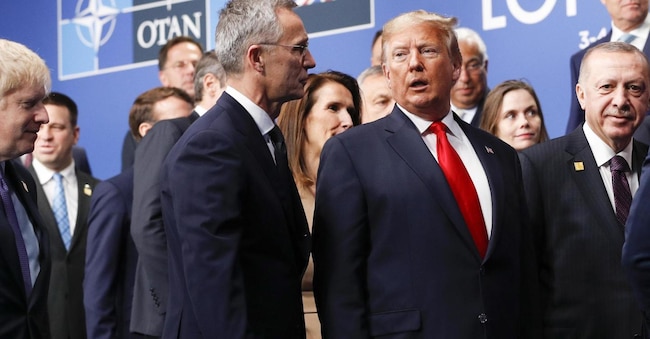
Da sinistra, l’ex premier britaninco Boris Johnson, il segretario generale Nato Jens Stoltenberg, Donald J. Trump e Recep Tayyip Erdogan al summit Nato di Londra nel dicembre 2019. ANSA/PETER NICHOLLS / POOL

3' min read

3' min read

It has long been one of his fixed nails. Those who do not spend enough on defence as agreed in NATO do not deserve the support of allies. In a rally in Conway, South Carolina, Donald Trump reiterated this in a very rude manner, as is his style: he said that he would not hesitate to "encourage" states like Russia to "do whatever the hell they want" of NATO countries that do not fulfil their financial commitments, dusting off his warhorse against countries reluctant to increase their defence contribution to 2% of GDP.

A tirade that the White House of Joe Biden - his opponent in November's presidential race - described as 'frightening and insane', while Alliance Secretary General Jens Stoltenberg pointed out that 'NATO remains ready to defend all its allies. Any hint that allies will not defend each other,' he warned, 'puts all our security, including that of the United States, at risk and puts American and European soldiers at greater risk'.

Loading...

The 2014 Summit

What exactly is the former US president referring to? At the 2014 NATO Summit in Wales, NATO member states had pledged to increase their defence spending to the target of 2% of GDP. Commitments reaffirmed in Warsaw in 2016 with the so-called Defence Investment Pledge.

As a document of the Chamber of Deputies from last October explains, the countries estimated by NATO itself to have reached this threshold in 2023 are only eleven (out of 31).

Those who fulfil their commitments

.

In addition to the US (3.49%), Poland (3.9%), Greece (3.01%), Estonia (2.73%), Lithuania (2.54%), Finland (2.45%), Romania (2.44%), Hungary (2.43%), Latvia (2.27%), the UK (2.07%) and Slovakia (2.03%) are in line with the 2% target.

Those who do not respect them

At the tail end are Luxembourg (0.72%), Belgium (1.13%) and Spain (1.26%). Below the 2% target and thus on Trump's 'blacklist' are also: Turkey, Slovenia, Canada, Italy, Portugal, the Czech Republic, Germany, Denmark, Norway, the Netherlands, Albania, Croatia, Bulgaria, North Macedonia, Montenegro and France (the latter narrowly at 1.9%). Finland, a new NATO member, is just under 2% but has pledged to raise spending to 2.3% of gross domestic product and thus could count on the 'shield' of a Trump-led America.

Where Italy is

According to the same Nato report, the ratio of military expenditure to GDP in Italy in 2023 is 1.46 per cent of GDP. In 2022 it was 1.51 per cent, in 2020 1.59 per cent. The Defence Multi-Annual Planning Document for the three-year period 2023-2025 envisages an expenditure of EUR 29.7 billion for the Defence Budget 2023, an increase compared to the previous period. As for the 2 per cent target, the document notes that the national goal is to reach the 2 per cent target in 2028, i.e. in five years.

The burden sharing

.

The issue of burden sharing, i.e. meeting the commitments made at the NATO Summit of Heads of State and Government in Wales in September 2014, is therefore still a very hot topic.

Burden sharing envisages the effort of each member state to strive towards 3 targets by 2024: 1. 2% of defence spending as a proportion of GDP ('cash'); 2. 20% of the share of the defence budget to be allocated to investment; 3. The contribution to missions, operations and other activities.

If on the first point, Italy is far from the target, it is on track on the second: the percentage of defence expenditure allocated to investment is estimated at 23% in 2023, 22% in 2024 and 22.8% in 2025.

In the event of Trump's victory in November, it is a safe bet that the burden sharing dossier will be back in the forefront of the Atlantic Alliance's summit.

Copyright reserved ©
Loading...

Brand connect

Loading...

Newsletter

Notizie e approfondimenti sugli avvenimenti politici, economici e finanziari.

Iscriviti