Cycling

Here comes the Tour de France, the big story of the summer, with the usual dilemma: Pogacar or Vingegaard?

The Grande Boucle returns with a brand-new route and a tight battle for the yellow jersey between the Slovenian dominant force and his Danish rival

by Dario Ceccarelli

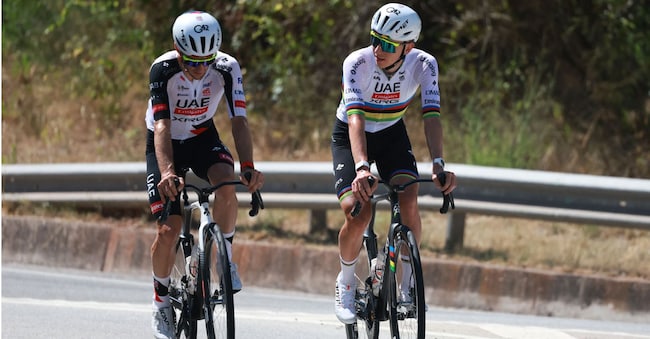
Ciclismo - Tour de France - Barcellona, Spagna - 3 luglio 2026 Tadej Pogacar dell'UAE Team Emirates XRG con un compagno di squadra durante gli allenamenti in vista della prima tappa REUTERS/Stephanie Lecocq REUTERS

7' min read

Translated by AI
Versione italiana

7' min read

Translated by AI
Versione italiana

In a summer dominated by football, with the longest World Cup in its history (which will end after 39 days on 19 July), cycling is making a comeback with its most iconic and global event: the Tour de France.

Setting off this Saturday, 4 July, from Barcelona and finishing on the Champs-Élysées in Paris on 26 July, the Grande Boucle sets off once again for the 113th time to reveal who will wear the yellow jersey. Or rather: to reveal whether the usual star of the show, Tadej Pogacar, will face any competition – in this case Jonas Vingegard – capable of throwing a spanner in the works. We’ll already see this in this team time trial in Barcelona (20 kilometres with two climbs up Montjuïc), where the time, this time, is recorded individually rather than for the team. The two big names will therefore have to be on their guard.

Loading...

‘The Tour is the Tour,’ say the French and cycling enthusiasts: meaning that the French race is an institution that shines in its own right, regardless of the champions who take part. Yet, as luck would have it, with rare exceptions, the best riders are almost always at the Tour. Just like this year, in fact, with the epic showdown between Pogacar, the ‘Cannibal of the New Millennium’, and the Dane Vingegaard, the only rider who, at the Tour (having won it twice), manages to give world champion. Then, of course, there are the others: the stage hunters (such as the Dutchman Van Der Poel), the time-trial specialists (the Belgian Evenepoel) and the highly competitive contingent of sprinters who will battle it out on the flat stages, of which there are 7 out of 21 in this edition. There are, however, five mountain finishes, three of which are in the Alps over the final four days. For fans of this type of racing, the double finish at Alpe d’Huez – on the third-last and penultimate stages – is one to watch.

The key question, given Pogacar’s overwhelming dominance, is whether the UAE Team Emirates captain will already have sealed his fifth Tour de France victory by this stage, or whether Vingegaard will have genuinely managed to put him under pressure. On paper, the balance tips entirely in favour of the Slovenian, who has been more successful than ever before, having arrived at the Tour with 13 victories in 16 days of racing. A veritable war machine, he was only beaten at Paris–Roubaix when the formidable Tadej was pipped to the post by the Belgian Van Aert. As if that weren’t enough, the Slovenian’s team, UAE, is extremely strong with the addition of the Mexican Isaac Del Toro, a formidable youngster already ready, if need be, to step up as leader.

The Dane, however, is a formidable contender: his victory in the Giro d’Italia – which he practically dominated in the final week – has restored his rightful status as a stage race specialist following a spell of underperformance. Vingegaard is backed by a strong team (Visma) and has already won the Tour twice. He is not as ruthless as Pogacar, but on the climbs he is a formidable opponent – the only one capable of giving the Slovenian a run for his money.

The cycling summit with 200 million in revenue

After the Olympics and the World Cup, the Tour de France is the most-watched sporting event in the world. And in cycling, it’s the pinnacle. It is a business that generates nearly 200 million in revenue each year, thanks to television rights (50 per cent), sponsorship (40 per cent) and the money paid by towns to host a start or a finish. A start is worth around 80,000 euros. A finish, which is more important from a media perspective, can be worth as much as 150,000 euros. The advertising parade alone – a festival within a festival, stretching over ten kilometres – is watched by 12 million people lining the streets to await the riders. Unlike Italia, a long, narrow country, France is the perfect setting and experiences the Grande Boucle as a national festival to be celebrated with pride and passion. It is no coincidence that this blend of tradition and culture is almost always followed, at least for one stage, by President Macron.

In Italia, this is not the case. Usually, with a few exceptions, the political elite view the Giro with a certain indifference. As if it had no bearing on votes or public support. You see plenty of councillors and mayors, but their involvement is more local than national. Only recently, since the Giro has been finishing at the Imperial Forums in Rome, have things changed somewhat, with ministers and government representatives in attendance. At the 2023 Giro, President Sergio Mattarella was also present at the award ceremony for the pink jersey, won by Primož Roglič. And last year, again on the final stage, Pope Leo XIV welcomed the riders to the Vatican Gardens and gave them his blessing.

Turning to the upcoming Tour, there are a few minor changes: one of these is that the race will take place mainly in central and southern Italy, with no fewer than ten new locations serving as start or finish points. The total distance will be 3,333 kilometres, with a total elevation gain of 55,000 metres. The start in Barcelona means, geographically speaking, that the route must first pass through the Pyrenees (Col d’Aspin and the legendary Tourmalet) before moving on to the Massif Central, the Vosges and finally the Alps, ahead of the final stage in Paris. The highest peak will be the Col du Galibier, a legendary mountain on the Tour, where Marco Pantani, in 1998, with his devastating surges, shattered Jan Ullrich’s resistance to claim the yellow jersey after having won the pink jersey at the Giro d’Italia.

The favourite, Pogacar

But whilst Pantani was Pantani, Pogacar is every bit his equal – indeed, this year he is set to achieve new feats that will secure him a rightful place amongst the Legends of the Tour. Should the Slovenian arrive in Paris wearing the yellow jersey, he would, in fact, win the French race for the fifth time, joining Jacques Anquetil, Eddy Merckx, Bernard Hinault and Miguel Indurain. A prestigious club from which Lance Armstrong was expelled due to his well-known doping scandals. One point in Pogacar’s favour is that, at just 27 years of age, he has plenty of time to reach six victories, thereby setting another record that would elevate him to the pantheon of cycling.

With Tadej, any comparison with the past seems destined to be swept aside. Not yet at the peak of his powers, but already incredibly strong mentally, it is becoming difficult to find an opponent capable of keeping up with him throughout the season. A force to be reckoned with in the major classics (13 victories) and a dominant figure in stage races (4 Tours and 1 Giro d’Italia), Tadej currently has only one rival: himself. The fear is that this overwhelming dominance might dampen his insatiable hunger for victory. A problem, however, that is not on the agenda at the moment. Indeed, it seems that his inner fire is fuelled by one success after another. He feels no pressure, enjoys exceptional health and shows no signs of fatigue. He breaks away for tens of kilometres and crosses the finish line as fresh as a daisy. Merckx won a lot, but often crossed the line completely exhausted. Tadej, on the other hand, looks as though he’s just come from the hairdresser’s – this time with a very short, platinum-blonde cut – or from a relaxing picnic on the grass. To many, he is the Champion of Champions; to others, an unlikable alien who doesn’t even grant his opponents the honour of a fair fight.

But what about the others? Who are the other potential contenders? We’ve mentioned the Dutchman Van Der Poel and the Belgian Evenepoel. The former could aim to wear the yellow jersey for a few days whilst also securing a few stage wins. As for Remco Evenepoel, his only problem is his endurance. Formidable in time trials and on the flat, the Belgian holds his own on the climbs. However, in a long stage race, he usually runs out of steam. Alongside him, as an alternative contender, the German Florian Lipowitz is raring to go.

The French hope, Seixas

Alongside the usual suspects, such as Almeida and Roglic, Paul Seixas, the rising star of French cycling, deserves a special mention. At just 19, he is making his Tour debut after a season that has been impressive in terms of both talent and character. Winner of the Flèche Wallonne, he was the only rider to hold his own against Pogacar at Liège–Bastogne–Liège, finishing second. There are high expectations of him, especially in France, which has long been lacking in great champions (the last Tour victory dates back to 1985 with Bernard Hinault). The problem is precisely this: that Paul doesn’t crack under the pressure. The lad is strong, no doubt about it. However, as this is his absolute debut at the Tour, we’ll have to see how he reacts. Like all diamonds, he must be treated with care and caution. In any case, he could well secure a place on the podium.

And now, last but certainly not least, “les Italiens”. There should be a dozen of them – not as many as in that famous film, but still a modest number for a country like ours, which has written glorious chapters in the history of the Tour. France has 30, whilst Belgium – the country with the most riders – has 31. That is the reality. We no longer have any champions in stage races. The last rider to wear the yellow jersey at the Arc de Triomphe was Vincenzo Nibali in 2014, when he took the lead as early as the second stage and defended it all the way to Paris.

In this edition, the Italian rider considered more or less a contender for the general classification is Antonio Tiberi, who didn’t exactly shine in the last Giro d’Italia. Filippo Ganna might give us something to cheer about in the time trials. Veteran Damiano Caruso, riding his final Tour, will also be there, acting as a top-class support rider for Tiberi. Finally, alongside Domenico Affini from Mantua, we should highlight the presence of one of our rising stars, Davide Piganzoli – who turns 24 on 8 July – Jonas Vingegaard’s favourite domestique. Following his exploits in the Giro, Visma have asked him to take part in the Tour de France as well, in support of the Dane. Piganzoli, from Morbegno in Valtellina, is currently working for others. But in the future, if he carries on like this, he could go it alone: take the big leap. Are we being unrealistic? Perhaps so.

Copyright reserved ©
Loading...

Brand connect

Loading...

Newsletter

Notizie e approfondimenti sugli avvenimenti politici, economici e finanziari.

Iscriviti

Tutto mercato WEB