
Meet Fasteer AI, the agent platform that builds start-ups from scratch

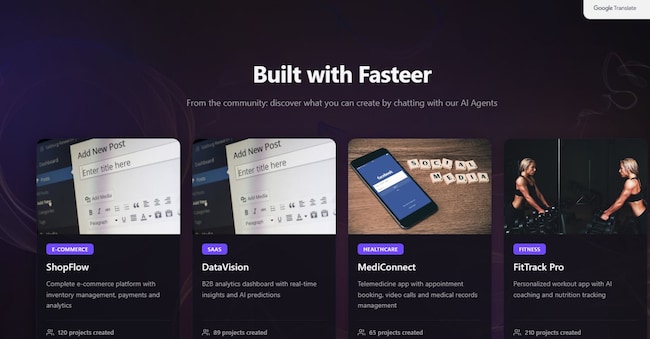
They are the theme of the moment, the 'new' chapter in the ever-expanding universe of artificial intelligence: we are talking about agents, tools capable not only of 'doing' (writing code or generating content) but also of thinking and designing, interacting with each other and with humans. And that's not all: when integrated within a single platform, veritable teams of AI assistants can design entire businesses autonomously and in a coordinated manner, replacing or flanking human consultants. And this is the case of Fasteer AI, the Agentic Business Platform born in the belly of FoolFarm, a startup specialising in the world of algorithms founded in 2020 by Andrea Cinelli, one of the digital pioneers in Italy (he was the creator of web portals such as Libero.it and Telecom Italia's Alice) and a leading figure in the international tech community (in 2021, he was elected among the top 5 CEOs in AI by Technology Innovator magazine). The goal of the project is ambitious, and is to reduce the construction of a business project from months to a few days of work, thanks to a 'workforce' of AI agents who collaborate like a real human team, each with distinct skills and coordinated by a super agent. "In FoolFarm," the CEO and founder of the Milan-based company explained to Sole24ore.com, "we have built a platform that takes its cue from vibe coding solutions such as Lovable.dev or Replit.com, but goes far beyond the ability to build a website, an e-commerce showcase or an application from scratch and in just a few hours: our platform includes a dozen agents with different tasks able to cooperate natively and develop complete new businesses, validating them from start to finish, from concept to economic-financial simulation, up to prototype and go-to-market".
From traditional to agent-based consultancy
Fasteer presents itself as an agentically orchestrated ecosystem, the underlying principle of which is to autonomously manage the entire creation cycle of a business, from the idea to its validation through to the development of the product and the simulation of the economic-financial framework required to support its growth. We are not talking about a single tool, in short, but a complete digital workforce. Its inception is rooted in the activity carried out by FoolFarm in recent years, and more specifically in the algorithms, software libraries and LLM models used to create and support the start-ups incubated by the venture builder (eight launched to date, of which five are operational, two have already been exited, such as Snaproof and Fragmentalis, and two others are being negotiated, namely VoiceMe and AidaGPT). "We industrialised what we used to use in our laboratory and gave it a more beautiful and structured dress with the idea that each agent,' Cinelli confirmed in this regard, 'should take charge of a task and carry it out, accompanying the startupper or entrepreneur step by step until the project is defined: there is the one who deals with strategy, who with legal, who with code, who with strategy, finance, design, product and development. And above them all there is Mario, the super orchestrator who coordinates the work of the whole virtual team of managers and developers'. Whether Fasteer, as its creator says, essentially marks the end of consulting as we knew it is perhaps too early to tell. What is certain is that compared to competing agent platforms, FoolFarm's claims the merit of not generating standardised ideas but distinctive projects in the logic of 'custom business designs': each initiative, Cinelli assures us, is validated in real time through comparison with over 200,000 comparable cases, integrating variables such as market, target, economic model and competitive advantage. The platform, another unicum with respect to a traditional team of consultants, works 24 hours a day and with continuous updates (each new start-up that is born feeds the system, creating a feedback loop that constantly improves the quality of the agents), guaranteeing scalability to a model that (on paper) can allow FoolFarm to tackle dozens of projects in parallel while maintaining constant quality levels.
How it works and the advantages
Underpinning Fasteer AI, which currently operates on the Google Cloud, is a controlled and certified approach to data, far removed from the generic use of the Net that characterises many current Gen AI models. The agents, in other words, work on an ecosystem of proprietary and certified sources that includes FoolFarm's more than five years of venture-building history, with hundreds of real business cases, more than 40 in-house software libraries and validated databases such as CB Insights, Crunchbase and PitchBook, as well as European open data, vertical market datasets and data uploaded directly by the team. All the information is processed by a data validation & normalisation engine that filters and certifies the contents, eliminating bias and 'noise'. At the same time, new customised models are being developed (based on open source architectures such as LLaMA) with the aim of making them trainable even in on premise mode, enabling the use of the agent platform even on the data of user companies, in total security and compliance with regulatory obligations. The most obvious advantage is in the speed and cost of execution: tasks that would normally take weeks are completed in days, with an increasing degree of accuracy as the user interacts with the agents. "The more critically and constructively I activate agents," Cinelli emphasises, "the more accurate and contextual the result, and the less prone to hallucinations.
The market launch and the American challenge
Fasteer's path is already mapped out: after the test phase and the first pilot partnerships planned for early 2026 in Italy (., the platform will be officially launched in the US next spring through FoolFarm's US subsidiary, an LLC (Limited Liability Company) based in Miami. The roadmap envisages an initial release of the Core Coder Agent in the second quarter of 2026 and the gradual extension of the other modules over the course of the year. The business model, as Cinelli confirms, envisages both the direct sale of the platform as a modular SaaS environment (the subscription fee starts at EUR 99 per month and varies according to the number of agents used), and the distribution in indirect and on premise form, through a 'white label' offer aimed at consulting companies, system integrators and enterprise partners. In short, FoolFarm's vision is clear: to bring agent-based AI to the service of business innovation, not as a mere technology but as a new organisational model capable of transforming companies into intelligent and collaborative organisms. "The goal is not to replace people," concludes Cinelli, "but to give them a team of artificial intelligence that amplifies their ability to execute, starting from the assumption that AI must not only accelerate, but must do so responsibly.

