
Here is Prism, the OpenAi model for accelerating scientific research
The San Francisco-based company has launched Prism, a chatbot designed for scientists and researchers. Here's how it works

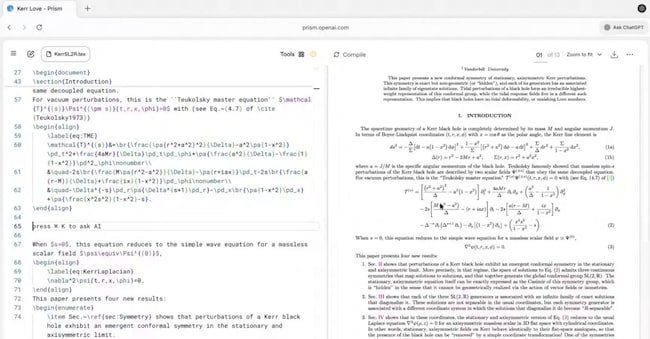
The goal, in the words of Kevin Weil, vice-president for Science at Open AI, is to 'achieve in 2030 the scientific breakthroughs that we would otherwise only have in 2050'. Slogans aside, the San Francisco-based company has launched Prism, a chatbot designed for scientists and researchers. It is free to access, you just need an account, it embeds GPT 5.2, to date the most advanced Open AI model. But what does it allow you to do?
In the meantime, it is possible to work with several hands on the same project, as is usually done in laboratories. After that, the model is able to improve paper texts, verify equations, and generate diagrams without researchers having to use Tikz, the programming language normally used by the scientific community. It then allows researchers to search the scientific literature on the subject of the paper, adding references in the bibliography.
And that's not all: since those who normally do research in universities are also involved in teaching, Prism also comes to the rescue in this respect. That is, it can generate notes for a lecture on a specific topic, but also set up problems for students to solve - ones that are perhaps done once and then 'recycled' for subsequent semesters and that with AI could be brand new every year. In other words, this tool wants to take care of all the tedious aspects of how scientific research is organised, thus speeding up the work of human beings. And, this is the hope, leave them more time to formulate new hypotheses.
Fine, but how do we avoid the hallucinations that chatbots are prone to, embarrassing when the research is scholastic but problematic when it is scientific? "Meanwhile, let us not forget that the number of hallucinations has dropped dramatically, especially since the advent of reasoning models," explained Weil when presenting the new Open AI tool to the press. The reference is to those LLMs who, to put it brutally, take time to think before responding. In this case, 'every reference to studies is provided with a link to the paper. Let's say it doesn't absolve the scientist from the task of verification, but it speeds up the process'.
And then there is the issue of privacy and data protection: how do you make sure that the paper does not end up on the servers before publication? How do you protect your data? "If in your ChatGPT account you have chosen not to allow conversations to be used to train the model, this setting is also carried over to Prism. And this option, Weil guarantees, should secure the work of researchers who want to use this tool.

