Here in Venice, glass is no longer a cliché: women dancing with fire
Furnaces were once the preserve of men. Today, more and more craftswomen are innovating this art, in Murano and beyond.
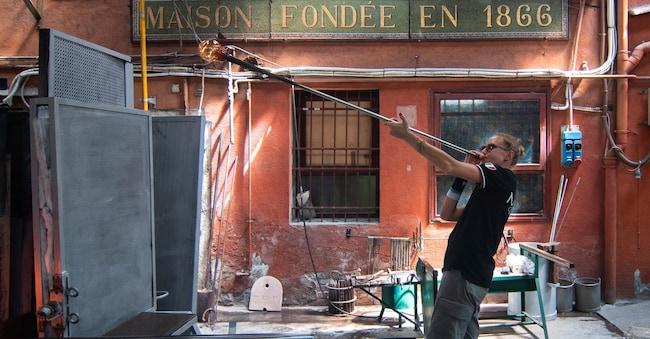
In the furnaces of Murano, the fire never goes out. Glassmaking is an ancient ritual rooted in the 1st century BC, when the technique of glassblowing was born. It was then in the 13th century that the Doge of Venice decided to concentrate all the furnaces on the island of Murano to avoid fires in the city, giving rise to the most important glassmaking district ever. For centuries it remained a circumscribed and secret world where the art was handed down from father to son and women were denied access. This is no longer the case. Today, on this incandescent island, more and more women are opening workshops and furnaces, experimenting with new languages and breaking down age-old clichés.
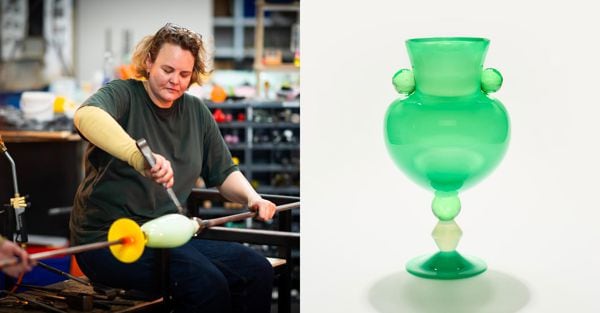
Agnese Tegon, 32, holds the record as the first Venetian woman to blow glass in Murano. 'At first I was looked at with suspicion, then I stopped worrying: glass does not wait,' she says. Since 2020 she has been working as a partner alongside Maestro Giancarlo Signoretto, one of Murano's best-known glassblowers with 50 years in the business. Her entry into the furnace was almost accidental. "After the Art Institute, specializing in glass, I answered Giancarlo's request looking for an intern. At the time, I never thought I would physically realise my designs, but after days spent applying gold leaf on glass medals, when Giancarlo proposed that I continue, I said to myself 'let's give it a try'". As a former triple jump athlete, she seems to have been born for this job that requires physical and mental endurance, as well as great sacrifices. "The blowpipe alone weighs ten kilos and has to be rotated continuously, plus you have to work in temperatures approaching 70-80 degrees in summer". Despite her experience, she still doesn't speak of herself as a Master: "It's an honorary title without exams. It takes years to become one, and you don't necessarily get it. It will be my Master who will say when I am ready. At that point there will be no need to publicise it, 'Murano is a small island, you know everything about everyone'. Among the works that Tegon has helped blow are the world's first large glass prancing horse - two metres high and 500 kilos in weight - and the statuettes for the Cannes Film Festival and Monte Carlo received by stars such as Michael Douglas and Morgan Freeman. The most extraordinary piece is the 100 kilos of life-size Michael Jackson statue commissioned for the Neverland Museum. "It took three months. The black trousers and red jacket are those from the Thriller video. Although the work I am completely proud of I have yet to realise".
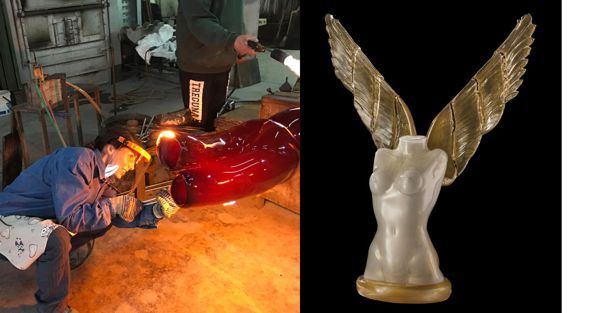
Before her, when American Alexis Silk arrived in Murano in 2012, many Maestri did not want her to try her hand at the furnace. "Not because I was not capable, but because I was a woman," says the Seattle-born artist in 1983. Today her sculptures, female bodies in solid glass that reach two metres in height, are exhibited in museums and collections from the United States to Australia, shattering all prejudices about the strength required to mould a living, seemingly breathing material. Silk has revolutionised blowing by pushing the boundaries of the possible. "I sculpt my figures freehand, without moulds, while the material is glowing," he says. Lifting masses of 20 or 30 kilos, turning them, shaping them with gestures of millimetric precision is like "dancing with fire", and requires the coordinated work of a team of assistants (he has been working for years with Ars Murano, where he has found the ideal environment). "For centuries, glass was manipulated by male hands. Now the bodies I create tell a different story: a strong and monumental femininity, which intends to occupy space'.
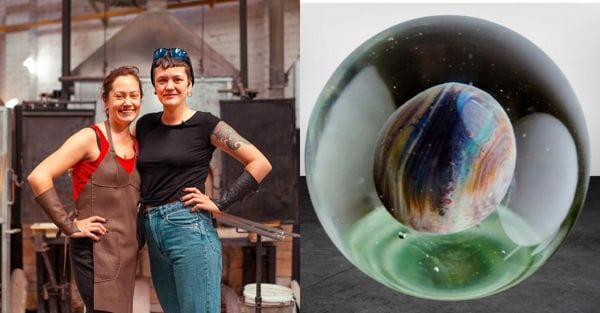
A challenge also taken up by 30-year-old Mariana Oliboni and Chiara Lee Taiarol - nom de guerre Vetraie Ribelli (Rebel Glaziers) - who opened the El Cocal Glass Studio in 2020 in the midst of a pandemic. The name, meaning seagull in Venetian dialect, reflected their desire to create 'new horizons even in difficult conditions'. Two high school friends opening a furnace on their own? The Murano masters, although they considered them outsiders, did not spare their secrets, even chatting over a Spritz. Their revolution started with the artistic language: light installations, sculptures with temporaries, musical instruments made of glass and works evoking prehistoric Venuses. "We have no real role models," explains Chiara, who learnt art by travelling the world and then landed for some time at the Berengo Studio in Murano. "We give vent to our thoughts by transforming them into glass, we revisit traditional techniques to create modern objects". Unfortunately, in 2022, 'we got a 52,000 euro gas bill. Impossible to sustain it. We reluctantly had to shut down the furnace,' recalls Mariana, who learned her trade in the Zanchi glassworks, known for its chandeliers. But it didn't end there. "We recently bought a mobile furnace from the Czech Republic, transportable in a van. It is the size of a refrigerator that expands. It can be switched on and off at will: an ecological break from the always-on ovens. Also perfect for teaching," he explains. "So we are no longer stationary in Murano, we are everywhere between festivals and schools. The important thing is to continue to spread this beautiful art that is in danger of dying".
_1-Collage-U67541317425hNC-U44266560702IkH-600x313@IlSole24Ore-Web.JPEG)
If the Vetraie Ribelli represent the avant-garde, sisters Elena and Margherita Micheluzzi have turned the family heritage into an international design brand. "Having grown up in the family's historic shop in Dorsoduro, near the Accademia," says Elena, 40, "we were both working in London, me in contemporary art and Margherita in fashion, when our father Massimo, a restorer and glass artist for over thirty years, suggested we come back, he wanted to teach us his art. So, five years ago, they accepted the invitation and launched Micheluzzi Glass. "Our speciality is grinding, a cold working process with diamond wheels that allows infinite variations on simple shapes such as vases and glasses. The engraving creates millerighe that catch the light, with irregular patterns that evoke the nuances of the Lagoon,' Elena further explains. They don't blow glass - "too difficult!" they admit - but make their designs at the Vetreria Anfora in Murano. Once a week, half an hour by vaporetto. "We don't arrive with the designs to the millimetre: with glass you have to follow the material that reacts in a second". The collaboration with the master glassmaker and assistants requires an almost symbiotic harmony: 'They couldn't do what they do without our design vision, and vice versa'.