
Here's how the financial wealth of Italians will boost stagnating incomes
The country's raw material is 6 trillion in financial wealth. Round table with Vincenzo Boccia, Paolo Acciari, Alberto Brambilla and Stefano Caselli

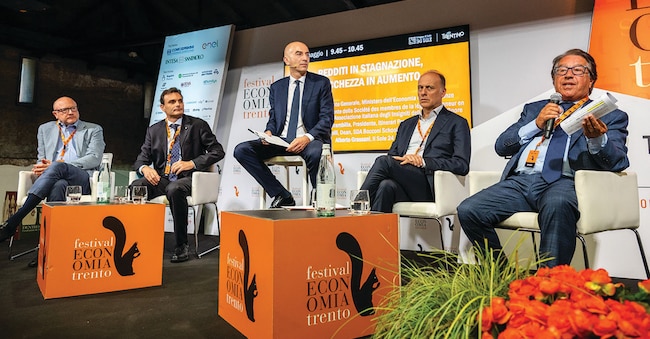
Productivity is stalling, markets are flying. Of course incomes are stagnating and wealth is rising. Italia is full of social lifts, only that of real incomes is at the mezzanine level, that of wealth is at the top. Because while the energy shock and the new international competition brake the marginality of the productive sectors, with inflationary flares that erode the purchasing power of families, the growth of real estate values and the records of the stock exchanges drive wealth: the real raw material of the country but yet to be exploited.
Bankitalia data say that, from 2005 to date, household incomes have risen from 1,044 to 1,422 billion, while financial wealth alone has taken off from 3,889 to over 6 trillion (54.6%), total wealth to almost 12 trillion. Of course, in some cases assets have struggled to keep pace with inflation, but incomes have always lost the race.
The most paradoxical aspect, then, is that today the very wealth of the country, which still allows Italian families to sustain and supplement their living standards, particularly those of the generations most disadvantaged in the distribution of wealth, is creating collateral damage to the system, hiding the problem of loss of productivity and competitiveness. In short, the wealth accumulated in the country is generating rents that mitigate the perception of the problem and discourage the defence of our productive system.
The topic was addressed at the round table 'Incomes in stagnation, wealth on the rise' at the Trento Festival of Economics. The protagonists of the event were Paolo Acciari, director general of the Ministry of Economy and Finance, Vincenzo Boccia, president of the Italian Association of Legion of Honour Recipients and past president of Confindustria, Alberto Brambilla, president of Itinerari Previdenziali, and Stefano Caselli, dean of the Sda Bocconi School of Management.
The starting point is the world of production, the only place where growth begins and progress can start: here the priority is 'the energy issue', explained Vincenzo Boccia. It is not just an issue of business competitiveness. 'Energy independence is a precondition for political independence,' Boccia emphasised, 'Either we address the issue of energy independence as a political fact of the country, and therefore competitive for companies, or we have no sense of the priorities to address. This energy emergency applies 'particularly in mature sectors where the energy component is higher' and where the loss of competitiveness towards countries, such as France and Spain, which have focused on nuclear and renewables for a long time, is greater. In other words, incomes and progress will advance faster when the country's production engine is out of the energy emergency, put back in a position to compete at least with European systems.


