Luxury

Hermès, first quarter below expectations due to war in the Middle East

Revenues at EUR 4.07 billion, up 6% at constant exchange rates and down 1% at reported level. Share price plummets on the stock exchange
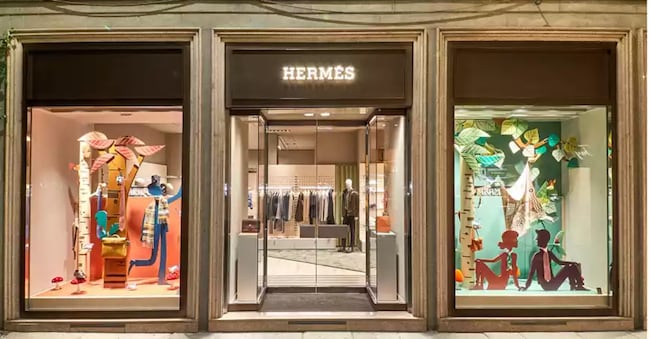
by Monica D'Ascenzo

4' min read

Translated by AI
Versione italiana

4' min read

Translated by AI
Versione italiana

Lower-than-expected results for French luxury group Hermès in the first quarter due to the impact of the conflict with Iran on consumption, particularly in the Middle East and in France, where the drop in tourist flows affected purchases of high-end goods. In Paris, the stock opened the session down 14%, before recovering slightly. However, it was still down more than 8 per cent at mid-day, dragging the luxury sector down with Kering down more than 9 per cent and Lvmh limiting its decline to 0.25 per cent. In London Burberry dropped 2.7 per cent, while in Frankfurt Hugo Boss was down 1.5 per cent. In Italia, Salvatore Ferragamo is down -1.6%, Moncler -1.4 percent and Brunello Cucinelli was positive.

Sales of iconic products such as Birkin and Kelly bags, silk scarves and perfumes grew by 6% at constant exchange rates, below the analysts' consensus (Visible Alpha) of a 7.1% increase. The negative exchange rate effect of EUR 290 million led to a 1% drop in reported revenue to EUR 4.07 billion from EUR 4.13 billion in the same period last year. However, the group saw double-digit growth in America, Japan and Europe (excluding France).

Loading...

"In a tense geopolitical environment, Hermès maintains its course, staying true to its long-term strategy. Backed by a high level of creativity, uncompromising quality standards and the loyalty of its clientele, Hermès continues on its path of profitable growth in 2026 with confidence and determination. The fundamentals of the Hermès model are more than ever a distinguishing factor of strength," comments Axel Dumas, executive chairman of Hermès.

Hermès, which caters to an ultra-wealthy clientele with handbags starting at around $13,000, pointed out that the conflict-related slowdown in tourist flows particularly affected sales in airport concession outlets and in the Middle East, as well as in key markets such as the UK, Italia and Switzerland, where Gulf customers are a significant driver.

The Middle Eastern market

In geographical detail, the Middle East recorded a decline of 6% at constant exchange rates, with revenues of EUR 160 million compared to EUR 185 million in Q1 2025. Although accounting for only 4.4% of total revenue, the region had been the most dynamic for the group last year.

"The Middle East, down 6%, was significantly impacted by geopolitical events in the region in March," said Chief Financial Officer Eric du Halgouet.

Particularly marked was the contraction in the United Arab Emirates, where sales in luxury shopping centres fell by 40% in March alone, reflecting the sector's sensitivity to geopolitical shocks and international tourist flows.

The geographies of revenue

At the end of March 2026, the Americas, Japan and Europe (excluding France) recorded sustained sales growth, the group's note said. Despite the slowdown in tourist flows related to the situation in the Middle East, group shop sales showed an increase of 7%. In contrast, the wholesale business was significantly affected by lower sales in concession shops, particularly in the Middle East and at airports.

In Asia (excluding Japan), revenues grew by 2% in the first quarter, supported by local customer loyalty and a brand enhancement strategy. Greater China continued to post moderate expansion, while Korea maintained good momentum; performance in the rest of the region was more subdued. In January, the opening of a new shop in Hanoi, Vietnam, further strengthened the Maison's presence in the country.

Japan confirmed a particularly solid performance, with sales up by 10%, supported by high levels of shop traffic and strong domestic customer loyalty. The Umeda Hankyu shop in Osaka was also expanded and renovated in March.

After a positive performance in 2025, America posted an exceptional first quarter, with 17% growth, driven by balanced development across all different business lines and product categories in the US, Canada and South America.

Europe (excluding France) also showed robust momentum, with sales up 10%, mainly driven by local demand. In France, however, revenues were down 3%, penalised by the slowdown in tourist flows, particularly in March, in relation to the situation in the Middle East.

The rest of the world, which mainly includes the Middle East, saw a decline of 6% penalised by recent geopolitical developments in the region since March, particularly in the United Arab Emirates, but also in Kuwait, Qatar and Bahrain.

The performance of the group's divisions

The Leather Goods and Saddlery segment, up 9%, benefited from high demand for the collections and increased production capacity. Among the new models, the Faubourg Express bag and the Collier d'attelage were particularly successful.

The Ready-to-wear and Accessories segment showed a stable trend, continuing on its development path, while the Silk and Textiles segment saw a growth of 8%, thanks to continuous creative renewal in the men's and women's collections.

The Perfume and Beauty segment showed stable sales. Less positive was the sales performance for the Watches division, which recorded a decline of 4%. Finally, the other Hermès businesses, which include Jewellery and Home Universe, recorded growth of 7%, continuing to express the creative strength and uniqueness of the maison.

Copyright reserved ©
Loading...

Brand connect

Loading...

Newsletter

Notizie e approfondimenti sugli avvenimenti politici, economici e finanziari.

Iscriviti