
The hi-tech secrets of Porsche batteries
Technology. Journey to the research centre where cells for Taycan, Macan and future electrics are created

2' min read
2' min read
WIESSACH (GERMANY) - Artificial intelligence, predictive maintenance, recharging times and longer range with zero emissions. Arguments that would have sounded like gibberish a decade ago if used within Weissach, Porsche's development centre where all high-performance sports models are designed.
Times change, the 100% electric expected in 2035 has turned the automotive industry (especially Europe) on its head, and now we find ourselves in the technological heart of the Zuffenhausen marque to discover the evolution of the batteries fitted in the current and future electric range. Strolling along the development centre's avenues we have confirmation of how Porsche's transition will continue to combine internal combustion engine and total electrification, while we still see the future electric Cayenne and the new 911 turbo hybrid camouflaged.
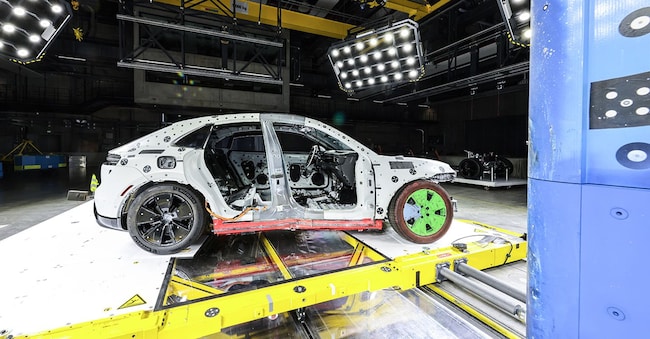
In the long workshop session, German engineers explained how the batteries fitted in the models in the range are developed, born, produced and even damaged. It is precisely artificial intelligence that is becoming increasingly important in vehicle development. AI supports developers in particular in detecting implausible behaviour within the battery. Through intelligent and adapted system design, the ageing factors identified by the AI can be reduced in a targeted manner. Precisely the life expectancy of the traction battery is a key factor in determining the cost-effectiveness and reliability of an electric vehicle. Tests simulate a service life of at least 15 years and over 300,000 km.
The initial capacity loss is already taken into account in the production process. The so-called 'State of Health' (SOH) decreases. In the first two to twelve months, the so-called 'initial drop' occurs. In this case, a lithium-ion cell loses about 2 to 5 per cent of its capacity. A newly manufactured battery therefore usually has a higher energy content than the declared gross capacity. Extreme conditions, such as exposure to temperatures from 60 to 100° Celsius, are also tested.
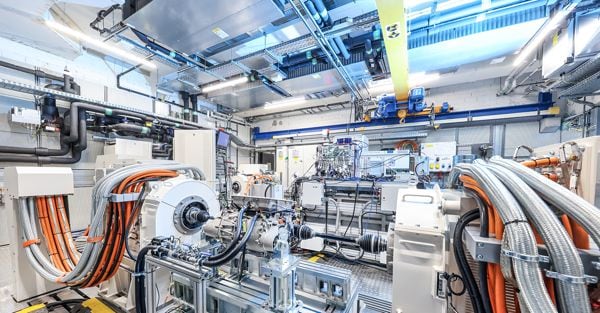
Before arriving at the road tests, the high-voltage battery and all associated components are tested on the high-voltage battery system test bench without failure. On the test benches, which we were able to see up close, it is possible to assemble the entire powertrain of a two- or four-wheel drive electric vehicle. Power ratings of up to 250 kW per wheel can be measured or applied. For charging tests, up to 350 kW of charging power is available.

