
Haute couture embraces experimentation
At Dior, Jonathan Anderson deconstructs and reconstructs. Schiaparelli: a blend of theatricality and rigour

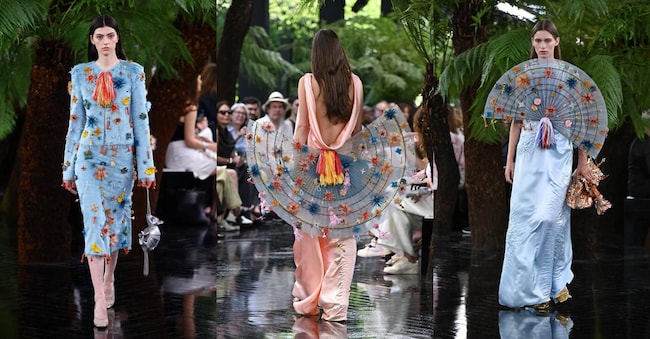
The Paris Haute Couture weeks got off to a start characterised by a certain flamboyant experimentalism: incongruous materials, not necessarily precious; bulbous, abstruse, flowing, unfinished shapes that were deliberately unflattering; a clear aspiration to transform every garment into an object that, if not artistic, is certainly one for the collector’s cabinet.
One possible explanation for this shift from haute couture – as a symbol of social status and overt affiliation with the ruling classes – to couture as a display of an extremely niche cultural and aesthetic status – it is still a matter of social markers, but in this second case even looking unkempt is a sign of power – may perhaps be found in the general shift in what is on offer.
With ready-to-wear at astronomical prices and garments often available in semi-couture versions, true couture – the kind crafted in ateliers – can finally, and quite rightly, become the arena for an extreme game in which the ultra-wealthy allow themselves to be tempted by impossible, abstruse visions, and savour them as a reward for their general pursuit of absolute individualism.
From Dior, Jonathan Anderson is once again collaborating with an artist: following Magdalene Odundo’s still, sculptural vases, it is now the turn of Lynda Benglis’s knots – gestural and precarious – made all the more ephemeral by the hand-pleated folds and thus destined, like everything else, to fade away – the melancholy of existence.
It is a step forward in reconciling the garment as an abstract entity with the body as a living, moving entity, but Anderson’s journey within the illustrious fashion house continues to be marked by a cold chaos that does not seem to be resolving itself in any particular direction, and which, above all, diminishes the feminine silhouette rather than celebrating it – an aspect that is central to Dior.

