Trip to Italia

Family high jewellery: the dynasties of made in Italy

The unique coral pieces of Nocito in Sciacca, the memento mori of Codognato in Venice and the semi-precious stones of Fratelli Piccini in Florence. Three dynasties, three cities and their three styles of creation.

by Silvia Paoli
4' min read

Translated by AI
Versione italiana

4' min read

Translated by AI
Versione italiana

Is it possible that an artistic gesture, a sensitivity to stone, a vision travels down the generations like an inheritance, almost inscribed in DNA? And that a place - with its genius and energy - imprints a subtle trace in those who grow up there, shaping their destiny? Three families. Three symbolic places in Italia. Epigenetics of high jewellery, in three exemplary stories.
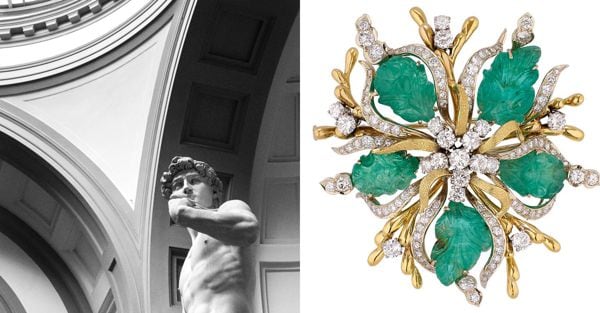
Spilla Carnivore in oro giallo con diamanti e smeraldi incisi, progettata negli anni Sessanta da Armando Piccini, FRATELLI PICCINI; il David a Firenze

The Gold of Florence

Loading...

Elisa Tozzi Piccini is the managing director of Fratelli Piccini, a jeweller's shop on Ponte Vecchio for 103 years, which has just opened a space in Via Roma in Florence. She has experienced the company founded by her great-grandfather since she was a child: 'With my grandmother I used to go to the centre, go up to the workshop where my uncle and grandfather were. It was my toyland: I would see the material take shape, I would draw and my uncle would teach me dry engraving'.

After studying at the Gemological Institute of America in Los Angeles, Elisa returned to bring her contribution as the fourth generation to the family business. The stories of the Piccini's ability to read stones are almost legendary. "Mum is the worst draftsman in history," she jokes, "but she has an extraordinary knowledge of stones, gained only through practice. She understands provenance, saturation, quality: few people in Europe have an eye like hers'. Elisa followed her to the Basel fair. "We would look at and compare stones for hours. Coloured ones, such as rubies, are more intense red in the north, but then, when they arrive in Florence, they lighten. And it changes the value by tens of thousands of euros per carat'. She remembers her mother's bright eyes if a stone, in Florence, turned out exactly as they had imagined it: 'They would say: "You got a bargain"'. Today, Elisa conveys this expertise through direct dialogue with customers in the new space on Via Roma: 'Bringing them into the stories of the creations is what I really like to do'. She succeeds very well.
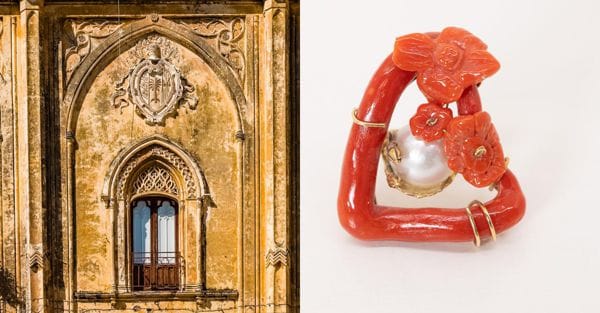
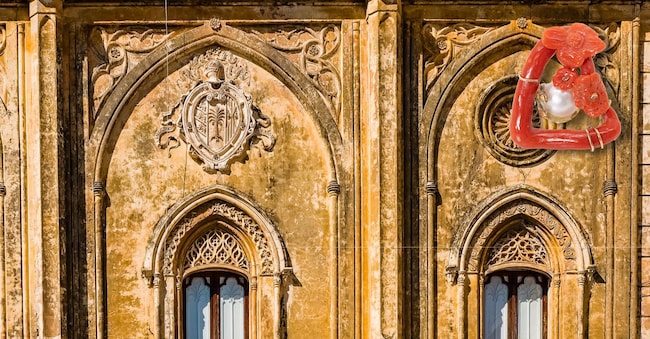
Anello in oro con creola scolpita in corallo e una perla al centro, NOCITO (2.200 €); un palazzo normanno a Sciacca.

The coral of Sciacca

"We lived near the beach and, after the sea storms, I would go down with my mother to see what the sea had returned. On the shoreline we would find small fragments of Sciacca coral, polished by time: they were the gifts of the sea. That simple ritual was my first sentimental education in coral'. This is how Laura Nocito recounts the beginning of her relationship with the material that has defined her family for four generations. She is the heiress of Nocito, an all-female goldsmith company founded in 1905 by her great-grandmother Concetta, specialising in coral jewellery made using traditional Sicilian techniques. With Laura, a master goldsmith with a contemporary sensibility, the company enters a phase of renewal that finds expression in unique pieces that do not subject coral, but let it express itself by supporting it naturally. The same with which the gestures were passed from grandmothers, to mothers, to her. "The most precious gesture I have inherited is the patience of waiting. Coral is not imposed, it is observed, studied, accompanied. Each branch has a unique shape, it is itself that suggests what it wants to become. We are simply the hands that follow the natural indication'. The women of the family have been strong figures, sensitive entrepreneurs, who 'have passed on to me grace, discipline, respect for tradition, which does not mean repeating what has been done. Tradition is a living language, a way of looking at the world. It is made up of ancient techniques, of gestures handed down, of a vision that always puts respect at the centre: for the material, for time, for history. Tradition is my base, my breath. My task is to bring it into the present, reinterpret it with contemporary sensitivity, and ensure that it can also speak to future generations'.

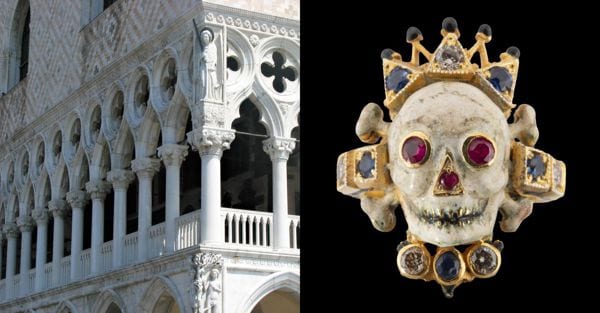
Palazzo del Doge in piazza San Marco a Venezia; anello teschio con ghiera in oro e smalto, diamanti, rubini e zaffiri, CODOGNATO

The Wunderkammer of Venice

Venice is Codognato. And Codognato is only in Venice, the jeweller's Wunderkammer that knows no other place than where it was born, even though it is loved the world over. In 1866, Simeone Codognato founded it as a workshop near St. Mark's Square. His son Attilio, inspired by the success of the excavations in Etruria and the interest that the jewellery found there aroused at the time, proposed archaeological goldsmith art, drawing on Byzantine, Roman and Renaissance culture. Casa Codognato breathes in all the events that make Venice the city of art and cinema, incorporating its beauty and mystery, irreverence and sense of transience. In 1958, he took over the jeweller Attilio, who was a singular, visionary man, immersed in contemporary art, a frequent visitor of artists and celebrities, highly cultured. The crosses, the memento mori (skulls), jellyfish and snakes are part of a surrealist mystique, where there is exhilaration in horror and a sense of protection through monsters.

When he passed away in 2023, the management passed to his children Mario and Cristina, who discovered themselves the natural heirs of a language they had never studied, but intimately assimilated. Mario, a contemporary art curator, and Cristina, a psychotherapist in London, find in their father's legacy a common starting point. 'I don't know if it's in the DNA,' says Mario, 'but we had the same ideas. We didn't want to abandon what our ancestors had created. Craftsmen and customers encouraged us to keep going. I went to the shop very little,' says Cristina, 'but I followed Dad on his travels: India, New York, museums, artisan workshops. It was a continuous teaching'. In the symbolism of Codognato jewellery, Cristina prefers Medusa, "a monster that can become an amulet", while Mario prefers cameos: "We are complementary. We remain faithful to the icons of the house, but each creation is unique. And an impressive archive of designs and objects allows us new variations on the theme'. It is crucial to reach young audiences through global channels. Leaving Venice? 'No, it is our identity, the starting point and the destination'.

Copyright reserved ©
Loading...
Loading...

Newsletter

Notizie e approfondimenti sugli avvenimenti politici, economici e finanziari.

Iscriviti