
High-speed rail is celebrating its 45th anniversary. Now the challenge is on Europe’s railways
On 22 September 1981, French President Mitterrand opened Europe’s first high-speed rail line. Today, the top teams compete on the European stage

Key points
It was 1981, and across Europe the date was 22 September. French President François Mitterrand stepped solemnly off the first TGV train, greeted by the sounds of a brass band. The French were inaugurating the first section of the LGV Sud-Est, the new high-speed line designed to link Paris and Lyon in just two hours and forty minutes, cutting journey times by one hour and twenty minutes. It was the train of the future materialising on French tracks: 260 km per hour, at the time a record for a commercial train in service. With the fanfare playing and the Socialist President striding across the platform, the era of high-speed rail in Europe began.
The French model conquers Europe
France, however, was not the first. Japan had launched the Shinkansen between Tokyo and Osaka many years earlier, in 1964, and Italia, too, held its own small claim to fame with the opening in 1977 of the first section of the Rome–Florence ‘Direttissima’ line. But there was no contest. The Paris–Lyon line turned high-speed rail into an industrial and commercial model capable of establishing itself on Europe’s railways. Its approach set a precedent: the new infrastructure was complemented by trains capable of running on conventional lines, bringing the benefits of speed to the outskirts of the network, where the high-speed line could not reach. The French model thus spread to other countries. In 1991, the German ICE trains began operating; the following year, Spain inaugurated the Madrid–Seville AVE. In 1994, the opening of the Channel Tunnel enabled Eurostar to connect London with Paris and Brussels. And what about Italia? The benefits of the ‘Direttissima’ were hampered by construction difficulties: it was not until 2009 that the main sections of the Turin–Salerno high-speed line were finally completed.
Italia kicks off the competition season
But it is Italy that holds yet another record. Thirty years later, in 2012, the arrival of Italo broke Trenitalia’s monopoly and, for the first time, opened up a national high-speed rail market – which had previously been a complete monopoly – to competition. “The Italian market was the first high-speed rail market in Europe and the world to be liberalised in 2012,” explains Andrea Giuricin, a transport economist at the University of Milan-Bicocca and a member of the Einaudi Foundation. In the first eight years of competition, demand in Italy more than doubled. Taking the 2011 level as 100, the index reached 218 in 2019, whilst average revenue per passenger-kilometre fell from 100 to 63. Growth has continued despite an economy that has remained largely stagnant: over the same period, the GDP index remained at 100. European legislation came into force later. The fourth railway package opened up national markets for commercial services from December 2020, and in 2021 competition also emerged in Spain and France. ‘European legislation came later, and Spain and France began to see competition for Renfe and SNCF in 2021,’ notes Giuricin. In Spain, Renfe had to contend with Ouigo, a subsidiary of the French SNCF, and with Iryo, in which Trenitalia holds a stake. In France, on the other hand, it was Trenitalia that challenged SNCF on the Paris–Lyon route. In 2024, the new Italian operator accounted for 11 per cent of rail services on that route, whilst Renfe covered 47 per cent of trains between France and Spain. European legislation came into force later. “European legislation came later, and Spain and France began to see competition for Renfe and SNCF in 2021,” notes Giuricin. The path is set, and there is no turning back. “Inexorably, the market is becoming European rather than national,” summarises Giuricin. “Italo and Trenitalia were the first to experience competition and are the ones that have managed to expand abroad.”
Open market: everyone against everyone
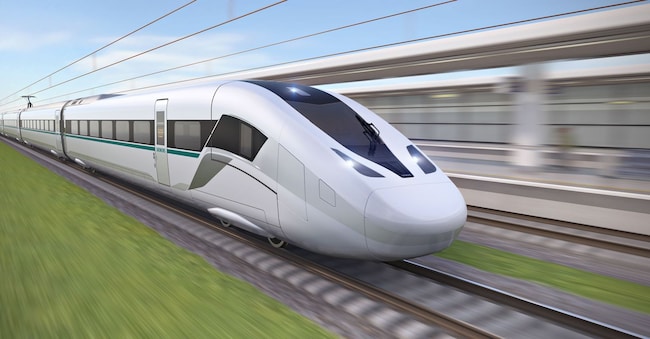
This is just the beginning, because today the sector is striding towards a period of intense activity. The market is ripe for even greater liberalisation, and the watchword is to challenge the national champions on their own turf. In 2028, Italo plans to launch operations in Germany, where Deutsche Bahn controls around 95 per cent of long-distance rail transport. The plan involves a total investment of 3.6 billion euros and the launch of services on the Munich–Cologne–Dortmund and Munich–Berlin–Hamburg routes. To prepare for its entry, the Italian operator has ordered 26 high-speed trains from Siemens, with an option for a further 14. “In 2028, Germany too will face competition with the arrival of Italo,” explains Giuricin. The French market is also preparing for a new entrant. Velvet, a private operator originally known as Proxima, aims to launch services on the Paris–Bordeaux route in 2028 and subsequently extend its network to Rennes, Nantes and Angers. The company has ordered 12 Avelia Horizon trains from Alstom. It will be SNCF’s first private French competitor on domestic high-speed lines. Future launches could also extend to Italia and the Channel crossing. “SNCF will enter Italia, after Spain, in 2028,” says Giuricin, who predicts the arrival of new competitors on the Paris–London route around 2030.
Market figures
The playing field is vast. In 2022, the European Union had 12,015 kilometres of high-speed lines, accounting for 6 per cent of the total rail network. The document is a European Commission report dated July 2025. Around a third of the 402.2 billion passenger-kilometres recorded in the EU were on high-speed trains. A market still dominated by Italia, France and Spain, which together accounted for 63 per cent of the network and around two-thirds of European high-speed traffic. This is the geographical landscape on which the old national champions are vying for large market shares. Forty-five years on, on the Paris–Lyon line where it all began, the TGV runs alongside the Frecciarossa. The Europe of rail networks remains national, but the trains are no longer: this is the era of competition and a free-for-all across national borders. And what of the network? The TEN-T, a web of corridors mapped out by the EU across the continent, is beginning to take shape. But the Turin–Lyon line, one of the most ambitious projects, shows us just how long and arduous the road ahead still is.


